
Author: James N. Gilmore
Note: This post was written for the anniversary of the January 6 attack on the Capitol, which the Collaborative researched in the Spring 2021 semester. This post is meant to reflect on our research and what it might offer. These thoughts may appear scattered and incomplete, but so it goes.
Last year, January 6 was the first day of classes for our spring semester. I logged onto a Zoom meeting with the students in my Collaborative for Communication and Culture. We introduced the course and we began brainstorming things to research for the spring semester. We talked generally about the election fraud conspiracies and the “Stop the Steal” movement, but we didn’t leave that first meeting deciding to focus our energies there. We put a pin in it and said we’d pick up the conversation the next week. This was at about 10 in the morning, before things had really spiraled out of control in DC.
That night, one of the students emailed me: “I think I know what we need to research now.”
Over the spring semester, a team of undergraduate researchers and I closely analyzed approximately 200 videos totaling over 12 hours that were distributed over seven different digital platforms—Facebook, Twitter, Snapchat, DLive, Twitch, Parler, and Periscope. We examined the content of these videos—what sorts of actions are represented within them—but also and just as importantly we considered the form of the videos. In other words, we thought about the participants as videographers, purposefully documenting and sharing the events of the day to their followers and networks online.
Much like every form of dissent over the last decade and a half, the Capitol Riots were very clearly drawing on networked public sphere models that scholars like Zeynep Tufekci have been charting for some time. Stop the Steal was coordinated and organized through online sharing of conspiracies and mobilization. This did not just happen through top political elites like the former president but through ongoing concentrated efforts of far-right organizations to first spread a lie (a lie which may have been earnestly believed among many of its proponents, but a lie all the same) and then mobilize people around that lie. Participants in DC were dialoging with online supporters throughout the day. In this ‘networked public sphere,’ filmed testimonials of all sorts were massively important for helping online observers feel like they were part of the action, as well as narrating what was happening and where throughout the day.
If you’ve paid any attention to the reporting on the Riots over the last year, you know this. Smartphone metadata has been instrumental in mapping where participants were and how the events unfolded. The footage shot on these phones and shared online has been part of nearly every news report and documentary produced, including the arguments made during the impeachment trial against the former president.
So what was this documentation—this mediation—of the Capitol Riots trying to accomplish? This is the question my undergraduate researchers and I wanted to answer.
The simple answer—and an answer that’s not much of a surprise if you study documentary filmmaking or protest networks generally—is that they wanted to craft a narrative.
When Trump addressed the crowd on January 6, he said the following: “Fight like hell, and if you don’t fight like hell, you’re not going to have a country anymore.” The House impeachment trial seemed more focused on Trump’s use of ‘fight’ as a directive and other rhetorical choices that rose to the level of incitement. What seems as important—maybe even more so—to us is that second line, “you’re not going to have a country anymore.” It parrots, in its own way, a lot of the videos on Parler encouraging people to join Stop the Steal. One video, a sort of ‘hype trailer’ to get people excited for the event, ended with the tagline “Fight for Trump. Save America. Save the World.”
In other words, Trump’s—and far right social media’s—directives were pitched in the language of nationalism. At stake here was the country itself, which needed to be unified around and through Trump and his supporters. The role of the videos we analyzed, then, were also to help produce this narrative, either through documenting the work of other participants, or through the narration of the videographers themselves who were commenting on what they were seeing.
While somewhat reductive, we saw two major narratives emerge in the videos we analyzed: The Riot as a form of collective action, and The Riot as a form of political revolution. In the former, videographers draw on images of the crowd or consciously highlight their place within the crowd to frame it as a movement of “the people,” broadly defined. In the latter, participants draw on speech, song, and other modes of communication that directly underscores the nationalist sentiments motivating many participants, while placing Trump as the leader of the nation and emphasizing the role of “the people” as agents of revolution. To put it another way, the Riot acts as a violent embodiment of the populist-nationalist sentiments that have pulsed through Trumpism since the early days of his candidacy.
To focus in here on some of the ways this nationalism made the Riot a sort of political revolution or insurrection, consider the prominence of chants like “1776,” “We the People,” and “Whose house? Our house” — all of which center a people-led revolution explicitly invoking the American Revolution, while others like “We are Trump” and “Fight for Trump” focus instead on Trump as the sort of figurehead of this movement. The lines between Trump and the nation blur across the videos, and the chants themselves narrativize the purpose of the Riot.
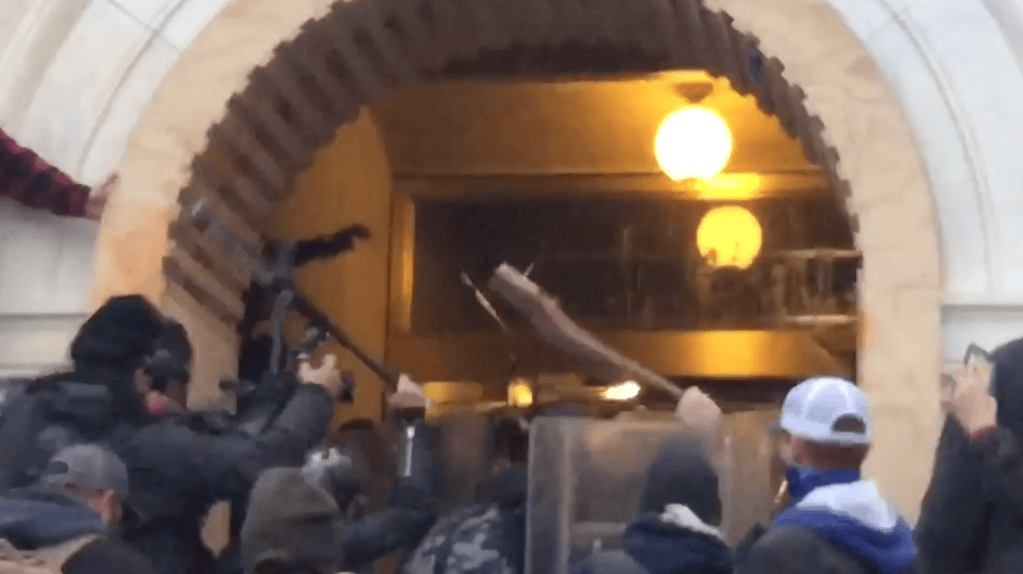
I still think about one video more than any other. It was shared to Facebook.It is shot from about thirty feet from the Capitol doors. Police officers use riot shields to form a barrier and push back the crowd. A woman on a bullhorn at the front of the crowd calls out: “Everyone, we need gas masks. We need weapons. We need strong, angry patriots to help our boys.” One man passes another an aluminum bat; that man brings the bat high above his head and crashes it down onto an officer’s riot shield. Another throws a fire extinguisher at the police officers. The woman continues: “It’s 1776, and we the people will never give up.” She calls for “we the people” to “stand up for ourselves,” during which time shoes, debris, and poles are hurled towards the officers. Then, one individual holds up a wooden board with a long nail taped to it. They bring the nail down once, twice, and again as more bats swing and the crowd surges.
Shot from behind, the image is shaky and somewhat hard to discern at points what’s happening. The person shooting the video is in the thick of the crowd. At the same time, it’s harrowing. The violence of the participants, the intensity with which they wield bats, poles, and other weapons, complements the dozens of people who hold up phones or mounted GoPro cameras to record what’s going on. It’s a disturbing, intense video that brings together all the threads we saw in our analysis.
The camera does its own kind of violence, working to build the narrative and the support for these actions.
Our documentation and analysis of these videos was meant, then, as a way to sap whatever power they might have, to point to them and show the work they are trying to do. The Capitol Riot was not a successful insurrection, at the end of the day, but these videos still have their own power and force. They are part of broader operations aimed at gaining political, ideological, cultural, and state power, and legitimizing that through violence. These mediations are part of that violence.
The Capitol Riots were aimed at violently overthrowing the democratic process. To suggest otherwise in any way is to refuse to examine the trove of evidence—a trove the participants themselves generated over the day. The participants themselves actively worked to frame their actions as a political revolution, an attempt to stage a war on the Capitol itself and its occupants, to go so far as to “Hang Mike Pence,” as many participants chanted throughout the day. Their videos provide traces of what happened, to be sure, but these videos are ALSO part of how they built their narrative. We must continue to examine them as part of complex ideological networks.


