
By: Sara Ciplickas
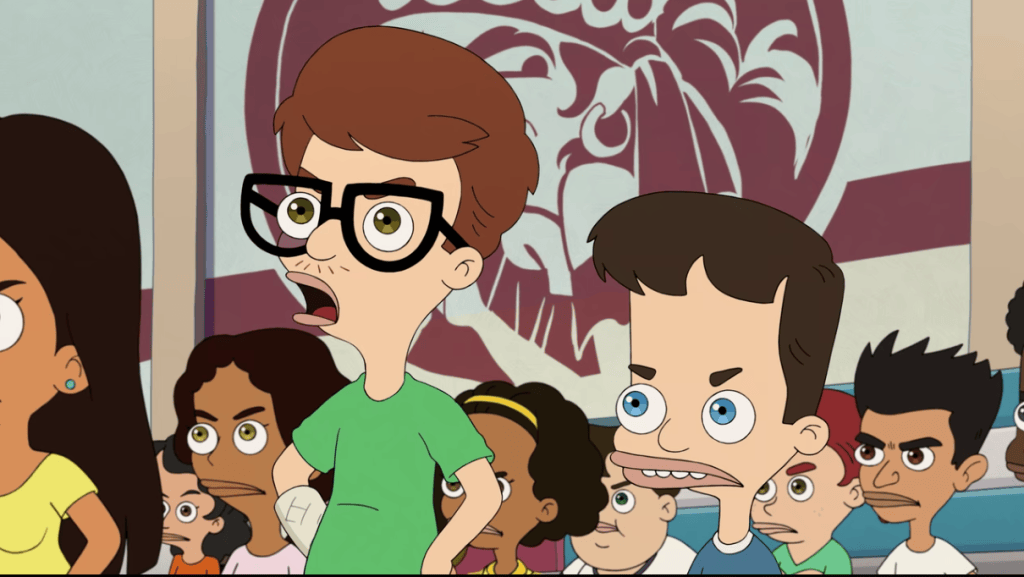
“Messy,” “repulsive,” “foul-mouthed” and “cringe” are adjectives used on Rotten Tomatoes to describe the Netflix animated success known as Big Mouth. Now with five seasons under its belt, Big Mouth has taken its audience on a wild ride following the lives of middle schoolers trying to survive adolescence. Created by Nick Kroll, Andrew Goldberg, Mark Levin, and Jennifer Flackett, the series is described as a mature cartoon as it graphically displays everything and anything related to sex and puberty. However, as individual states pass and continue strict comprehensive health laws, once comedically uncomfortable shows like Big Mouth are now offering empathetic, safe spaces that younger generations need.
After starting in 2017, the show has explored a wide range of topics including masturbation, porn, sexuality, and mental health. In season one, the audience is introduced to the Big Mouth universe that includes main characters, Nick and Andrew (voiced by Nick Kroll and John Mulaney), their friends Jessi, Jay, and Missy, and Maury the Hormone Monster (also voiced by Kroll). Along the way, more friends, family, and the monsters who make their lives complicated are introduced. The pilot episode (S1, E1: Ejaculation) quickly lets the audience know that this show is not going to hold back. The season introduces us to the shit-show that is puberty and touches on both male and female issues including poorly timed erections and periods (S1, E2: Everybody Bleeds). The show conjures up pop culture icons including The Ghost of Duke Ellington (voiced by Jordan Peele) and The Ghost of Freddie Mercury (also by Peele and Brendan McReary) when Andrew questions his sexuality (S1, E3: Am I Gay?). The show even introduces more “adult” (as if it isn’t already mature enough) situations when the young character’s first encounter sexual assault (S1, E8: Head Pusher).
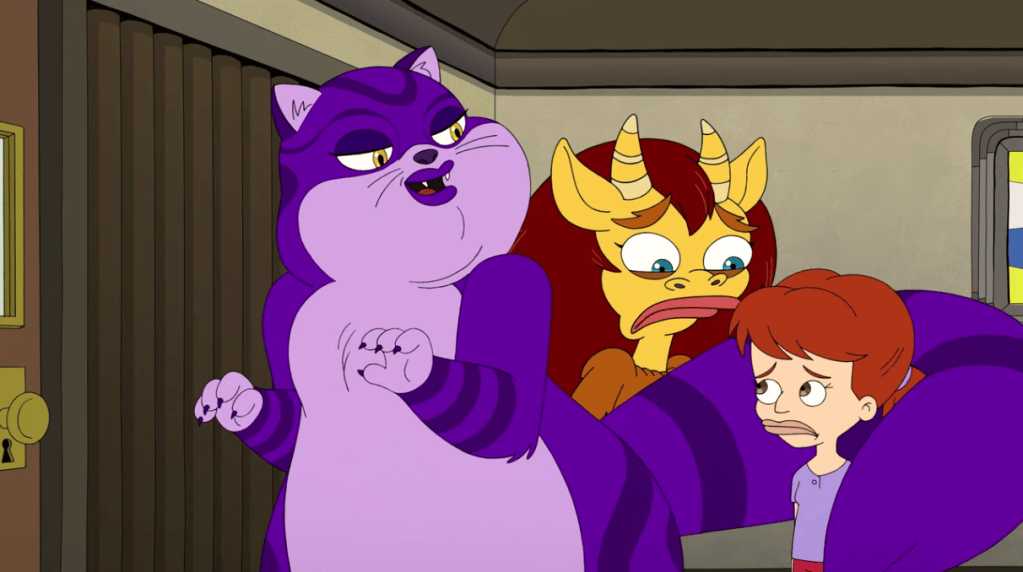
After the initial shock of season one, the show continues for four more seasons poking fun at both the mental and physical changes people go through as teens. Season two introduces The Shame Wizard (voiced by David Thewlis) and The Depression Kitty (voiced by Jean Smart) forcing the pre-teens to self-reflect, or self-destruct. Writers engaged with serious national issues allowing for commentary, open discussion, and laughter at the uncomfortableness of the complex situations. In season three, after the guidance counselor Mr. Terry Lizer (voiced by Rob Huebel) imposes sexist dress codes and forms an inappropriate relationship with a student, the show presents some hilarious musical numbers about “sex-walks” and the movie, Disclosure (S3, E2 Dress Code and S3, E10 The Musical). With recent movements in the Black community, Big Mouth corrected itself mid-show by changing voice actors for the character of Missy. Instead of being voiced by white actress, Jenny Slate, the show brought on black actress and writer, Ayo Edebiri. They continued to evolve in season four and five, putting heavier emphasis on both sexuality and gender including the inclusion of their first trans character, Natalie (voiced by Josie Totah), at the beginning of season four (S4, E1 The New Me).
While the majority of views are positive, and Big Mouth has corrected some of its content, the show has had its fair share of criticism about its depictions of sexuality amongst pre-teens. Some critics have claimed that the depictions of sexual preteens are borderline pedophilic or that is glorifies preteen masturbation. The ambitious writers, at times, have struggled to grapple with the ramifications of what they are trying to accomplish. The show deals with heavy complicated topics, intertwines realism and fantasy, makes large amounts of pop culture references, is supposed to be funny and entertaining, and refuses to limit itself on how many jokes it makes about urine, feces, and other bodily fluids.
The criticisms are, however, overblown and largely fail to consider the important work the show’s representation is doing. First, talking about sex/masturbation when it comes to preteens does not make the show or viewers pedophilic. In all sexual situations, the show shifts into the fantasy of animation and gives the viewers metaphors for what’s really going on. In other words, the show does not show children or teenagers explicitly engaging in sexual situations. But the show does allow for conversation about those situations, which is something our American classrooms do not. Second, while I agree that the show is very complex and balances a lot of elements, I personally think it works. However, this isn’t a piece destined to sell you to watch Big Mouth. It’s truly not for everyone. Despite the fact that you might see genitalia, bodily fluids, or something else that is just plain gross, the show manages to address complex situations in less than one hour an episode. It is raunchy and shameless, but it is also ridiculously inventive and demonstrates how popular culture can connect us to sex-ed.
Only about half of the young people in the US are receiving sex education. Many states do not require comprehensive health programs or do not require it to be medically accurate. Furthermore, the US, and conservative states in particular, love to preach “abstinence is key” rather than addressing the ins and outs of safe sex. With the recent influx of anti-LGBTQ laws passed, such as the “Don’t Say Gay Bill” in Florida, students who are part of the LGBTQ+ community are disproportionately at a disadvantage when it comes to learning about puberty, sexuality, and gender identity. As some will claim, the US is failing our youth. Not only do we lack educational resources for American youth, we are increasingly losing safe spaces for students to explore, question, and try to understand who they are. There are obvious gaps in our sex-education system, and one can only wonder who and what will fill those gaps.
Just like the US’s current sex education system, Big Mouth isn’t entirely scientifically accurate, but it is based on real-life experiences of the writers. While the hormone monsters, ghosts, and ghouls don’t appear during depressive episodes or unexpected, erotic moments, the situations and the awkward reality of growing up is true to life. If anything, the addition of the animated monsters allows for a better understanding of all the different aspects and inner monologues people must face when they go through puberty. The audience may not have had the same experiences the writers had, but many can relate to storylines about unexpected periods or boners, new relationships, divorcing parents, coming-out, and standardized test taking. It may not have been funny at the moment, but the show reminds us that everyone has awkward moments, and they can be funny (way after the fact). The conversations, stories, and complex dialogues do not exist in many American classrooms. Some students don’t even learn about the changes their own body goes through, let alone the changes other students may experience.
Netflix is continuously growing as more and more people turn to streaming services for television and film. Kids ages 2 to 18 watch almost 2 hours of streaming TV a day, and since 61% of Netflix originals, including Big Mouth, contain mature content, there is no doubt that younger audiences have access and watch “adult shows.” Kroll’s show follows a no fuck’s given policy full of compassion, empathy, and acknowledgement of one’s own flaws. Yes. It is adult content, but over the past five seasons the show has constantly addressed relatable, relevant situations experienced by the American pre-teen and teenager. Is it the filler our American sex-education program needs?
No. The show, as entertaining as some may find it, is not the solution to the educational problems in the United States. However, it is becoming clear that shows like Big Mouth who comedically address real life, sex related issues might become a safer space for younger generations to talk about sexuality, gender, and puberty.


