
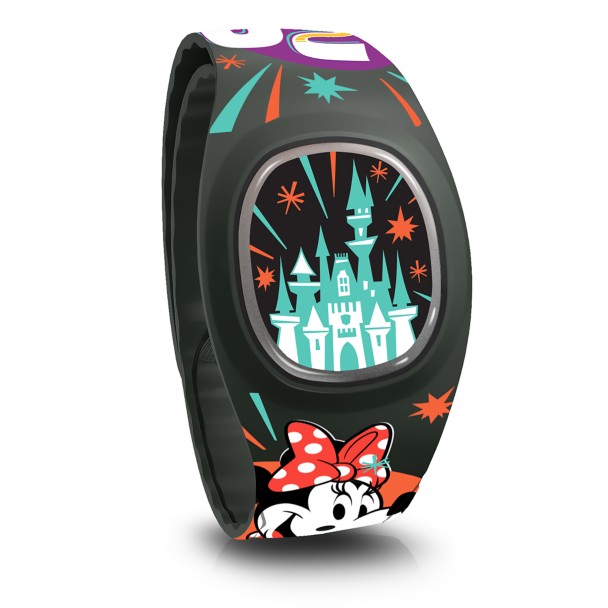
Last week, my family and I went to Walt Disney World in Orlando, FL. We stayed for three nights at a Disney resort and went to two parks: Magic Kingdom and Hollywood Studios. My kids had a blast and it was truly unlike anything they had ever experienced. The crowds, the park design, the characters, and the rides are pretty mind-blowing for a six-year old.
But to put aside the joy of being with my family on vacation in The Most Magical Place On Earth(TM), this was also the first time I was able to actually experience using Disney’s Magic Band and the My Magic Experience application. If you’ve read Bringers of Order (and really, you should read it. It’s very good!) you’ve spent time in my last chapter that offers a critical look at the development of the Magic Band system from about 2013-2020. I examined Disney’s stated reasons behind developing the Magic Band system, what it is and how it works, and how it comports with an articulation between wearable devices, infrastructure, and ideologies of datafication. It’s basically the only chapter of the book that wasn’t thoroughly rewritten from my dissertation. As much as I enjoyed researching and writing that chapter, I did not have the opportunity to go to Disney World myself and be, to put it as an ethnographer might, a participant in the field.
This post provides some initial thoughts after this trip to WDW, and how I found myself dialoguing with Bringers of Order throughout the visit. I may expand or add to these thoughts in the future, or shape them up into something more refined. At any rate, consider them a set of unpolished reflections.
If you’re familiar with my published research (again, please buy Bringers of Order) you’ve likely seen me talk about the dividual before. This idea comes from a mere suggestion Gilles Deleuze writes in his very short “Postscript on the societies of control” from 1992, where he is speculating on how adminsitrative technologies might enable forms of control in the decades to come (spoiler: he basically nails it). In talking about the proliferation of data collection and analysis of human behavior, Deleuze proposes an emerging shift where the “individual” becomes the “dividual.” Whereas at one point, an “individual” was the smallest way we could conceptualize people, we have increasingly seen the continued and ongoing division of individuals into various data flows. The things we buy, the places we travel, the websites we visit, the keystrokes we make, the time spent on different apps… all of this is tracked, collected, analyzed, and even sold for profit. To think of ourselves as “dividuals” is to see ourselves as comprised of many different (potentially infinite) possible “divisions” of data. If you use an Apple Watch, you can think about how its health systems (which I wrote about a month ago on this blog) provide many different layouts of data streams that divide your bodily function in different ways to continuously track and monitor you.
The experience of using Magic Band—especially after spending so long researching it as part of my book—made me constantly think about being a dividual, and what that means for Walt Disney World (WDW). Even before going on our trip, I had to individually pair my family’s bands and assign them to specific profiles for each family member. My children were, as you might imagine, amazed at how they could use their band to unlock our hotel room door. I noted it as another potential moment of dividuation: did Disney store a record of our comings and goings? Did they note which Band unlocked the door?
In their Privacy documents for Walt Disney World, they draw a vague line around this. In discussing whether Disney can track location using the devices, they note they “are not GPS-based and do not enable collection of continuous location signals. However, we may be able to determine your location through the RF Devices while you are at our Parks and Experiences. For ecample, MagicBand, MagicBand+, and DisneyBand+ products can be detected by long-range sensors placed in select locations in our Parks and Experiences.”
The devices themselves don’t store any information, but they “contain a randomly assigned code that securely links to an encrypted database. This allows us to associate your RF Device with the benefits you have purchased and to collect information regarding your interactions with the various RF Device sensors located at the Parks and Experiences.”
But what is the range of those interactions? Where are they stored? How are they analyzed? How often are they deleted if they are stored? You can read plenty of very generic public reports about how the system works, and this was indeed a problem I ran into with my book: Disney is relatively tight-lipped about the actual technical processes undergirding their Parks (which is to be expected; corporate propriety and all that). The infrastructure is both visible and invisible simultaneously, making it difficult to actually suss out how long interactions are stored and how they are being analyzed together. The privacy policies and FAQs for the MagicBand and its related products are also fairly boilerplate. They mention RF scanners may be able to trace your location in the park, but they don’t mention whether those location points are stored beyond, say, a five-minute refresh period that monitors crowd flows.
As we used the MagicBand more and more, this dividuation started to feel dizzying. After getting a picture with The Evil Queen from Snow White, we tapped a Magic Band to a photographer’s device, which then moments later synced previews of the photos to our account. The same thing happened after riding Tiana’s Bayou Adventure, The Seven Dwarfs Mine Train, and Slinky Dog Dash, among others. Our photos would be available in the My Disney Experience app because the radio frequency beacon stationed at the ride camera matched to the identifying signal from our Band; the Band, in turn, was paired to my phone through Bluetooth and was synced with my Disney Experience app, which provided photo previews for us to consider purchasing. Yes, this is ‘efficiency’ and ‘convenience’ and whatever other buzzy tech narrative word you want to put in there, but it was also a reconstituted partial itinerary of our day. The photos were all time-stamped, and they all demonstrated the moment our Bands interacted with these precise beacons and cameras. We didn’t buy a Photo Pass, but it’s easy to see how families that try to get many photos taken at the various photo opportunities throughout the day could have their timelines reconstituted in the app – Fantasyland in the morning, Frontierland in the afternoon, some photo opps near Cinderella’s Castle around dinnertime, etc. While families may enjoy how it becomes easier to get copies of your photos since they are sent and stored in the app, Disney’s data science team can also see how frequently people are getting photos, where they’re getting them, at what time, and how park visits can be remapped through them.
This is to say nothing of other things we could do through the Band and app that would provide traces of our activity: ordering food for mobile pickup through the app (which we didn’t do) or linking credit cards in order to make souvenir purchases through using MagicBand as a kind of “contactless” pay system (which we also didn’t do). As much as I wanted to go all-in on using MagicBand for as many interactions as I could, I started to feel my own dividuation very acutely over the course of the day. Because it wasn’t just me, it was also my family. Our Bands are connected, and I was inviting my children into the supposedly magical process of being broken down into data streams and reconstituted into a profile, an experience.
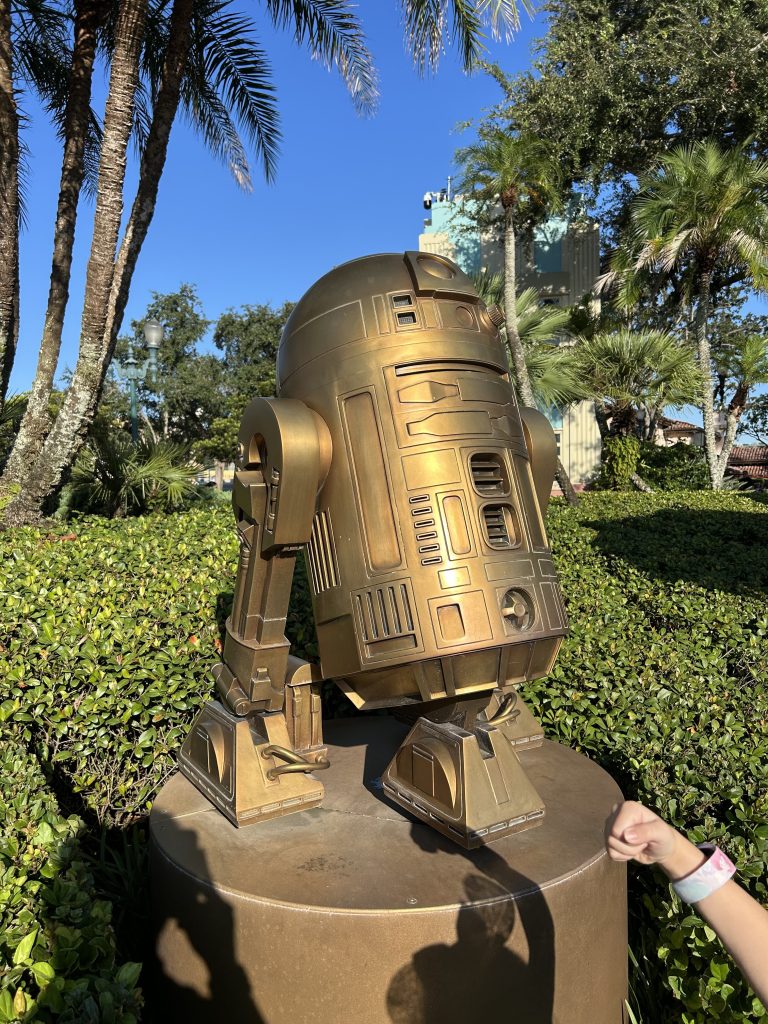
I also felt this with an interactive feature WDW calls the “Fab 50” statues: a series of 50 golden character statues littered around the parks, each of which has a “magical,” interactive experience you can summon with your MagicBand. It involves standing within distance of the near-field sensor, making a circulation motion with the wrist housing your Band (think using an invisible magic wand), and then waiting for some kind of music or message from the statue. R2D2 and BB8, for instance, made a series of beep boops, while Dumbo played some circus music. A couple things here: My kids and I routinely found these statues were not responsive, and often took several tries to get the statue to recognize the Band (a magic trick requiring a few attempts, as it were). If we’re thinking of them from the viewpoint of logistics, they serve the function of heralding the user to come and notify the infrastructure of their presence. In a mode of Althusserian interpellation, a tracking system presents itself as a game, and teaches the wearer how to interact with the system to get a little reward. On the other side, that infrastructural data may help the real-time data analysis in the park get more accurate checks on where specific MagicBands are throughout the day.
I say all of this speculatively, because I just don’t know. This was the same problem I ran into with writing about the MagicBand in my book. There is both a lot and very little public information about how the actual tracking components of these beacons work. We ‘know’ that Disney monitors population flow throughout the parks using sensors, and we ‘know’ the Bands are linked to specific accounts using identifying numbers and encryption. But, again, how long are the beacon notifications stored? Are they reviewed at all?
I’ve been thinking about my colleague Jordan Frith’s work this week, especially his work on barcodes. Part of Frith’s reconstruction of the history of barcodes is to show how the specific form of logistics they offered migrated into dystopian science fiction and other critiques that actively worried about turning humans into scannable, trackable objects. Part of what WDW has achieved is the near-total reversal of this dystopic fear: instead, wearing an identifying band is something to be celebrated, something which makes the logistics of human bodies a magical experience of centralized surveillance.
Part of the point I made in Bringers of Order is that Disney is one of many companies that uses “Magic” as an excuse to mask how its infrastructure works. It encourages us to not look at the seams of how the trick is engineered (or, in Disney’s terms, imagineered). But as I subjected myself to the dividuating environment of WDW, all I saw was misdirection: look over here, don’t think too much, and be amazed.
But does that even matter? I know well enough how this system works and I still enrolled my family into it. I ‘trust’ that WDW is operating our data securely, and hopefully they are. No, I don’t think WDW is secretly a dystopia, but they are still an environment that is using constant and proliferating data flows to learn about “optimization,” “efficiency,” and a specific understanding of how to map human behavior. As I felt myself becoming-dividual while still being enchanted by all the little Easter eggs stuffed into the design of Star Wars: Galaxy’s Edge, I felt very clearly how I had been hailed. I suppose that is the ambivalence of dividuation: these services provide pleasurable experiences at the same time as their technical infrastructures work as exercises in trying to understand human behavior.
There’s a lot more to say here, and I will likely continue chewing on how interpellation and infrastructures work together, or how wearables serve as mediating functions in apparatuses. These are, again, just provisional reflections on a few days’ experience, but I wanted to get something down as a way to start extending some of the work on Disney I’ve already done in Bringers of Order.


