
Fall is officially here, and with it is the start of Spooky Season. For me, that means reveling in horror movies as many nights as I can for the next month and a half. This year has already been great breakout horror movies, and arguably none has entered the zeitgeist more than Curry Baker’s Obsession.
Enough ink has been spilled on Obsession’s performances, its shoestring budget, its violence, and its commentaries on gender dynamics. Part of what makes Obsession work, and what makes it so unnerving, is how little of it really makes sense. I don’t mean that in terms of the narrative logic. The “One Wish Willow” system’s rules are decently established within the scope of the film. Everything in the movie “feels,” for lack of a better word, “off.” What I want to explore here are some examples from throughout the movie that demonstrate this off-kilter aesthetic and extrapolate it into some thoughts I’ve been having about why this particular seemed to touch such a nerve, and how it is implicitly commenting on the economic horror of the housing market.
Fair warning: I’ll write here as though you’re familiar with Obsession.
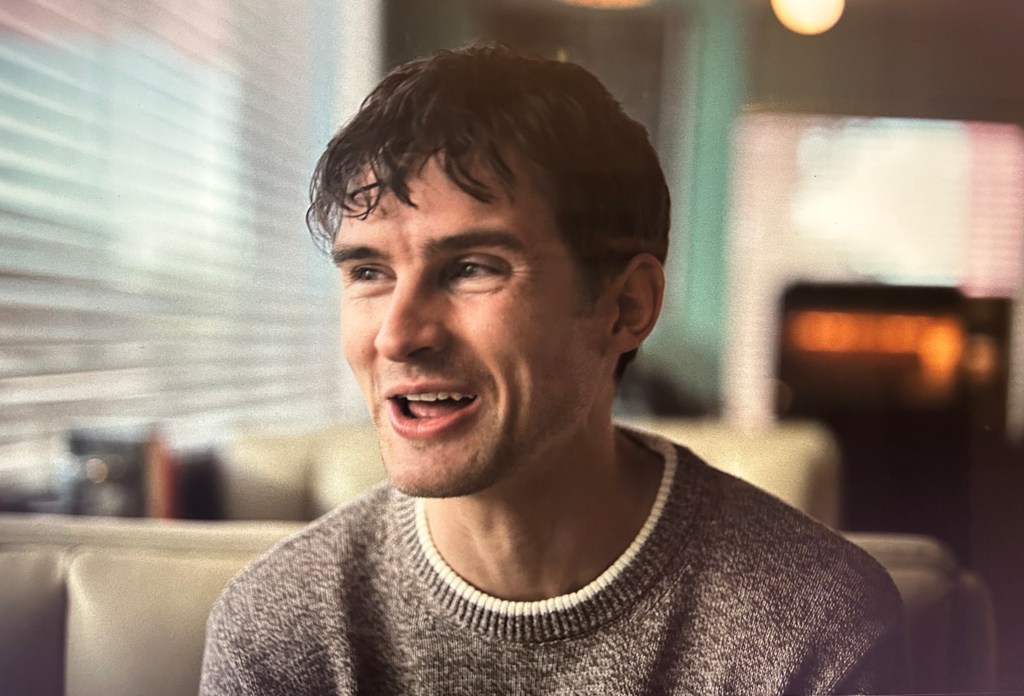
Consider the first composition of the movie, where Bear is framed in the center, but there is a window diagonally on the left of the frame, a window in the negative space behind him on the right of the frame, and a jukebox (or something?) framed within that window behind him. The composition is, I think, the aesthetic thesis of the entire film: that the action takes place in fairly standard compositions, but the space around that action is unsettling in ways that break into the foreground during the film’s most horrific moments.
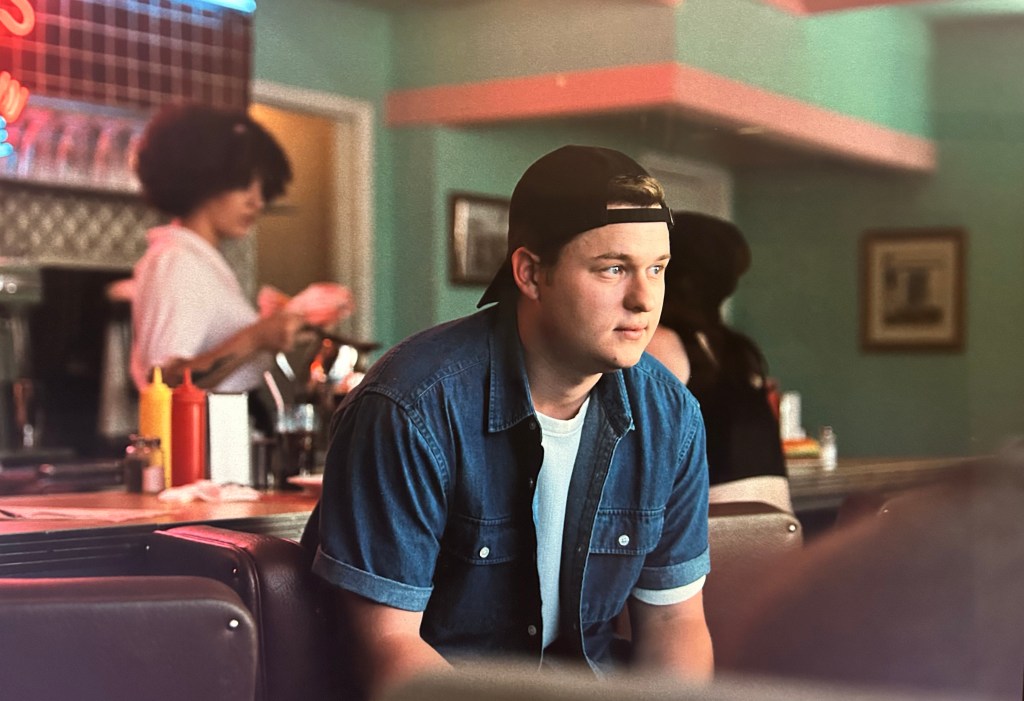
Part of that unsettling nature has to do with the displacement of time. The first scene takes place in a retro diner, which is only really established with the cut to Bear’s friend, Ian. While he, in the foreground, is dressed in contemporary style (open shirt, backward cap), the soft focus behind him shows a waitress in a somewhat retro top with a tile wall and neon sign that is certainly keyed into the “timeless” vibe of diners across California. It’s complete with a milkshake with a candy-cane stripe.
This conversation also introduces the theme of “time” in its dialogue. When Bear discusses when he should ask out Nikki, his friend insists asking her out at their weekly trivia night is a bad idea. “When should I ask?” Bear asks. His friend’s reply includes: “All you have is time,” which he clarifies to mean “Wait. Do it at the right time.”
The first somewhat clear image we get of the inside of Bear’s home comes after he arrives to discover his cat, dead from apparently eating a bunch of pills. Bear’s discovery and disposal of the cat is all in dark close-up. In this shot, Bear is on the right side of the frame, backlit by a desk lamp. Above his bed are four scatter-shot posters of different sizes, and the wallpaper in his bed has vertical stripes, which both contrast from the horizontal stripes in the opening diner scene and make the bedroom look like a prison. Later that night, Nikki calls Bear and tells him she is resigning from the music store where they both work. When he asks why, she says: “I don’t know. Yeah, we’re kinda running out of time, Bear.” As she says “time,” the film cuts to a shot that is presumably from Bear’s perspective looking at a clock in the shape of a red cat ticking back and forth. Like the cut in the first diner scene, the cut to the cat clock feels anachronistic. The clock is a “Kit-Cat Klock” which, per their website dates to 1932. So, then, what is “time” in Obsession? How can Bear be told “All you have is time” while Nikki laments “We’re kinda running out of time.” There’s a tension here that the production design is already reinforcing, where the past seems to be haunting these characters who are often shown in their own shots, isolated in their own focal plane, or boxed into the corners of frames.
Bear and his friend group are all coded as being in their early 20s. They all work at a music store, which is owned by Sarah’s dad. Nikki talks about needing a new direction in her life, and Sarah is waiting to hear about her acceptances into college. Bear can only barely articulate a desire for his life (a food critic, despite no ostensible training or drive or plan), and Ian never states any sort of goal for his own life (I guess being a billionaire might count). Despite Nikki off-handedly mentioning how “busy” work is, there are hardly any customers ever shown in the store. It’s unclear what the four of them do: are they running retail, managing stock, do they offer music lessons? These characters are wandering; some with more direction than others, but all of them clearly stuck at a juncture in their lives and trying to figure out, to varying degrees of success and intentionality, where to go from here.
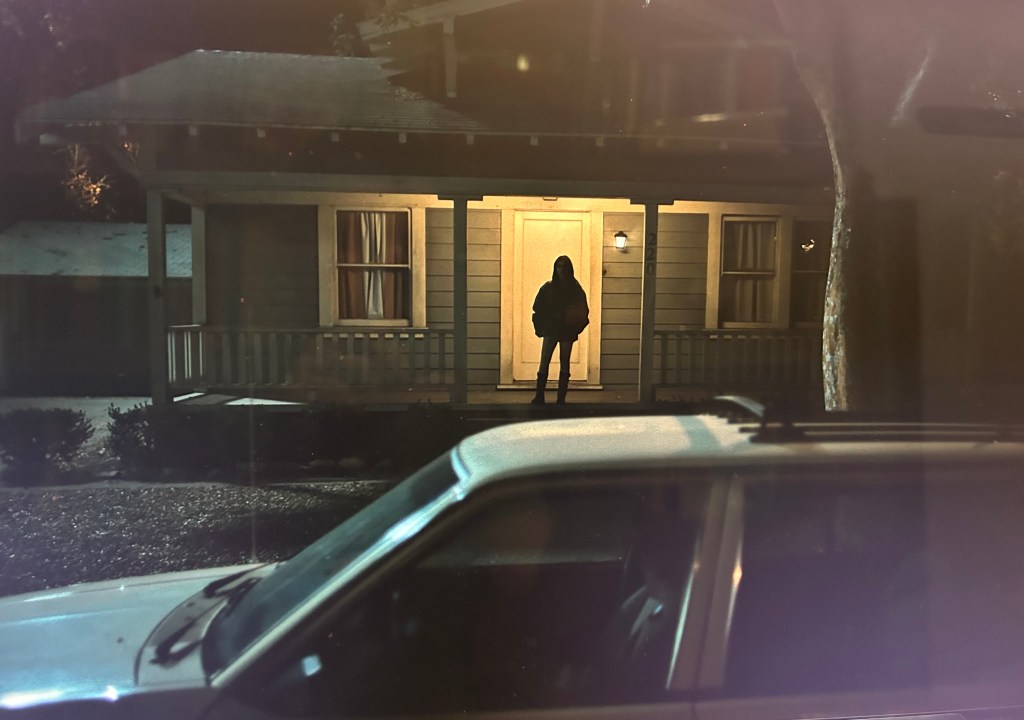
Bear’s car is similarly an old station wagon, its aesthetic clearly out of step with contemporary car trends. Its doors creak constantly throughout the movie. When Bear takes Nikki home, the exterior of her house does not indicate whether she lives alone, and there’s no explicit moment in the movie that says if she has a roommate or lives with a family member. There is no car in the driveway and no lights on inside. A lone porch light is the only source of luminescence and sign of life in the domestic space. After Bear makes his wish and looks back at Nikki’s house, the reveal of Nikki standing on the porch has her backlit in a way that is unnatural to how the diegetic lighting appears. The one porch light would not create enough light to cast her into such an aggressive backlit appearance, suggesting there are more lights hidden up in the ceiling of the porch projecting onto the front door and creating the dynamic contrast between the light of the door and her shadowy figure. Again, space is behaving in a way that is subtly “off.” (For whatever it’s worth, this is the only time we ever see a full exterior of any character’s house in focus). When Bear and Nikki go back to Bear’s house, we seem then enter from an interior shot showing Bear open the door. The only thing visible outside are two porch lights. The design of this room speaks to the uneasy, out-of-time feeling in Bear’s house: the left side of the frame is an older aesthetic with a wooden table, a lamp, photos on the wall, and some books. The right side of the frame has a desk chair, computer monitor, speakers, and light weights. This space is torn between being stuck in a decades-old aesthetic of dark, organized wood with a smattering of different patterns, and a collection of random objects meant to connote a young man with no identifiable style or personality.
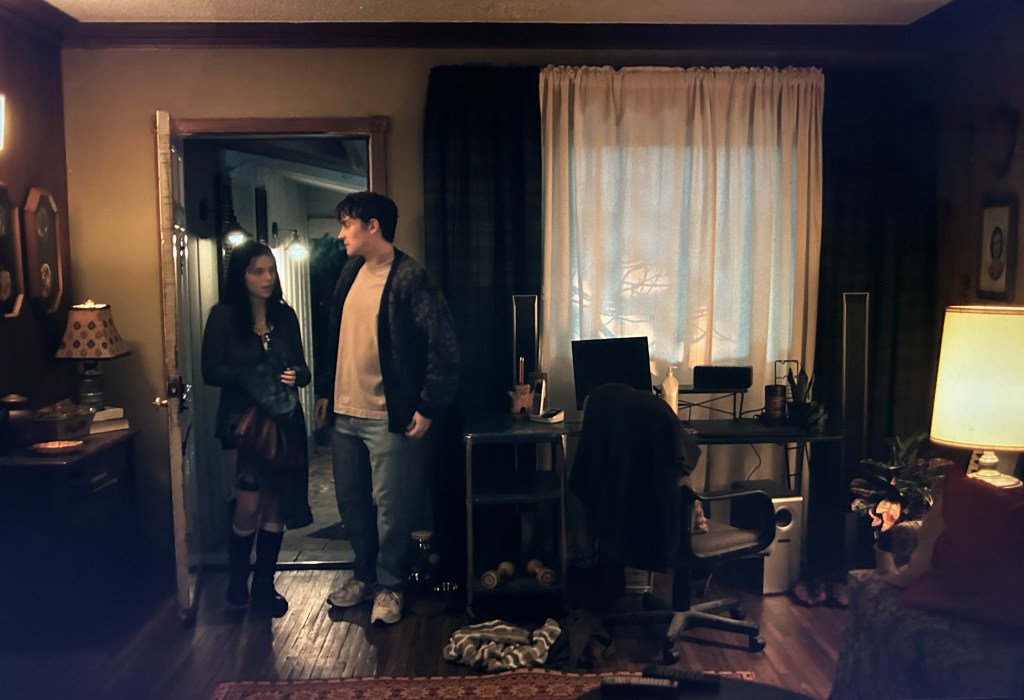
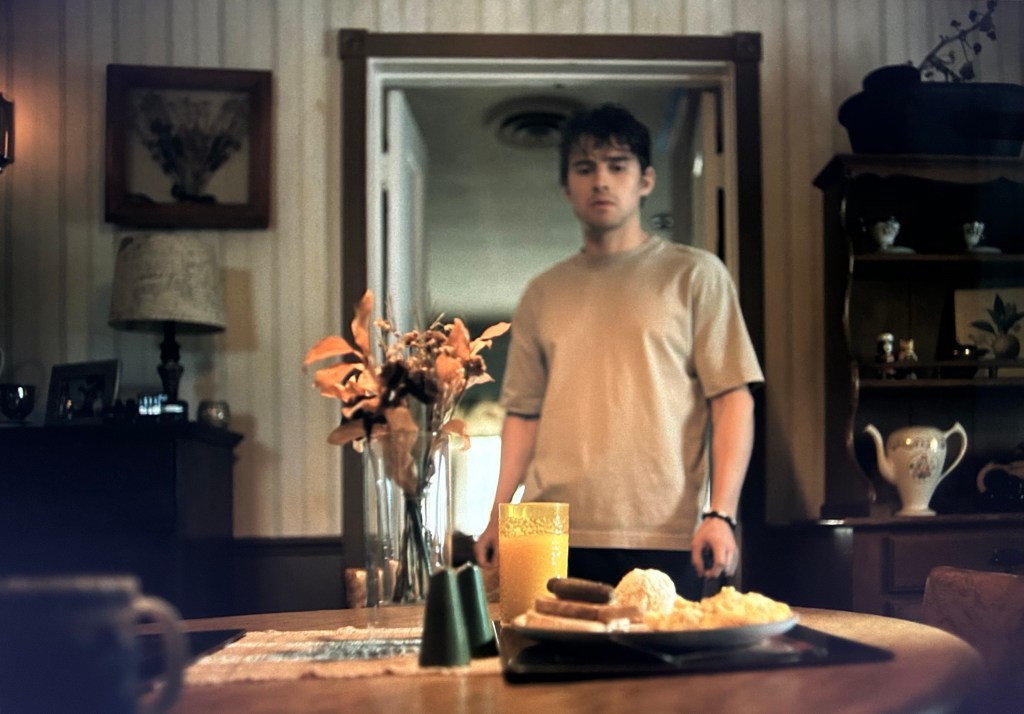
It’s here that Bear notes, “It’s Grandma’s. I got to keep it.” Death (the death of a family member) allows Bear to obtain the stability of home ownership, allowing him to access, as Nikki puts it, a “much bigger” place, but he seems incapable of doing much with this newfound stability, and it’s never established how long he’s been living here. His efforts at making it “his own” are scattered and lack any kind of discernible visual coordination, and he leaves traces of his Grandma on the walls, the refrigerator, on the surfaces of dressers, and on display chests. The appliances in the kitchen do not look like they have been updated in decades. Stacks of boxes are in the corner of his bedroom. The next morning, when Nikki serves Bear breakfast, dying flowers are centered in the composition while the chest on the right of the frame displays, among other things, a tea chest. The image on the left side of the frame hanging on the wall appears to be pressed flowers, an apt metaphor for another once-living thing trapped inside a display (perhaps like Nikki?). Dead flowers become something of a motif throughout the movie, a sign of how Nikki, in her possessed state, does not understand how to care for things and how Bear’s house is basically a space of dead and dying objects.
So even as the supernatural events that set Obsession into motion begin, these characters are all presented as being lonely and stuck. There is, I think, something to how Obsession treats these characters that is meant to reflect generational anxieties about loneliness, connection, and fears about the (im)possibility of domestic life. What the movie is doing is not operating within a kind of “postmodern aesthetic” collapsing different time periods into some form of collage for a commentary about how the past shapes the present. These elements of the design are often relegated to the background, again contributing to the “off”-ness of Obsession and compounding its dread as it moves into its second half. The past is this static thing that lingers, which speaks to a different kind of intrusive haunting.
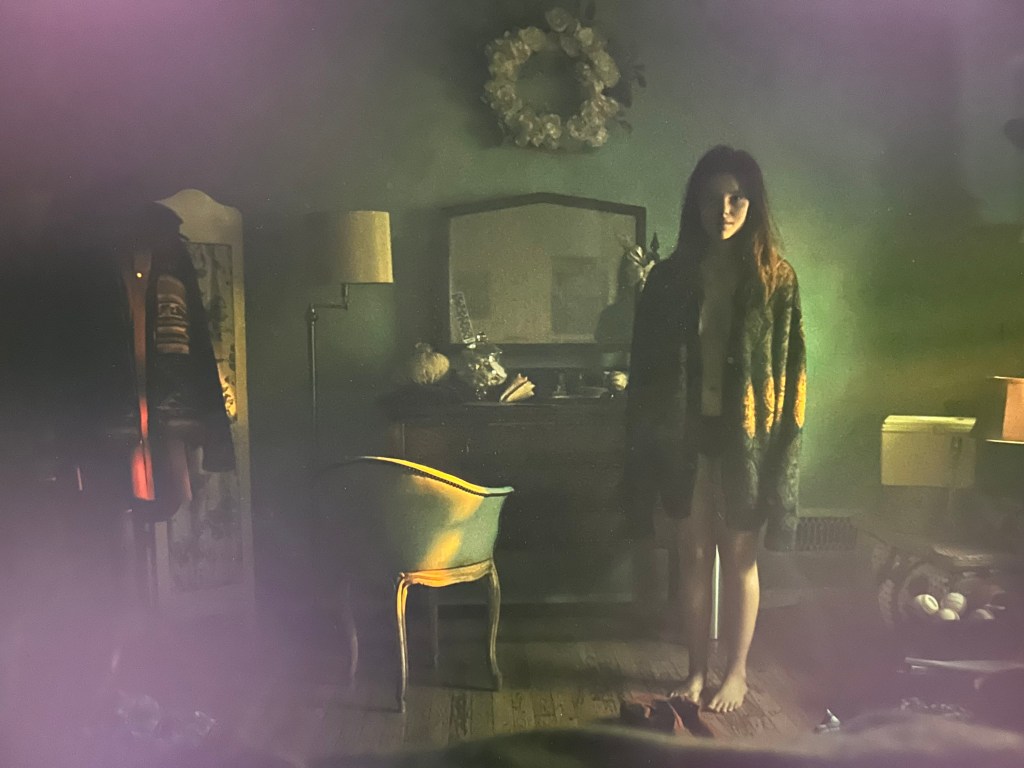
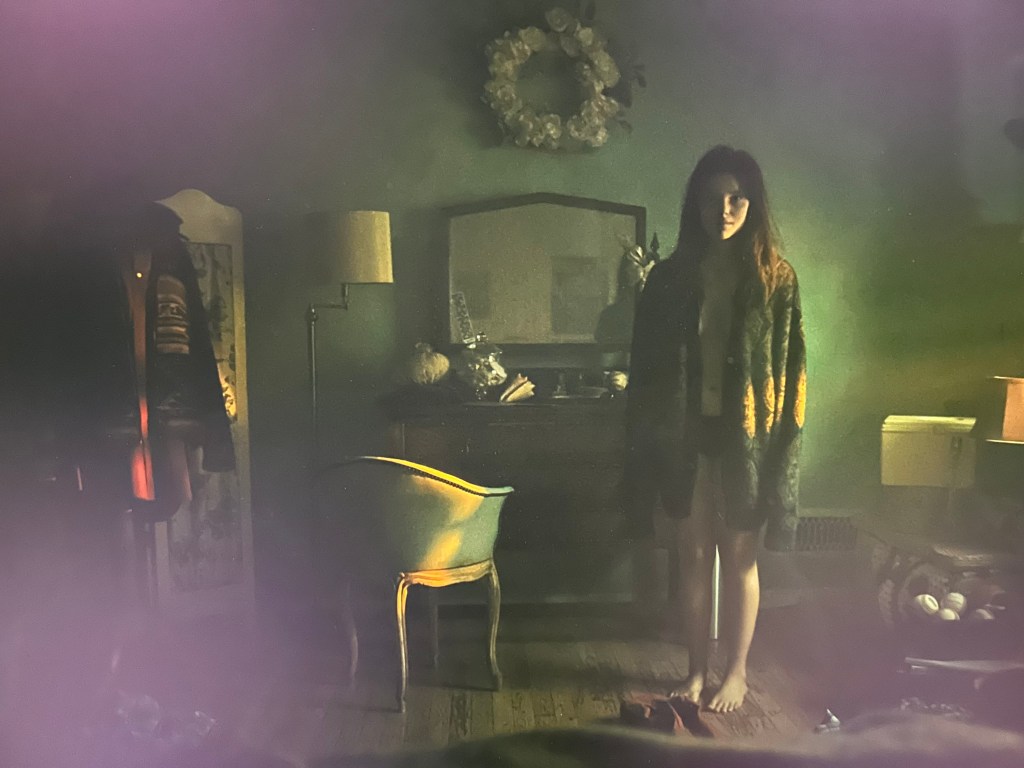
Consider the moment about halfway through the movie when Bear wakes up at 3:45 am to find Nikki watching him sleep from the corner of the bedroom. When Nikki moves from the corner to talk to Bear, she is cloaked in shadows and stands off-center. But the rest of the composition has details that show how the room is still stuck in Bear’s Grandmother’s world: the stacked hat boxes, the wreath of fake flowers, the sitting chair in front of the dresser mirror. Each of these work together in this composition to underscore how Nikki doesn’t really exist here either. The next morning, when Nikki offers Bear a packed lunch, she hands him a hardshell plastic lunchbox that looks like it’s from the 1980s or 1990s, before either of these characters were born but still heralding the way they are navigating their lives against a mess of artifacts from past decades stacked up around them.
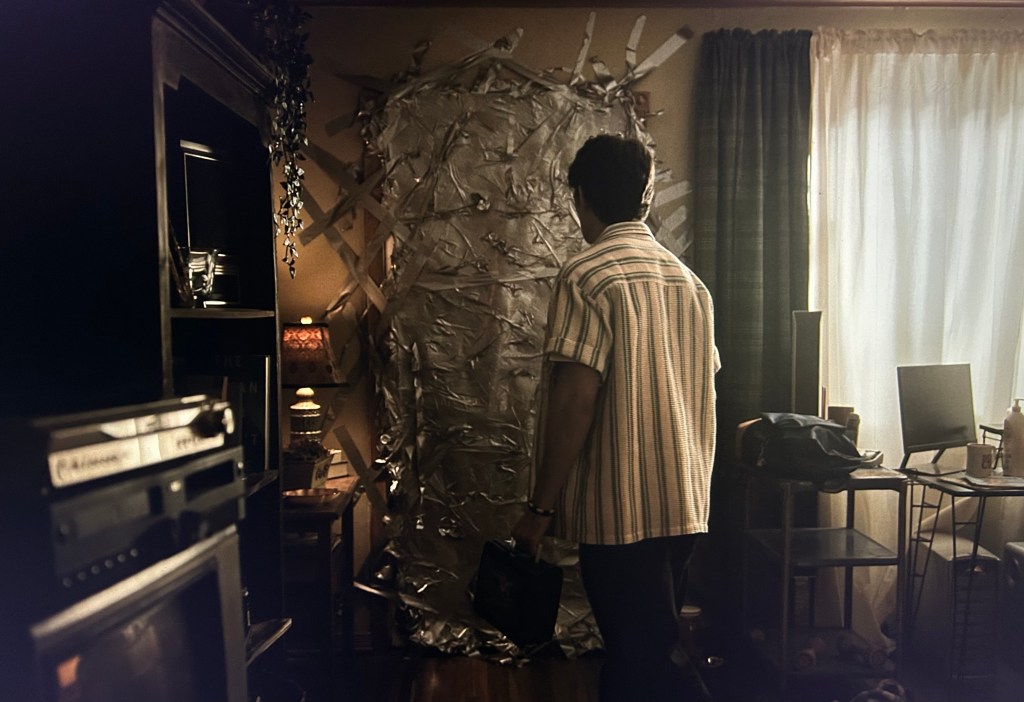
The increasing horror of Nikki’s situation is often juxtaposed against this mess of detritus. When Bear realizes Nikki has completely duct-taped shut the front door, he is framed between his desktop computer on the right side of the frame and a decades-old box TV with a VHS player on the left side of the frame. While the focus of the composition is the door—it’s almost comical while also underscoring the increasing claustrophobia of Nikki’s situation—it’s the technological artifacts framing this moment that speak back to the way these space is unnavigable even behind the supernatural violence exerting its force on Nikki. Even at work, Bear eats lunch and consoles Sarah in front of an old piano while an electric keyboard sits on top of it. Time periods constantly clashing, different eras of technology in odd juxtapositions.
So, what to make of all this? How does it point to the way they are running out of time? Increasingly, young Americans are struggling to afford homes. Nikki’s living situation is never explained. Sarah presumably lives with her dad. Bear inherits his dead grandmother’s house. Ian invites Bear to a party at “my place,” but at the party he immediately scolds a party-goer to “keep your hands off my mom’s china,” indicating Ian also still lives at home but may have co-opted a basement as a semi-apartment. There is not a lot of mobility or opportunity for these characters. This year, U.S. affordability for homes hit a 21-year low, with median home prices rising nationally for the last three years. I think this is one of the more unacknowledged dimensions of this movie and why it seems to have resonated so much with so many people. The increasing impossibility of achieving what was once “The American Dream,” where for many having enough money to afford a down payment would require a One Wish Willow, is where the movie is actually thinking about the tensions around time. It is both the lingering elements of the past as well as the tension where these characters have ‘all the time in the world’ because they are young, while at the same time recognizing they are ‘running out of time’ to figure out how to advance in a context that offers them little room to move forward. Bear’s house feels like it has never really left, at the latest, the 1980s, like it is a portal to a dimension where affordability was even possible.
Again, what I really enjoy about Obsession is how it does not draw attention to any of these things. So much of the foreground and the center of the compositions are focused on the performances and the horror, while the edges of compositions and the production design keep enhancing the instability of these characters’ entire social context, even beyond the supernatural dressings of the plot.
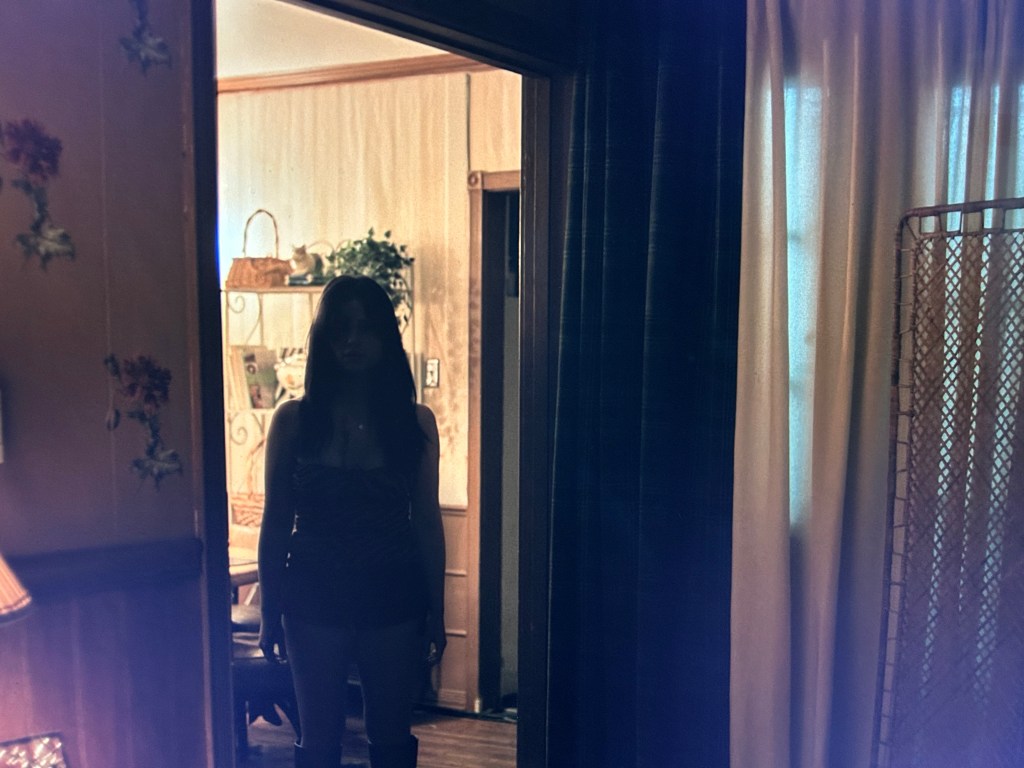
As the movie dovetails into violence in its last thirty minutes, it uses these established patterns to heighten its own tension. Take this shot of Nikki standing in the doorway. She is slightly off-center, after so many compositions put her directly center-frame. She is standing between rooms, framed by the moulding of the doorway, while the edges of another doorway appear directly to her right. The right side of the frame is filled almost entirely by a window with white light coming from an outdoor light, which contrasts to the warm yellow lights inside. This whole composition adds to Nikki’s unnerving performance because it both builds on the way the house has been framed but also violates that framing by moving her out of the center of the composition and changing how the geometry of the house has been presented through using this different camera angle and actor placement. It’s small, but it works, and it depends on the aesthetic the film has already established around the house. Even Bear’s recognition early on that he’s only in this house because he dead grandmother left it to him seems to serve as prophecy for where the movie ends: Death is the only way forward.
In a movie full of nightmares, the current economic context is almost like its own supernatural force.

