
by Hillary Hardig
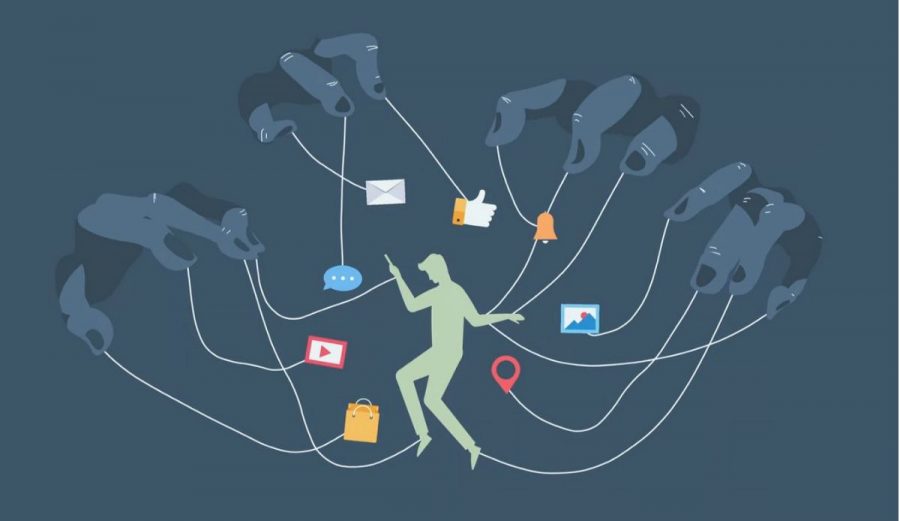
Users of Facebook have long dealt with ongoing changes to the application’s privacy policy. And these changes aren’t necessarily wrong. It’s now been seventeen years since the launch of the platform by creator, Mark Zuckerberg, and seventeen years since Facebook led an explosion within the realm of social media. However, Facebook’s privacy policy is often scrutinized for its language and structure of the terms, making it difficult for users to clearly choose what data they are or are not willing to share with the company. The company’s data collection policies have not gone unnoticed and users are becoming increasingly aware of internet privacy. In turn, large corporations like Apple are making strides to ensure customers that their privacy is being prioritized. This has led Facebook and Apple, two of tech’s top companies, into a war over privacy.
In 2018, Facebook rewrote its Terms of Service (TOS) and Data Use Policy (DUP) to use more plain language to clearly illustrate to users how their data is collected and used. This was likely due to theories that Facebook collects data from user microphones and SMS messaging. In 2021 TOS and DUP changed again, this time revamping the layout of data settings on the platform and decentralizing the settings into multiple different places. In a statement explaining the renovation of settings, Facebook commented, “Settings are now grouped into six broad categories, each containing several related settings: Account, Preferences, Audience and Visibility, Permissions, Your Information, and Community Standards and Legal Policies … We’ve unbundled the Privacy Settings category and moved the settings previously contained within it into other categories.” Now, if users want to change a privacy setting, they must navigate multiple pages and scan through each page individually looking for specific toggles to turn off and on. Regarding this change, Facebook stated in the same statement that “we’re confident this new settings page will make it easier for people to visit their settings, find what they came for, and make the changes they want.” But to users, controlling their privacy settings just got a lot more difficult.
In a 2018 article published in the journal of Social Media + Society, authors Jennifer Jiyoung Suh and Eszter Hargittai asked participants to answer questions about their Facebook use and attitudes towards privacy. Interestingly, the study found that there is a considerable discrepancy between participants’ intended online privacy management and its actual effectiveness. The study stated that “despite participants’ perceived high level of knowledge and skills of online privacy management on Facebook, the majority of the posts collected for this study were shared with more people than the participants had intended” (p. 9). Since then, Facebook has been fighting a battle with Apple who, with the release of newer iOS versions, requires that app developers explicitly ask for permission to track users’ behavior across Apple’s App Store and the internet. But gaps in Apple’s push to increase privacy don’t fully limit Facebook’s ability to collect location information from your iPhone without your awareness.
In 2021, researchers Anatoliy Gruzd, Joanne McNeisha, Lilach Dahoah Halevib, and Martin Phillipsa studied the change in user privacy concerns and behavior on Facebook after exposure to a privacy literacy intervention called Data Selfie. The study found that after viewing their privacy information from Data Selfie, participants became increasingly more concerned about their online privacy. However, privacy intervention tools like these are likely underutilized. Platforms like Facebook require contracts of adhesion to be signed as written when a user creates a profile. This research suggests that because the contract must be signed as stated, users may be less likely to read and understand these contracts when knowing they cannot implement changes. Additionally, there are no regulations that protect users against the actions of Facebook and address users’ perceptions to motivate privacy-protective behavior.
In September of 2021, Facebook announced new capabilities for business owners following the danger to its ad targeting by Apple’s IOS 14 privacy initiative. Facebook testified that Apple’s changes would have a negative impact on the small businesses that rely on Facebook ad targeting to find and attain customers. In an interview with The New York Times, Apple’s CEO Tim Cook came back at Facebook’s comment saying, “I think that you can do digital advertising and make money from digital advertising without tracking people when they don’t know they’re being tracked.” However, Apple didn’t budge on any of its IOS privacy updates. Instead, Facebook was forced to implement a new way of connecting businesses to their target audience.
Among some of the changes, Facebook has made is a way for customers to explore businesses from their News Feed posts. When a user clicks on a topic like beauty, fitness, or home decor, users will be redirected to explore businesses related to their interests. This new system has two main advantages. The first is that users may stumble across a new business that relates to their interests. The second is that this feature allows Facebook to create its data set of users who like certain types of content. Eventually, businesses may be able to pay for higher placement on the News Feed, working a similar system to Google’s search bar advertising. Along with this roll out in 2021 were multiple other new business advertising tools like organic lead generation tools on Instagram, and quote requests via Messenger.
Changes to Facebook’s TOS and DUP are likely to continue. Efforts made by companies like Apple aren’t keeping Facebook from collecting data. The company continues to try and find ways to extract data from users, regardless of the effect on individual users or businesses. Luckily, battles between companies like Facebook and Apple are likely causing users to become more mindful of their personal data and different perspectives between companies bring the conversation of data collection to the consciousness of the public.

