
– by James N. Gilmore
At this point, trying to untangle all the relationships of the various Oz texts is a journey in its own right. While L. Frank Baum’s original novels (beginning with The Wonderful Wizard of Oz in 1900), the original stage adaptation in the 1900s, and the MGM adaptation in 1939 form sort of a “core” of iconography around the Oz storyline, the world has had its fair share of revision over the decades. From the multitude of books written by different authors after Baum’s death, to “unofficial” sequels like Walter Murch’s 1985 Return to Oz, the Land of Oz has been a source for all manner of fables. None of these has been as successful as Gregory Maguire’s 1995 novel Wicked and its subsequent 2003 stage adaptation, which has defied gravity to become the odd example of a revisionist history to a piece of popular culture whose popularity rivals—in some circles, anyway—the popularity of the original texts.
Wicked Part 1 has seemed to arrive, like a Kansas farmhouse dropped from a twister, at an opportune moment. Over twenty years after the premiere of the musical of the same name, and nearly thirty years after Gregory Maguire’s revisionist history of Oz, Wicked’s representation of an authoritarian government quite literally scapegoating its Animal citizens and naming an ambitious young witch Wicked in the process is hitting theaters the same week newspaper headlines discuss the potential for 2025 to entail the mass deportation of immigrants from the United States, the suspension of birthright citizenship, and the possible dismantling of the Department of Education, with other government services and departments on the chopping block in the name of increased efficiency.
The Wonderful Wizard of Oz, despite its fairy tale dressings, has always been treated as a political fable. Baum’s original novel has been subjected to a variety of interpretations about the social and political contexts of the 1890s, including debates about gold and silver, whether “Oz” is really a play on the abbreviation of “ounces” and thus about the centralization of markets, and the emerging power of mass media to facilitate propaganda, as in the role William Randolph Hearst’s newspapers played in facilitating the beginning of the Spanish-American War in 1898. Whether these interpretations are “correct” or the result of clever scholars reading backwards from the vantage point of decades later is almost beside the point: Readers have been eager to filter Oz through the Technicolor prisms of social, political, and economic conditions. The Wizard himself is a bit of a cipher for reading a variety of fears about media and persuasion: he deceives the citizens of Oz using projection technology and audio technology; he refuses to grant Dorothy’s wishes until she kills the Wicked Witch of the West; and his giving of gifts has little in the way of magic. The Wizard was always a con man, but Baum’s novel and MGM’s film present him more as a bumbling magician who is not, in Dorothy Gale’s words, much of a wizard at all.
That 1939 film, similarly years in the making, also arrived at a fortuitous moment. It premiered on August 25, 1939, one week before Hitler began invading Poland on September 1. The MGM film is a constant reminder of the power and vibrancy of artifice. Its painted backdrops, full-body makeup, and trick photography remain incredible to look at, and the repeated framing of special effects through proscenium arches—seen in the film’s best shot, Dorothy opening the door from her sepia-toned home onto the colorful world of Munchkinland—seems to cheekily point to how “the movies” are the only medium that could facilitate the kind of magical transportation at the heart of The Wizard of Oz. For older viewers, though, the reveal across the second act that the Wizard is not, in fact, all he is cracked up to be is surely aligned with the structures of feeling at the time that radio, journalism, and movies were crucial propaganda tools for Axis and Allied powers alike.
The political interpretation of Wizard of Oz remains at the relative margins of the movie, which is celebrated more as a family film and delightful fantasy than anything else. Gregory Maguire’s 1995 novel, Wicked, provides a revisionist pathway that fully explicates the Wizard as an authoritarian who has instigated a coup, mined the land of Oz for its resources, suppressed Animals, and installed a special police force to patrol the streets and kill dissenters. It is a book as much about authoritarianism and propaganda as anything else, where the Wicked Witch—here, as in the stage show, named Elphaba—becomes a political insurrectionist after the murder of her professor (a Goat trying to advocate for Animal rights against the increased oppression of the Wizard’s regime) radicalizes her.
The stage show softens these politics a bit, turning Maguire’s book into more of a two-hander about the relationship between Elphaba and Glinda (Galinda at the beginning) and the paths that lead them to become the archetypes of Baum’s fairy tale. It is still fundamentally a show about propaganda, though: When Elphaba realizes the Wizard is behind Animal suppression, and she is tricked into creating the flying monkeys, she revolts. The Wizard and his allies, in response, label her ‘Wicked.’ As my daughter put it when we discussed the movie after seeing it, Elphaba was “tricked.” The stage show premiered on June 10, 2003, less than three months after the US invasion of Iraq—yet another geopolitical conflict that happened largely due to propaganda and manipulation on the heels of rampant Islamophobia across the country.
While this is all, for the most part, coincidence—the MGM film, the novel, and the play clearly took years to produce, their release dates selected months if not years ahead of time—what I’m pointing to here is more the nagging persistence of that so-called Wonderful Wizard as a reminder that we can’t seem to rid ourselves of tendencies towards authoritarianism, as well as the role that media technologies of all sorts play in deception.
In all renditions, the Wizard is always marshaling technology as the means to control fabricate narratives about his rivals. Be he more a numbing magician or a violent ruler, his power is populism and sovereignty: appeals to the citizens of Oz that his Emerald City is a bastion of invention and progress, when really it serves the centralization of his own mythos. After all, he basically forces Dorothy to kill the Wicked Witch of the West before granting her safe passage back to Kansas. To put it another way, the lasting power of these stories is in part about the seductive allure of con-men who are more than happy to use manipulation and violence to achieve their ends.
It is curious, then, that Elphaba describes him as having “no real power” upon realizing what has happened. She means, of course, that he has no capacity to perform magic, but the line also works to undercut sovereign power. The Wizard’s only powers are those he has given himself. They are industry and technology, and they are cultivated and maintained through the discipline he imposes onto the citizenry of Oz. Even if they are nothing but smoke and shadow, they can sound and seem profoundly frightening. And that’s part of why Wicked has worked so well for 30 years: the Wizard isn’t a hapless nitwit here, but someone who understands deeply how to seize and hold power over the regions of Oz through violence of many forms.
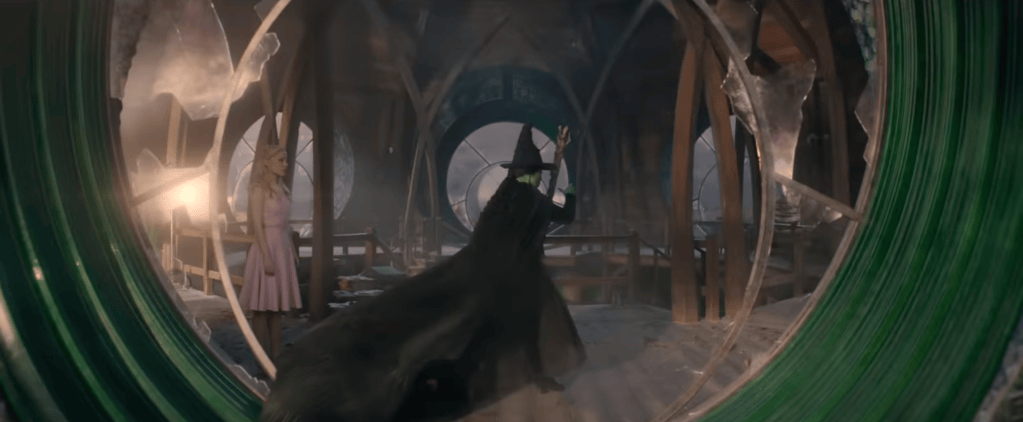
Wicked: Part One has the gloss and shine of theatrical camp and the feel of a movie with an enormous budget, but it too is deeply engaged in the politics of this moment. Let’s not mince words, then: Elphaba’s cry at the end of Defying Gravity is a protest against the creep of authoritarianism, a call for all of Oz to wake up, to see what the Wizard really is. Here, at the end of 2024, we are reminded again of the need to resist how easily propaganda can twist its way around the social fabric. We can’t afford to not pay attention to the man behind the curtain.


