
by James N Gilmore
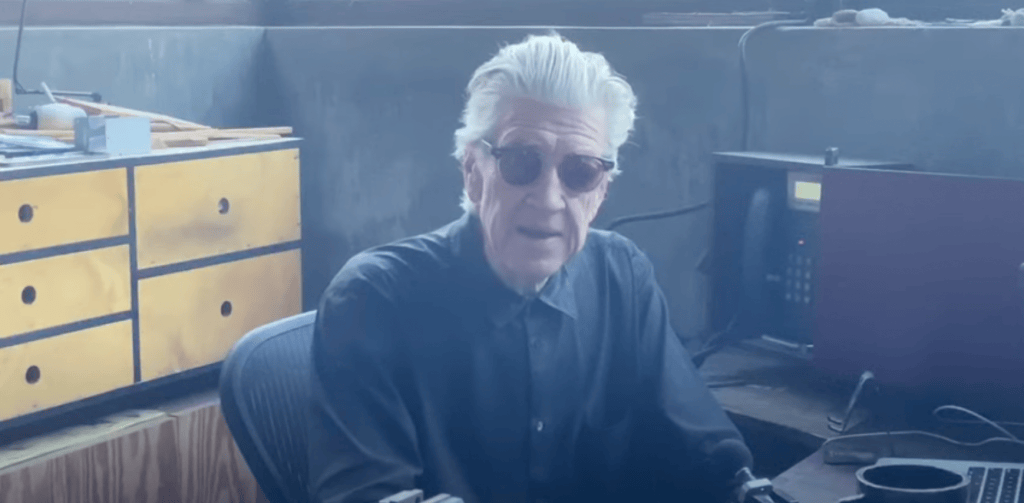
It is impossible for me to tell you what David Lynch has meant to me. His work, and his life, and his philosophy, are irreducible, and I have no intention of reducing them in whatever sort of tribute this could possibly be. The news of his passing has deeply affected me, as it has for so many of us.
For about twenty years, I have been swimming in David Lynch’s work, letting it move me and mean to me and matter to me, but I don’t know if I’ve ever really expressed WHY, exactly, that is. So I figured I would try.
The first I remember hearing about Lynch was in 2001, when Mulholland Dr came out. That was my first year really paying attention to the Oscars, in part thanks to how much I loved and cared about The Lord of the Rings. I was 12. In the build-up to the Oscars (and the months after—things took longer to come out on DVD 20+ years ago), I saw basically everything that was nominated, but I didn’t see Mulholland Dr (Lynch’s last Best Director nomination). I must have watched it at some point in high school. I remember it having a reputation—amongst the burgeoning Online Film Culture I was so giddily involving myself in—as a “puzzle film” with lots of clues and theories about “what’s really going on.” I remember trying to understand who this “David Lynch” guy was—being aware of davidlynch.com, hearing about Eraserhead, trying to see clips of Rabbits, eventually reading about Inland Empire but not seeing it until years later. In this period of 2001 until about 2007, I was a growing cinephile, and Lynch’s reputation in my mind was mostly as a “Puzzle Filmmaker.” His stuff was strange and required close attention. I tried to “figure out” Mulholland Dr and I think I saw Lost Highway in this period. They felt very cool, very edgy, very provocative, very artsy, but I was admittedly way too young to really understand the emotional pull at the heart of these movies.
I remember, very vividly, The Year I Fell in Love with Lynch. It was my sophomore year of college. I decided to use my Netflix account—still DVD by mail then, with streaming barely available—to watch all of his movies, and all of Twin Peaks. This was the first year I had the money to pay for my own Netflix account, using the funds I was earning as a staff movie critic for the university’s newspaper. I had heard of Twin Peaks at this point and I was still sort of carrying around a fondness for Mulholland and Highway, and Netflix offered the opportunity to easily get most of Lynch’s work (a lot of it on pretty crummy DVDs, but that was part of the charm!). But I remember the excitement of receiving—one DVD at a time—Twin Peaks (about 3-4 episodes a disc if I remember). I’d watch the entire disc in one sitting and put it back in the mail. When I watched Fire Walk With Me after finishing the series, I did so having heard that it was a “bad movie” that “didn’t answer anything” but it completely floored me and emptied me. Few movies, I think, are as deeply affecting, horrifying, and troubling as Fire Walk With Me, and it’s only gotten better over the last decade now that Twin Peaks: The Return sort of ties the knot in how to conceptualize the broader arc of Twin Peaks, Laura Palmer, and Dale Cooper. Those marathon viewings of DVDs, and waiting patiently for 3-4 business days for the next DVD to show up, are cherished memories.
In college, I was attracted to Lynch’s work because it was surreal and strange and different. I thought the way he told stories was deeply impressive and immersive. It was accessing a way of thinking about movies and experiences that I hadn’t ever really seen or thought about before. My year-long plunge into Twin Peaks involved getting—and rewatching—the DVD Gold Box Set, reading all manner of online theories about the Black Lodge and some of the more disconnected elements of Fire Walk With Me—elements that would inevitably be ‘answered’ (or at least addressed) in Lynch’s final work, The Return. The blend of mystery, soap opera, and nightmare that is characteristic of Twin Peaks has been oft imitated but never equaled, because Lynch (and the team around him, including of course Mark Frost) had such empathy for human experience. Things didn’t need to make sense in Lynch’s worlds. They had toproduce a sense, though. A deeply felt sense of human connection, often manifesting as agony or pain.
“Maybe that’s all Bob is. The evil that men do.” This line, uttered by FBI agent Albert Rosenfield after the big revelation halfway through season two of Twin Peaks, could serve as a thesis statement to a lot of Lynch’s work. It tries to understand human joy and human suffering, and how these things exist at the same time. Dale Cooper reminds us throughout Twin Peaks to buy ourselves gifts, to savor coffee and donuts and the smell of trees. Yet Twin Peaks is also about elemental evil that traumatizes and kills in the most horrific ways. And as much as Lynch’s movies are concerned with quite terrible, nightmarish things—chief among them abuse, murder, and grief, often happening to or around women—he himself was also someone who presented as someone deeply in love with the world and its possibilities for living. He was concerned with the sadness, but he always seemed to seek joy.
I remember watching Blue Velvet in an undergraduate film theory class—not the first time I’d watched it, but the first time I had an opportunity to really analyze it and engage it in the way it’s meant to be engaged, to see its dialectic tension between different visions of American life.
I remember watching Eraserhead and just completely not getting it, but being—as I think everyone must be the first time they watch Eraserhead—completely enthralled by the images, the sounds, the feelings it was eliciting.
I remember meeting Lynch’s Steadicam operator in my undergraduate years. He was an alum of my program at University of South Carolina, and he came to do an alum visit and talk about his experiences in Hollywood. He talked about shooting the opening shot of Lost Highway. I went up and shook his hand afterwards and told him how glad I was to meet him, and how much the use of camera in Lynch’s work impressed me. He was kind and grateful.
It’s easy to get lost in the surreal elements of Lynch’s work, like the Black Lodge in Twin Peaks (and Bob, Judy, the Woodsman in The Return), the mysteries around fugue states or body swapping or however you want to describe Lost Highway, and the divides between dreams and waking life in Mulholland Dr ; they all speak to the complex abstraction that is part of so many of his best projects. But to consider Lynch a “weirdo” or even a surrealist is to miss why his films and television shows have had such enduring legacies. It’s not really about the weirdness: it’s about the humanity. The intensity with which he treats human experiences.
It wasn’t until I saw a screening of Mulholland Dr at the Aero Theatre while living in Los Angeles that I felt like I finally understood David Lynch (or at least, began approaching an understanding). It was on a double bill with Sunset Blvd — two movies about LA streets! Mulholland Dr probably didn’t begin until 9 or 9:30, so it let out close to midnight, maybe even a little after midnight. I was seeing it with my friend Josh, and afterwards I drove him home through, in part, driving down the parts of Mulholland Dr connecting Westwood and Beverly Hills to West Hollywood. I can still feel those turns, see the lights on the road. Watching Mulholland Dr late into the evening, in what was probably my fourth or fifth time watching it, I realized that trying to “follow the mystery” or “trace the clues” wasn’t really the point.
There is a narrative in Mulholland Dr, but in many ways the narrative, or the vignettes of a narrative, serves as a way to access something else. What the film is “about” is a set of feelings. Terror (at whatever the hell is behind that Winkie’s diner), passion, loss, desire and aspiration, suicidal ideation, trauma—the movie is in part about producing these affects. That people often cry, or scream, or dance, or sing in Lynch’s movies is all part of this. What he was trying to attune to, I think, was his own particular way of processing human experiences, and share his struggles to process the world with all of us. At this point, Mulholland Dr is in my top 5 movies ever, and is making a play for the #1 spot. But if you asked me to explain why, I don’t know if I could beyond what I’ve written above. It isn’t just about the filmmaking, the writing, the acting (which are perfect, just to be clear), but it’s about all the ways it’s made me feel, all the ways it has opened ways of thinking and imagining and being to me. And how it opens those things up for others, often in ways that are entirely different from what the movie has made me feel.
There was something magic about the summer of 2017 as The Return came out week by week. Again, as with his other work, the mystery and the strangeness were completely immersive, but what made it work and transcend basically any other television show or long-form storytelling I can think of off the top of my head is how all of that was anchored in the tragedy of its characters, each of them struggling and working to make some good in their life. There is an extraordinary sadness around The Return, amplified through the characters who are not in the show because the actors had passed on, or images of actors quite near the end of their lives offering hushed monologues in close-ups for just a few scenes. That the show builds to Agent Cooper trying to literally go back in time and change a tragedy from happening is a fitting end, I think, for Lynch’s work. “What year is this,” Cooper mutters to himself in the astonishing final scene of The Return, and while I won’t dare to speak a word about my read on what’s ‘actually’ ‘happening’ in that final scene, it remains one of the most emotionally and intellectually overwhelming and cataclysmically devastating moments I can remember watching. It’s a “twist,” sort of, but it’s also a tragic culmination of not just the 17 hours of The Return, but the story of Twin Peaks from 25 years prior. What remains so staggering about Twin Peaks and The Return is not the mystery, per se, but rather how the mystery matters in so far as it is about the characters trying to navigate their lives in the wake of what they experience.
Honestly, reading that paragraph back now, I’m not sure if it makes any sense at all, but trying to produce tidy words around something as monumental as The Return doesn’t really seem possible, at least to me. Perhaps someday I will have the space and time to really reflect on what The Return was able to achieve. But I guess I should leave it at that: What it—as a story, as a television season, as an experience—made me feel was not like anything I had felt before or have felt since.
And that, I guess, is why I continue to watch Lynch’s movies. And why there are images, sounds, and sequences in them that haven’t left my brain from the first time I watched them. They tackle our experiences, the ways we struggle, the ways we try to deal with the evil men do—with “people like Frank.” They are beautifully made. Lynch was always an artist. His work is deeply felt, carefully produced, with stunning sound mixes, wonderful music, and some of the best and most intense acting. Lynch encouraged us to feel so many things, to try and work through so many things in his work.
I’ve been talking a lot about emotions and affect and meaning, but I should of course mention that the other inspiring thing about Lynch is he never stopped creating and making. His avant garde roots, his painting, his music, his weather reports and all the small trinkets of digital content he created over the last 15 years are all part of a larger fabric of what he called the art life. Even as his health declined, he said he would never retire.
I love the joy of creativity. I love writing. I love being imaginative. Even at their darkest, most intense, almost unbearable moments, Lynch’s work is so fundamentally creative. It creates. It generates. It moves. It makes things happen.
I’m not sure if I’ve said anything meaningful or even coherent in these reflections. I guess I don’t really intend to. What Lynch continues to mean to me goes beyond and goes deeper than a typical gushing about an artist’s work. This may not, in the end, be much of a tribute, but I hope it gets close to capturing something about why his work matters so much to me. I just wanted to get this down on words, in this moment, in some form or another.
His legacy should inspire us all to just keep creating. Keep making room to dream.


