
There’s no way to sugarcoat this: I loved a lot of the movies I was able to see from 2025. The movies on this list represent efforts at capturing the complexity of the present conjuncture, as well as representing complicated human emotions and experiences through sometimes absurd, sometimes tragic stories. They all resonated deeply with me. I hope they resonated with you, too.
10. Weapons (dir. Zach Cregger)
The breakdown of American communal life is beneath much of the pulsing dread in Zach Cregger’s follow-up to his breakout Barbarian. Weapons uses the disappearance of (almost) an entire classroom of children as a launch point into paranoia, incivility, anger, and distrust in its first act. As it goes on and switches perspectives, it follows multiple characters who are trying to investigate and make sense of this disappearance in ways that reflect gendered and classed conceptions of community roles. By the time Weapons pivots its perspective again to become a movie more about the terrors of family itself (and, okay, yes, witchcraft), it has twisted itself into a breathless noose. While Weapons ultimately becomes a bit supernatural, its horror nevertheless reflects the increasingly absurd reality of how fractured and terrifying it feels for many of us to simply live amongst each other.
9. Friendship (dir. Andrew DeYoung)
As someone with often-crippling social anxiety, Friendship is quite literally one of my worst nightmares brought to life. Craig (Tim Robinson) thinks he’s finally made an adult friend in his neighbor Austin (Paul Rudd). He’s an awkward guy; Austin is cool. Austin seems to genuinely enjoy spending time with Craig, and invites him into his social circle, but Craig can’t go one night without horribly misreading a situation. A single faux pas, one miscalculation sends Craig’s life spiraling out of control. He loses his friendship with Austin, his marriage (to Kate Mara, understated but excellent) disintegrates, he has a meltdown, he loses his job. Friendship is in many ways a pair with DeYoung and Robinson’s other collaboration 2025, HBO’s The Chair Company, and they share a paranoid, slightly askew aesthetic style that mimics independent arthouse approaches to camera lenses, lighting, and framing to make your skin crawl with cringe and unease. Where The Chair Company is more about hyper-fixation, Friendship is about social cues and social dread. It feels more like a horror movie than a comedy, where the terror comes from simply existing in society.
8. Train Dreams (dir. Clint Bentley)
“Hold on to something,” Robert Grainier (Joel Edgerton) is instructed to do in the final moments of Train Dreams. The act of grasping, the sensation of being thrown off-kilter as Grainier experiences a small plane ride, sends him catapulting through his memories. The entire movie runs back, distilling its sensitivities down into glances, touches, rays of sunlight, wood and leaves, smiles, and heartbreak. Up until its final moments, Train Dreams moves along briskly, quietly, showing a man who lives his life the best he can despite the immense sadness he’s had to deal with or the violence he has seen. It appears first as a love story, then a story of resiliency, and then ultimately a story of acceptance. Edgerton’s smile, his eyes closing, looking away from the sky and the clouds and the ground, is a moment of catharsis and recognition. Train Dreams is a beautifully composed movie, and many have written about how it seems rooted in Terrence Malick’s exploration of the relationships between humans and nature. I think there’s even more to it than that, although the cycles of nature and the randomness of disaster are very much at the heart of Train Dreams. It is about how we are all caught in cycles and tides and occurrences we can hardly make sense of. They disorient us, they destroy us, but the best we can do is hold on to something.
7. The Secret Agent (dir. Kleber Mendonca Filho)
The Secret Agent is another deeply immersive film about paranoia and survival. Its opening scene, a prolonged stop at a gas station where Armando (Wagner Moura) sees a rotting dead body and is interrogated by the police for ostensibly no reason, immediately thrusts us into a space where we’re trying to find our bearings and understand the stakes for Armando against the political context of Brazil in the 1970s. As The Secret Agent goes on, it slowly reveals more about Armando’s actual persecution and why he is trying to flee the country, as well as a rich tapestry of others in exile trying to simply keep their heads down and survive. I’m speaking in vagueries here because The Secret Agent works magnificently at slowly unspooling information while building an immersive environment for its characters, all of whom feel rich and complex even if they only have a scene or two. While all of this would make for a great political thriller, it’s the way The Secret Agent begins to integrate a consideration of the historical archive into its narrative that really builds its power. In a dramatic last-act shift that the film has teased fleetingly in its build-up, audio cassettes, newspaper clippings, and photographs become key for sorting through what happened to Armando. What kinds of stories do we tell ourselves about our families or our countries? What would it mean to be confronted with information that contradicts those stories? What is the role of historiography, or of storytelling, in excavating links to the past? The Secret Agent has haunted me in the weeks since I finally had the chance to see it. It is both a compassionate portrait of life under a dictatorship and a bracing consideration of dealing with our own histories.
6. Hamnet (dir. Chloe Zhao)
I want to be clear that I didn’t really want to watch Hamnet. Knowing that it’s based (spoilers, I guess? But it’s really the conceit of the film so you should know this at this point) on a historical fiction representing the death of Shakespeare’s eleven-year-old son told from the perspective of his wife Agnes, I was fully prepared for Hamnet to be Misery Porn of the tallest order, replete with shrieking and wailing and People Being Sad. Movies about grief are a tough sell for me, and I think they’re hard to get right. Too much melodrama and it can become unbearable, too much monologuing and it can feel redundant. How wrong I was about Hamnet. From its very first moments of Jessie Buckley laying in the forest, with Max Richter’s strings swelling contemplatively around her, and Lukasz Zal’s cinematography seeming to swoop in on this private space with intimate handheld work, something felt very different in Hamnet. Yes, it’s a movie about unspeakable levels of grief, but there’s also a real beauty and tenderness to how Hamnet treats its titular character, how his death is rendered, and how Agnes and Will’s different ways of processing grief lead to an unspoken, wordless (at least between the two of them) climax at the Globe as Hamlet plays onstage. If you still haven’t seen the movie I’ll say the next part as carefully as I can, but the moment where Agnes reaches out her hand is transcendent. From the way it’s edited, to the dramatic change in cinematographic composition, to how Jessie Buckley and Paul Mescal’s faces convey monologues of unspeakable emotion, and yes, to Max Richter deploying his “On the Nature of Daylight” to cap it all off, it really is Pure Cinema. It has to be seen to be felt.
5. Sentimental Value (dir. Joachim Trier)
Devotees may recall I’ve been a fan of Trier’s work for over a decade at this point. The Worst Person in the World is in the running for my Top 10 of the whole decade right now. I love the way Trier writes, I love the way he films scenes, the performances he is able to consistently get from his amazing actors (Renate Reinsve, my beloved), and I love the surprising ways his human dramas dialogue with more philosophical ideas about identity, time, place, history, and meaning. Sentimental Value begins with a narration about a house. That house, and the family that cycles in and out of it as they try to confront and reckon with their own pain, serves as a major character in Sentimental Value. The stories the narrator tells at the beginning become the basis for other stories the sisters speak of to younger family members and to each other. They are complicated by revelations their father shares with an American actress he has cast to play a version of his mother, a role he originally wrote for his daughter. Their father’s attempt to make one final film that ostensibly dramatizes his family’s life while using it as a gambit to reconnect with his daughter is the conflict at the center of the movie, but it is part of a variety of different strings and chords and notes about how we choose to engage with pain, with separation, how abandonment lingers and shapes and defines us in ways that are both very clear and very hard to explicate. That the film ends (not really a spoiler) on a soundstage recreation of the house, with father and daughter exchanging tentative smiles but nonetheless separated in their own shots, still at uneasy distance from one another, might signal a need to move on, or a recognition of the role of artifice, or the therapeutic nature of art, or the struggle to actually reconnect despite this earnest attempt at creating art together. One of Trier’s greatest skills as a writer and director is that his movies are about human experiences but he leaves it to us to decide what to make of it.
4. Eddington (dir. Ari Aster)
For me, this is the best movie about COVID-19 anyone has made so far. I know it’s a divisive, polarizing movie. I know it’s nasty, and it descends into absolute violent madness in its last 30 minutes. But Aster’s town of Eddington, its dueling police chief (Joaquin Phoenix) and mayor (Pedro Pascal), and its array of citizens young and old scrambling to derive meaning during the early months of the pandemic, captures in deeply unsettling ways how it felt to watch ideologies intensify and amplify, how it felt to watch communities crumble over masks and testing, how misinformation and disinformation warped people’s senses of reality as so many seized on COVID-19 as their own platform for gaining influence and celebrity, how well-intentioned protests might still be performed by people who are good at saying slogans but not really grappling with the words they’re saying. And, beneath that, how Eddington builds its crescendo of political violence, of corporate conspiracy, and how it doubles back on data centers as sources of resource and value extraction that are literally crippling power and authority in local communities… this isn’t just a movie, it’s an entire thesis about the rot of this whole decade. I’m not even saying I agree with all of Aster’s provocations, but his willingness to provoke and to consider how COVID-19 enabled and accelerated violent articulations between politics, technology, ideology, identity, and social life is remarkable.
3. Sinners (dir. Ryan Coogler)
One of my favorite theorists and philosophers of the early twentieth century is Walter Benjamin. Benjamin writes about something he calls “the dialectical image,” a moment of shock and interruption that disrupts the flow of linear time and forces us to come into contact with what he elsewhere called “the wreckage of history.” Sinners is a monument to the wreckage of history build around one of the most extraordinary dialectical images I can remember seeing in a mainstream movie. When Sammie (Miles Caton) performs during the opening night of the Mississippi Juke Joint that serves as the setting for much of the film, entire histories of Black music swirl around him, projecting the past and the future into a beautiful harmony through which he swerves as he plays his guitar and sings. It’s an astonishing sequence, and one that becomes the pivot point of the movie: up to this point, it has focused on “Smoke” and “Stack” (both played by Michael B Jordan) building this Juke Joint for their community with money they’ve lifted from Chicago gangsters. After this point, it begins to devolve into a horrific vampire movie that focuses on its own themes of predatory extraction—of music, of bodies, of blood—that is then refracted through a final confrontation with the vampiric force of white supremacy. Sinners is a masterful movie. It’s gorgeous, it’s thrilling, and its ultimate point is about how hard it is to hold on to a truly free community when so many people would rather suck the life from you for their own gain.
2. Bugonia (dir. Yorgos Lanthimos)
Again, I’ll do my best to not spoil anything outright, because the thrilling setup for Bugonia — where the conspiracy-addled Teddy (Jesse Plemons) and his cousin (Aidan Delbis) kidnap CEO Michelle (Emma Stone) because Teddy believes she is an alien hiding as a human who has been sent to destroy the planet — barely scratches the surface of how the second half of the movie spirals out of control. All I’ll say is that the final twist of Bugonia made me make a noise somewhere between a gasp, a laugh, and a genuine “guffaw.” It’s an audacious and uproariously entertaining movie, with Stone and Plemons giving amazingly captivating performances. But apart from how genuinely exciting and thrilling I found it, Bugonia is tapping into the confluence of social, economic, and technological conditions that create people like Teddy. Its great virtue is not to treat him as a caricature—as a foolish idiot who believes everything he sees on YouTube—but as someone who has been traumatized by corporate America and by people in his community simultaneously, and who genuinely feels there is no other truth and no other path for himself. Bugonia starts with what is, at first glance, a sort of tongue-in-cheek critique of CEOs (“they’re so out of touch with the real world they’re basically aliens,” or something like that), but it morphs into what feels like an entire condemnation of our social condition.
- One Battle After Another (dir. Paul Thomas Anderson)
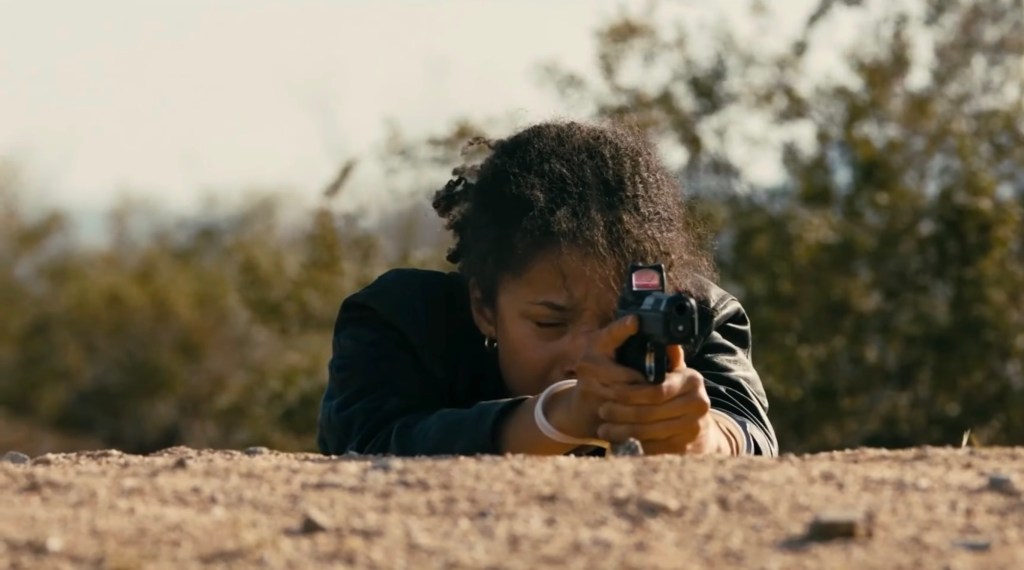
Although Benicio del Toro’s “a few small beers” quip has become one of those Instantly Iconic bits from One Battle After Another, I do think his Sensei is at the heart of what this movie is about. Sensei is not only about caring for the students in his dojo like Willa (Chase Infiniti, in a performance so good and so gripping I refuse to believe it’s her first movie role), but about the immigrant communities around him that he helps to protect. When Bob (Leonardo DiCaprio) comes to him for help finding Willa and evading Steven Lockjaw (Sean Penn), Sensei doesn’t hesitate. He provides care and shelter for those who need it. He picks Bob up and drives him as far as he can. He gives him shelter as long as he can. His calm demeanor in the face of the absurdity of what’s happening around him contrasts to Bob’s manic, pot-addled inability to keep everything straight in his head and Lockjaw’s robotic sadism. As Lockjaw uses immigration raids as the pretense for stalking Bob and Willa, One Battle After Another opens up into a movie where the characters are all chasing each other but the world around them is about military violence, immigration, community, and resistance. What makes it such a masterpiece isn’t just its immense technical skill or the ways it’s dialoguing with political violence, but also the ways it expands and contracts its tension. The movie can be as big as a military raid and a street protest in its second act, and then it condenses down into a stretch of highway for its nailbiter of a climax. It’s the ways the tension itself is predicated on absurdity — the supremacist group The Christmas Adventurers worship Santa, and it’s deeply amusing, but the hitman they send to dispatch Lockjaw is also terrifying. DiCaprio’s now-famous scene of screaming on the phone about how he can’t remember revolutionary codes is very funny, but it is also about this dad’s frustration and pain and fear about finding his daughter and protecting her. That One Battle is about this father-daughter relationship at the same time as it’s about the violent condition of American society, that it ebbs and flows and expands and contracts across this spectrum so effortlessly, is what makes it so astonishing, so thrilling, such a capstone for PTA’s career thus far. But, again, for me anyway, it’s Sensei at the heart of the movie, staying calm, making sure everyone’s taken care of, offering “a few small beers,” or calmly reminding Bob to have courage, that resonates most with me. Because really, we can understand One Battle After Another as a movie where everyone is dealing with fear. Bob is terrified of losing Willa. Willa is terrified of being thrust into this situation that stems from things that happened before she was born. Lockjaw is terrified of being “found out” as potentially fathering a child with a Black woman. Fear drives them and motivates them in different ways, but it ultimately seems to rest on Willa learning to not be afraid, or at least to push past her fear, and for Bob to abandon the fears that kept him from really living for 16 years. “You know what freedom is? No fear.”


