
Recently, Apple announced its Apple Watch Series 12 device, which will come with a “Health Sensing System.” The Watch is set to go on sale today.
This new version of the Watch increases the amount of sensors on the underbelly of the device, adding more (and updated) eletrical and optical sensors. As I’m writing this, the new Watch is just becoming available to purchase, so there still aren’t really any reviews, blog posts, or social media discussions of the device ‘in the wild.’ But even before I get my hands on this Watch or am able to sift through public conversations about it, several things jumped out to me that I think are worth talking about:
In Apple’s press release, Kaiann Drance (VP of Worldwide Apple Watch Product Marketing) describes Apple Watch Series 12 as “the most advanced health and fitness companion we’ve ever created.” I can’t remember seeing Apple use the word “companion” to describe these devices much in the past (although I’m sure this is not the first time). It seems to me a highly intentional word that is meant to anthropomorphize the Watch to a degree. As a specific word, “companion” is an interesting choice, as etymologically the word’s derivation from Latin quite literally translates as “bread fellow” (com [together] + panis [bread], from the PIE root *pa- [feed]). Apple may have the later meaning of the word in mind (“a person who lives with another in need of society” as an equal rather than as a servant) as a way to sort of ‘elevate’ the device from being framed as a ‘servant’ and position it as a ‘friend,’ but the way you can trace “companion’s” etymological components down to ‘feed’ has a fascinating implication.
If companions are formed through their ability to share food together, then what is the Apple Watch eating? I ask this rhetorically, because we all know the answer. Say it with me: your dataaaaaa.
Apple’s companionship is based on a proverbial breaking of bread where the device’s sensory array interacts with the wearer’s body repeatedly. Apple calls their revised system the “Health Sensing System.” Apple now claims to offer the “most accurate heart rate sensing in a wearable”. I know I’m parsing semantics when I say this, but note how Apple describes this as ‘heart rate sensing’ rather than ‘heart rate monitoring.’ Even Apple’s promotional materials for AirPods Pro 3 use the combined phrase “heart rate monitoring sensors.”
With the Health Sensing System, there’s a pivot from focusing solely on the functions of sensors to framing a more active process of sensing. Again, the language may offer hints of what’s going on. A “sensor” is “a device giving a signal about some physical activity” and emerged around 1947 in relation to “sensory.” Sensory has been around since the mid-1700s in its adjective form, meaning “of or pertaining to sense or sensation,” and comes from the Latin sensorius and the past participle of sentire meaning “to perceive, to feel.”
Okay, so a sensor is a device that performs some function of perception. Fair enough. A movement sensor perceives some form of motion and then engages in an action to turn on outdoor floodlights, for instance. A wearable’s sensors coordinate with algorithms and biometric data to perceive a step. But before we get into the weeds of machinic perception, let’s pause and unpack the big word, sense.
There are many definitions and connotations of sense. In the late 14th century, “sense” had a collection of meanings related to “meaning, signification, and interpretation” and, broadly, “the faculty of perception.” The word comes from the Old French sens (one of the five senses) and the Latin sensus (“perception, feeling, meaning”) from sentire (“perceive, feel, know”). “Sense” only took on the meaning of “sensible or intelligent” around 1600.As a verb, “sense” (and, by extension, “sensing”) takes hold around the end of the 1500s as a way to describe perception by the senses, which accords with the definitions above. By the 1680s, “sense” in its verb state could also mean “to be conscious inwardly of,” as in sensing a state or condition not by direct perception (a meaning which is only more visible around the 1870s).
The Online Etymology Dictionary suggests the literal meaning of sense is closer to “find one’s way” or “go mentally.” As the entry for “sense” describes, “this is from a PIE root *sent- “to go”” related to the Old High German sinnan (“to go, travel”), the German sinn (“sense, mind”), Old English sio (“way, journey”), and the Welsh hynt (“way”).
There are, clearly, lots of avenues we could go down in aesthetics, metaphysics, consciousness, and more to explore these different dimensions of sense, and that’s far more than I’m really able to tackle in a short blog post. Indeed, I toyed with going down the rabbit holes Gilles Deleuze offers in his book The Logic of Sense, where “nonsense” describes contradictions and “sense” describes correlations. (Yes, I’m writing very reductively about an extraordinarily complex book. I know.) But I think, even without treating Deleuze too deeply in this specific post, we can take this reductive understanding that sense is ‘produced’ through associations. Following on from Claire Colebrook, as quoted in Tomas Byrne’s summary of Logic of Sense: “Sense is not reducible to the ‘meanings’ of a language; sense is what allows a language to be meaningful.” Sense is always related to nonsense, and language attempts to stabilize the processes of nonsense into something that is, well, sensible.
So when an Apple Watch displays health data, it is ‘making sense’ in the ‘language’ of its numbers, graphical displays, words, etc. through the ways its sensors and algorithms are programmed to produce sense from human bodies. Pattern detection, which is something driving most algorithms designed to look for possible signs leading to blood oxygenation, atrial fibrillation, and hypertension, is about treating the human body as becoming sensible through algorithmic analysis.
If you want to read more about this sort of thing, I would gladly point you to my book, Bringers of Order: Wearable technologies and the manufacturing of everyday life (available from many fine online distributors of quality books), which has whole chapters about how wearables do this and the broader conversations around these devices. In that book, I talk about the production of “order” in much the way Apple is now talking about “sensing” here: Wearables “bring order” to life through treating everyday life as a chaos which demands particular forms of ordering; human health benefits from machine-based perception where sensor arrays (devices for perception) perform the act of sensing (processes of perception). Returning to the literal definition of “sense” as “finding one’s way,” sensing becomes an act of ordering.
Apple seems to have favored the shift to “sensing” because of the more active, continuous, and interpretive nature of its new system. Again, quoting from their press release: “HRV [heart rate variability], a key indicator of stress and recovery, is now measured up to 24 times more often and available to view in a new section of the Heart Rate app.” It measures heart rate “every five seconds, all day long,” a “new daytime vitals view lets users toggle between overnight and daytime metrics, and can potentially spot shifts in their metrics before they show up overnight,” and overnight vital measurements analyze “against a user’s personal baseline.”
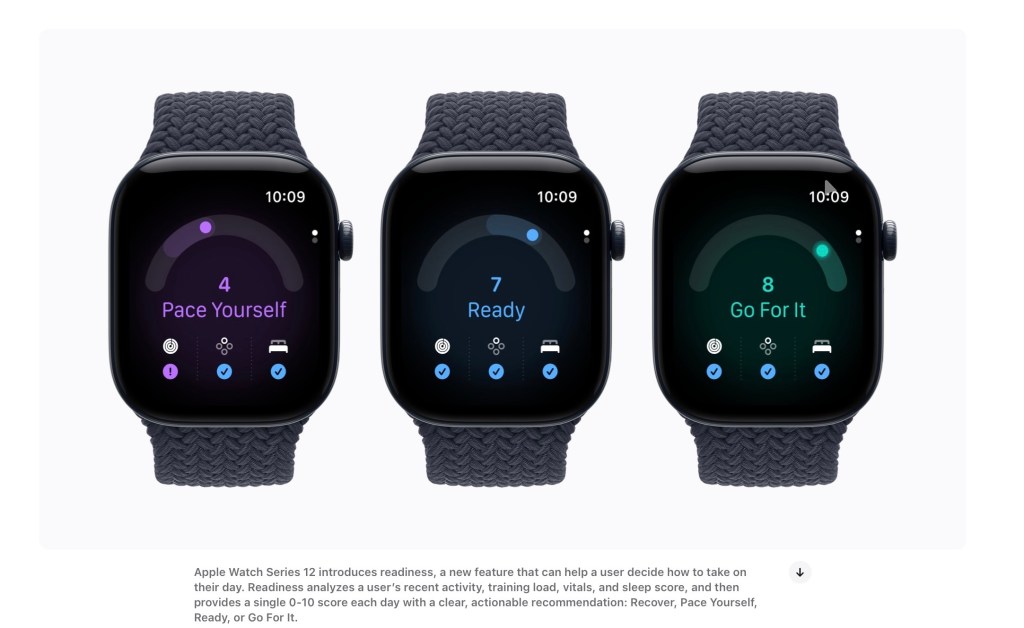
These continuous, more frequent, and (as Apple argues) more precise measurements are then funneled not only into health notification features (more on that soon, hopefully, as I have some research under review that is tackling those), but into “Readiness” scores that render one’s condition in “a single 0-10 score with a clear, actionable recommendation: Recover, Pace Yourself, Ready, or Go For It.” Apple is not the first company to explore “readiness scores;” Oura has been touting the readiness scores on their Rings for years. The new “Longevity” tab in the Health app “analyzes a user’s longitudinal health data for deeper insights, including Health Age,” which can compare your ‘health age’ to your ‘actual age.’ Apple has borrowed this logic from organizations like Northwestern Mutual, Avidon Health, the Heart Foundation, and the the NHS, which all have varying ways of predicting how healthy one’s body is for their age.
There is a lot to interpret and analyze about how “Readiness” is constructed, and indeed I may do that in another blog post. If you’d like to hear more of my thoughts on the construction of Readiness, let me know in a comment!
But I think I’ve gone on enough for today, so what’s one of the big takeaways from the announcement of Apple Watch’s Health Sensing System? Up to this point, the Watch’s notification systems have been largely responsive in their interpretations, indicating to users that something about their health data suggests patterns related to, say, atrial fibrillation or hypertension. Pivoting into the language of companioship and sensing is also a pivot into predictive logics of “readiness” and “longevity.”
Sensing is a gerund, after all, and the Health Sensing System is changing the tense of how Apple discusses the everyday work of their flagship wearable device. As the device enters the market, we should continue exploring how it tries to instantiate a particular logic around machine-based perception and algorithmic analysis, and how this form of “sensing” is expanding—not just refining—the way this little “companion” breaks bread with you over the way it digests your blood.
Metaphorically speaking. There is no evidence Apple Watches are vampiric.

