
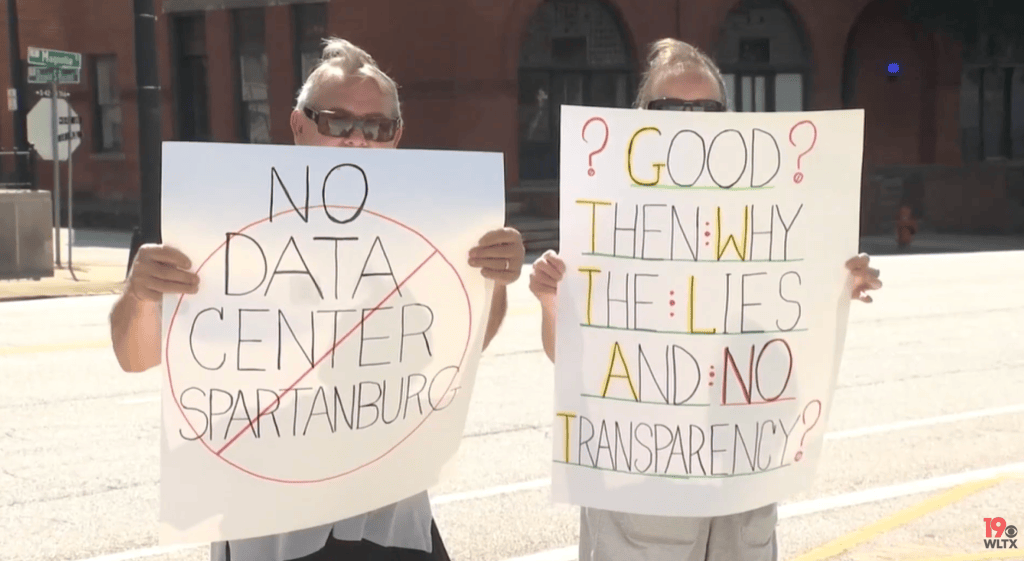
Image: Screengrab from “Spartanburg residents protest $3 billion data center over noise and pollution fears,” News 19 WLTX, YouTube, 19 July 2026, https://www.youtube.com/watch?v=13OjQXP4-yg
This week’s election has been extraordinary, and most of the discussion is rightly focusing on the generational pivots happening at the federal level and the governors level in the elections themselves. But amidst all the talk about this massive wave of changing patterns, there is an important policy discussion that represents another potential culmination of years of work in communities across the United States.
On Tuesday, 40 out of 41 proposed ballot measures placing some form of restriction on data centers passed around the country after considerable growth in local protests to data centers in communities around the country. Here in South Carolina, we saw protests against the Valara data center project in Spartanburg over the summer. Last month, Carroll County, KY residents went viral for playing the hum of their local data center throughout a fiscal court meeting. As Wired put it: “The results are in: Voters hate data centers.”
NBC shared data from an exit poll related to data centers: When asked, “Thinking about your vote for Congress, how important to you was AI data centers?” The responses indicate 23 percent called AI data centers “crucial,” 33 percent a “major factor,” and 13 percent “not a factor.” When asked if they would be in favor of the construction of a data center in their community, “24 percent of respondents were in favor (27 percent Democrat to 72 percent Republican) while 76 percent opposed (63 percent democrat to 35 percent Republican).” Earlier today, AP showed the results of a Voter Poll survey showing that 88% of Democrats, 61% of Republicans, and 80% of Independents. On Thursday, the stock market saw massive tumbles for a number of tech stocks, and Meta’s president directly said the results will make data centers harder to build. Where the Trump administration has embraced data center development as one of its domestic policies, many newly-elected Democratic Congresspersons campaigned at least in part on regulating the development of AI and its associated infrastructures.
There’s a lot to write about this, and it’s a story I aim to follow closely over the next years, but I am feeling very reflective about how this vote represents the culmination of at least 15 years of work from scholars, organizers, and activists to raise community awareness around the concerns of rampant data center development. So this is more of a personal reflection than it is anything else, though I hope to write more formally about this at some point over the next year.
When I first started writing about data centers in 2019 with my graduate student-turned-collaborator-turned-friend Bailey Troutman, “media infrastructures” were still a relatively niche subfield. We were far from the first people to write about data centers, but we became focused on Google’s Berkeley County data center (located near Charleston, SC). In our publication in the International Journal of Cultural Studies, Bailey and I suggested the need to focus on agri-culture, or the articulation between the land and our ways of life, and how data centers represented a specific problem trying to rearticulate land from communities and into corporate powers. Our research examined the debates around Google’s successful bid to extract water from an aquifer in the Lowcountry, to help cool its data center. We drew on local reporting from the Post and Courier, Google’s scientific self-studies, and local meeting reports to piece together a debate that was happening across the Charleston area. As reporter Bo Petersen put it, “Whoever gets the water decides the region’s future, its development and livability.”
As Google has continued to expand throughout South Carolina, these concerns have continued to be vocalized, with Google using its economic investments as a key frame to offset the potential concerns about natural resource extraction. In an article I published this year with my graduate student Kamila Eshalieva, we looked at Google’s Where the Internet Lives podcast, which presents itself as a piece of science education to teach listeners about how data centers work, but we argue is more a tool for insisting on their economic value for local communities and the need to keep building them to support the Internet.
I first came to infrastructure research through reading Nicole Starosielski’s 2015 book The Undersea Network, which examined the translatlantic cable system. I wrote more about infrastructures for my dissertation’s chapter on Walt Disney World, which became a chapter in my book, Bringers of Order on the datafication of Disney World. One of the things Starosielski discusses often is the idea of ‘negotiated visibility,’ that infrastructures are sort of meant to be out of the way. We might glimpse cell phone towers as we’re driving, but we rarely pay them any mind. Infrastructure becomes, quite literally, signal noise. Part of what this research does – and what my research on data centers so far has tried to do – is to de-naturalize infrastructure and ask us to pay attention to it and ask critical questions about its form and its function.
When I started teaching at Clemson, I would routinely include a week on “media infrastructures” and focus on underseas cables (South Carolina serves as a landing station for connecting North and South America) or data centers. Usually, students’ eyes would kind of glaze over during these lectures, despite all my best efforts to be excited about it and get conversation going. And I get it, on some level–looking at cables and cooling systems and wires and hard drives appears less exciting than studying social media influencers or something like that. But over the years, I have seen this shift happening where more students come in with an opinion about data centers, more of them are invested in learning about data center development in SC, and more of them want to know more about how cooling systems work, why they’re so controversial, and what data center development enables and disables.
To be clear, my own work in this area is meager compared to the most dedicated scholars and organizers working in this space. While I am proud of how I teach about these issues in my classes and of my own contributions to this research, what I’m pointing to is this: It’s remarkable that in an 8-year period, data centers have gone from being these odd curios that at most a few of my students seemed interested in to being an important issue in a midterm election that is driving community protests around the country, including here in South Carolina, a state where data center development was framed as economically necessary less than a decade ago.
In 2021, Blake Hallinan and I published a double issue of Cultural Studies on infrastructural politics. In our introduction, we laid out a concept called “infrastructural politics” that attempted to build on top of Raymond Williams and Gilles Deleuze simultaneously to demonstrate why Cultural Studies should care about infrastructure. As we suggested at the time, “the task of infrastructural politics…is to assess the urgency and efficacy of systematized relationships and to situate systems within a given conjuncture.” We framed the creation of infrastructures as the intentional construction of a relationship, and we saw current attempts to understand infrastructure as a response to untangling Deleuze’s societies of control. We offered Scale (the physical form of infrastructure), Formalization (the symbolic abstractions on which systems depend and the social arrangements they support), and Imaginary (the descriptive and normative, the what and the why) as three unifying concepts for Cultural Studies researchers to interrogate infrastructural politics.
One of the points we made about the Imaginary is that it is “the means through which different connections or even different worlds become possible.” While understanding Scale helps us understand the work of specific material infrastructures and how they create friction at local levels (how data center white noise disturbs residents and how they are blamed for rising energy costs) and Formalization helps us see those systems are presented and understood (see Google’s podcasting, for instance, or their self-studies on their infrastructure), Imaginary points towards not only how we think about infrastructures but also what is possible (a point we borrowed from Ruha Benjamin).
I’m at the point now where I’ve taught “Communication Infrastructures” as a graduate seminar twice, where I’ve included weeks on media infrastructures (with a focus on data centers) basically every semester for the last five years in my undergraduate Media Communication course, and where I’ve published multiple pieces with student co-authors about infrastructure. Part of what I try to impress with students is not just a need to de-naturalize those systems that seem to have been naturalized, but to understand that the growth of data centers is not assured and needs to be formally interrogated.
Again, I’m far from alone in saying this (please don’t mistake me as a representative of this entire subfield full of people who have done much more work than I have), but what we have seen over the last year in the United States, and what we saw on Tuesday, was a direct repudiation of the kind of Logic of Inevitability that companies like Google, Meta, and OpenAI use when they talk about data centers (“they’re going to get built, you might as well accept it”). This is what we mean when we talk about a changing Imaginary around infrastructural politics. It is the belief that a different conversation and a different logic can happen. Things are not inevitable. Infrastructures need not be taken-for-granted. The project of imagining otherwise is part of the project of politics, infrastructural or otherwise.
What we saw on Tuesday was one step in the ongoing enactment of that project.

