
by James N. Gilmore, Malaysia Barr, Eliza Moore, Marie Quaranta
Introduction: The Knowledge Predator
For this collaborative post, we performed a textual analysis of the first season of You during our Collaborative meetings over a three-week period. This idea sprang from a desire to work on refining textual analysis skills we’d started working on in our first series of the semester, on the politics of ‘apolitical’ television. Given the recent release of You’s third season, the show is something that was on all of our minds and something we’d discussed as a potentially exciting media text to analyze.
We started with a relatively straightforward question to guide our analysis: How does the first season of You represent the relationship between social media and surveillance?
After viewing just one episode, though, we realized this question was pretty limited and wasn’t accounting for the ways You represented the relationship between social media and surveillance as just one part of a larger discourse on identity management and the ways we try to construct and perform particular identities and ideologies online. Further, the focus on surveillance in-and-of-itself did not quite acknowledge how abuse and violence are core parts of the show, in particular how online performativity can become targeted by abusive men.
As we moved through the season, we came to see You as actually quite concerned with Michel Foucault’s conception of power/knowledge–that those who are in power are able to set conditions of knowledge. Likewise, people who aspire to have power over others use knowledge as a means to do so.
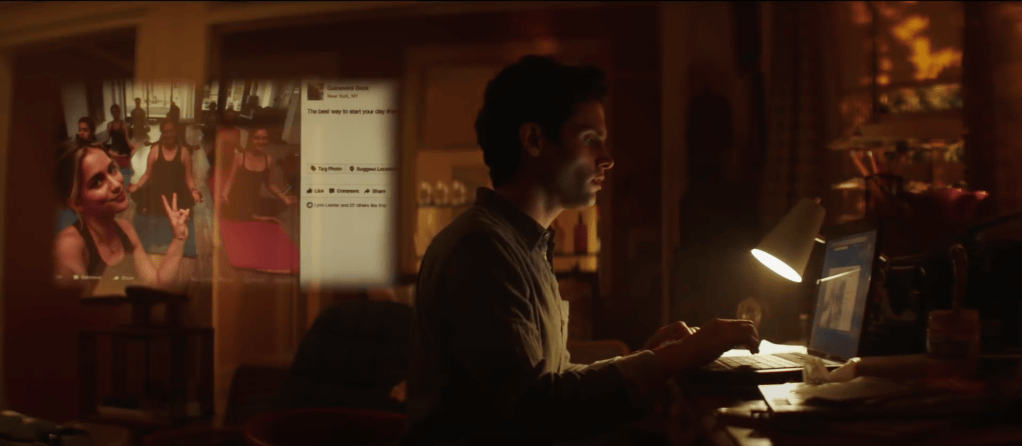
In You’s Pilot, bookshop manager Joe Goldberg meets and becomes infatuated with MFA student and aspiring writer Guenivere Beck. Joe believes immediately that he and Beck are destined to be together, and he sets out to learn everything he can about her, first through social media and then through progressively intimate stalking. He uses the information he gathers to insinuate himself into her life and perform as the person he believes she wants. Meanwhile, Beck also hides important parts of her personal life, using social media to carefully craft an understanding of her worldview and manipulate her way into particular social circles.
We came to define Joe as a knowledge predator. His stalking of Beck begins as a sort of pleasure, a particular form of voyeurism and scopophilia that comes not just from looking at her body but from knowing what she is doing and where she is at all times. In this way, Joe comes to embody a process of power/knowledge, a way of gaining power over Beck based on how he learns and uses knowledge about her everyday life.
Being a “knowledge predator” has, for Joe and for You, at least four distinct phases:
- Voyeurism: Learning about Beck is a pleasurable activity, which occasionally translates into sexual pleasure or fantastizing about Beck while viewing her. This is a game for Joe, where learning about someone doesn’t simply make him desire them more: the looking and the learning are themselves forms of pleasure.
- Control: Once Joe and Beck are dating, he uses the knowledge he’s learned to try and manipulate her. He buys the same books she has in her apartment, he acts similarly to men he’s watched her sleep with, and he works hard to cultivate a ‘perfect’ sense of himself. This is all meant to draw Beck further into Joe’s life, where he is able to more easily monitor her comings and goings. This is exemplified by Joe stealing Beck’s phone and using it to spy on her text messages and scheduled appointments, and in turn using what he’s learned to vary his performance.
- Abuse: This form of control, while Joe justifies it as a way of being romantic, eventually becomes abusive. Joe begins following Beck and becomes more forceful with her, leading her to break up with him for a time. Joe acts violently towards Beck’s friends, he stalks her therapist to find out if Beck is cheating on him, and he deploys other strategies meant to keep Beck’s world small and under his thumb. This is, again, largely played out along the axis of power/knowledge, where Joe understands the value of knowledge as a way to manipulate other people.
- Violence: Eventually, Beck figures out what Joe has been doing, and that he has murdered multiple people to keep her tied to him. Because Beck learns this knowledge, however accidentally, Joe kills her as she tries to flee.
In tracing this arc, we came to see You as a complex story about gendered violence, abuse, and identity management alongside its depictions of surveillance and stalking through digital technology. Our idea of a “knowledge predator” offers one way of examining how the relationship between knowledge and power manifest in regards to romantic relationships and digital technology. While perhaps a far cry from how Foucault developed the term out of his archaeology and genealogy of different institutions, using it as a through-line alongside questions of identity and performance as we analyzed You provided a useful prism for analyzinng how power/knowledge operates as a form of control and manipulation in interpersonal relationships.
While the remainder of this post focuses more on the themes of identity management and performance, the idea of the knowledge predator as a figure sitting at the intersections of power, knowledge, and control provides an underpinning to our textual analysis that situates You as a critical text which is actively questioning how knowledge about other people gets constructed and how this knowledge can get deployed for abusive and violent ends.
The analysis below focuses on six characters–three major and three minor–from the first season of You, and how they embody the theme of identity management: the conscious performances, both online and off, of how we communicate our personalities, desires, and histories. We tried to identify the characters within archetypes and overall themes of what they contribute to the show’s ideas, and selected relevant examples to explore these ideas. The sections here, patchwork though they are, point to how these characters are all bound up in complicated relationships built on how they choose to construct, perform, and manage their identities.
Identity management in You
Joe (The Narrator)
As season one of You unfolds, we are guided with the narration of main character Joe Goldberg, a voice of manipulation and obsession. From the outside Joe seems like a normal, nice guy. He works in a bookstore and is seemingly harmless in his interactions with other characters. But as Joe’s narration reveals his thoughts and intentions with Beck, we become aware of his uncontrollable obsessiveness.
We first see Joe’s obsessive nature in his desire for any form of knowledge of Beck. Whether it is collecting information from her social media or stalking her outside of her apartment, ultimately Joe is a predator. Joe not only preys on Beck’s information, data, and location, but he also preys on her identity. He uses this information to make assumptions about Beck and craft a story in his mind for who he thinks she is. This obsessiveness consumes his thoughts as he convinces himself that anyone that holds a piece of Beck’s identity is a threat, leading him to acts of violence. His violence begins as his “way of protecting Beck”, leading him to murder first Benji (her boyfriend), then Peach (her best friend), and eventually Beck herself. While his murder of Beck is obviously not out of intentions to protect her, it expresses Joe’s spiral when he longer can hold any sense of control over her. His spiral of obsessiveness leads to an outburst of violence, showcasing his inability to deal with anything outside the realm of his control.
Joe as the narrator also reveals that he is manipulative. He manipulates situations and information to make himself appear as a necessary “savior” in Beck’s life. While he manipulates Beck and her surroundings, his narration exposes he even manipulates his own thoughts to convince himself he is doing acts of “good” for Beck. This is seen when Joe assaults Beck’s friend Peach while she is runs in the park. In voiceover, he narrates to himself his need to get rid of Peach because of her “threat” to Beck saying “it’s brave what I would do for you” to later convincing himself that he isn’t violent saying “I would never do this I would never hurt a woman”. Joe is driven by control to a point where he can manipulate his own thoughts. His need for control leads him to a need for knowledge, eventually leading him to violent acts, resulting in Bec’s downfall with many others as collateral damage.
While Joe Goldberg may appear and present himself as an “ordinary” guy, viewers are brought into his true intentions through his narration: control. Joe as the narrator allows viewers to receive insight of his predatory nature while outside characters receive no warnings to his surprising acts of violence. This dramatic irony allows us to consider how Joe constructs himself to other characters on the show and understand how this builds his concluding act of violence: the murder of the one he wanted so desperately to protect.
Beck (The Writer)
Beck has two facets within You. On the one hand, there is the narrative she creates for those around her where she is working as her own author and storyteller. On the other hand, from Joe’s perspective and narration, she is a metaphorical book he is trying to understand internally and repair externally. Joe talks about books as things of ‘value,’ and he repeatedly positions Beck alongside and in relation to books, as an object that needs tending and care. Neither the narrative she creates about herself, nor what Joe assumes of her are accurate depictions of the true Guinevere Beck. It seems the ‘real’ Beck has been lost in translation so many times that it is nearly impossible to access her truth.
Let’s begin with the image Beck creates of herself. Based on her social media, Beck is an untroubled, unworried, at peace, and a witty individual who lives a perfectly balanced life in the big city. On social media the only time Beck’s life is a mess is in a cute way, which does not properly reflect her true physical and emotional stress. She is struggling to make ends meet, feels out of place with her friends, and lacks confidence in her writing. To her followers, the image she creates through Instagram and Twitter gives her some kind of reassurance that on the outside she seems fine even if she is struggling on the inside.
The image Beck creates with her friends and the people physically around her adds another dimension to the narrative Beck writes for herself. She spends money she doesn’t have to keep up with her high society friends, who in reality have little in common with her. To them, her intelligence and creativity as a writer gives her a unique value they lack in their own life, but unbeknownst to them writing is her greatest struggle. The most egregious discrepancy from the life Beck creates for herself and the deeply hidden reality is the story of her father. Everyone is under the impression that Beck’s dad died from an overdose when she was a kid, when in reality he survived and started over with a new family. She has even blocked him on social media, writing him out of her digital identity altogether.
When Joe first sees Beck she is like a pretty book cover that he uses to make assumptions about the material on the inside. Upon further investigation, she is far more complicated and filled with plot twists that he could never expect, which leaves him enthralled in her story and desperate to fix and protect the outer image, just as he is shown repairing rare books throughout the course of the season. From Joe’s perspective, Beck is an object, one of his rare book editions, a love that is fragile and unique and must be protected. However, Beck is not a book, even if she ends up that way after being trapped in Joe’s cage. Even though Joe thinks he knows her, he only knows the story she has told him and the picture she allows him to see. Which leaves Joe content to close her chapter in his book when the story goes awry.
Peach (The Repressed)
As Joe fights to narrate his story and Beck desires to put her own story into words, there is much to be said aboutPeach Salinger. As one of Beck’s closest friends, she played a major role when it came to how Joe fit her into the narrative he was creating for himself about Beck. At first glance, it seems as though Peach is a typical rich, snooty, and mean friend. In later episodes, however, it is revealed that Peach is gay and has an obsessive crush on Beck. We see this in episode five, as Joe is stalking Peach’s everyday routine. He manages to swipe her bag and finds a racy photo of Beck inside her journal (19:06-20:44). Scenes later, Joe hacks into Peach’s laptop and finds even more intimate photos of Beck (27:02-27:56).
This revelation changes Peach’s representation considerably. Instead of viewing her as a character straight from Mean Girls, she is positioned as someone who is in conflict with who she really is. Until her death, Peach portrayed herself as put-together and well-off, both financially and socially.. But underneath the surface level, she was actually repressed and closeted, afraid to live her truth because of pressures she felt from her family to live a particular identity. Because Peach’s family would not be accepting of her sexuality, she locked that part of her away. Instead what manifested in its place was a manipulative and controlling person, specifically within her friendship to Beck.
We see this in episode five, when Beck tells her that she is getting connected with a literary agent. Instead of rejoicing for her friend, Peach takes it into her hands to remove the agent that her school has given her and instead connects her with someone she knows. She then tells Joe (18:39-18:41), “She’s lucky she has me. Beck rarely knows what’s best for her.” In saying this, Peach unknowingly identifies with her enemy- Joe. Both feel that they know what is best for Beck and can control her. However, Beck differs greatly from Joe because while Joe manipulates and controls Beck’s life in a private, sneaky manner- Peach does this openly to prove that she is the alpha female in Beck’s life.
This controlling narrative increases after she gets attacked in the park by Joe. After the incident, Peach attempts to isolate Beck and takes her to her family’s estate in Connecticut. While Peach claims she needs to recuperate from her attack, her plan is really to woo Beck into going to Paris with her. Yet- just like her sexuality- she represses her actual plan by buying Beck nice things and attempting to get her drunk and high. When she and Beck kiss in episode six, it causes Beck to leave the room and reject Peach’s advances.
When the morning comes and Beck confronts her about her sexuality, Peach then decides to return to her default setting: repress her true feelings and act out of meanness. This repression is what leads her to her downfall: Joe tries to manipulate Peach based on the knowledge he’s gained about her. After they both wrestle over a gun, Joe kills Peach, removing another perceived ‘threat’ from his relationship to Beck.
Annika (The Influencer)
One of Beck’s other friends, Annika, is represented as a body-positive social media influencer who has multiple brand partnerships and a large following. The job of influencer is a new one that came to life in the age of the internet and social networking. Annika was able to transform herself and her story through social media influence. Annika no longer had to be just Peach’s ‘overweight’ sidekick but instead created a following of her own as a body positive influencer. Her status as an influencer gave her a newfound power in her dynamic with Peach. Her social media following, even while most were anonymous strangers, gave her a sense of reassurance for her crafted persona that was lacking in her everyday life.
On social media, Annika had carefully crafted herself to demonstrate confidence, positivity, and perseverance. Annika created her posts to seem carefree and natural, yet based on what we see of her behind the scenes, Annika is far from the image she creates. Peach still has the power to tear Annika’s confidence down when they are in person. Annika is far more hesitant to respond and maintain her strength when the approval of thousands is not echoing around her.
The most pivotal moment in Annika’s storyline is when she posts an unflattering picture with Peach, all under Joe’s suggestion and manipulation, with the caption “Bitches being our most authentic selves.” In response to this, an anonymous account, clearly presumed to be Peach’s retaliation, responds with a video of Annika making a racist statement about black men and white men responding to her curvaceous figure. Peach was able to destroy Annika with the very thing that once gave her happiness and power. The storyline demonstrates the fragility of a false–or, at least, highly constructed–identity and the fickleness of a social media following. The image one creates for themselves, as Annika did using social media, may take ages to develop and properly curate, but can all be destroyed with one inconsistency or mistake.
Candace (The Ghost)
Joe Goldberg’s ex-girlfriend Candace certainly plays a role in revealing his identity as a manipulative predator, as she becomes “the ghost” for Joe throughout eason one. While Candace appears primarily in Joe’s flashbacks and hallucinations, it is evident she is Joe’s “ghost” because the essence of her is constantly haunting his mind, only pushing him closer to his obsession with Beck.
It is clear Joe is filled with desire and control. While Candace may have not been physically present, she certainly held a form of control over Joe, as he is unable to erase her from his mind. This only drives him further in pursuance of control over Beck, using Beck to fill a void left by Candace. Joe often sees Beck and imagines Candace. He sees Candace, but is constantly reminding himself that Beck isn’t like her, while Candace is still very evidently on his mind. Several scenes throughout the season show Joe looking at Beck and seeing Candace. While Candace may be “the ghost” of the season, Beck’s curiosity about what happened to her led to Beck discovering Joe’s violent actions becoming his prisoner.
In the final episodes of season one, Beck decides to research what really happened with Candace. When she cannot get a clear answer, Beck becomes increasingly suspicious of Joe and begins investigating him, ultimately finding several of Joe’s horde of stolen items (including some of Beck’s underwear and some unidentified human teeth) . While Candace had no true physical presence for almost the entirety of the show, her role as “the ghost” is vital in driving both Joe and Beck into spirals for information.
Karen (The Detox)
As Candance is the ghost, Karen Minty might be considered “the detox”. Karen is a friend of Claudia, Joe’s neighbor. She becomes Joe’s “rebound” girl after he and Beck break up. Karen can be positioned as ‘the detox’ for several reasons. The first reason is that she literally helped Claudia detox from drugs in the eighth episode. As a nurse, Karen is trained on how to help sick people. So when Claudia was detoxing from drugs, she took great efforts to help her friend come back to her normal self. Karen also helps Claudia when it comes to her relationship with Ron. Ron is abusive to Claudia, and has never been great to her son Paco. In an attempt to keep him away at one point, Karen chases Ron with a baseball bat. Although Claudia goes back to Ron, she does successfully kick her drug habit with help from Karen.
As she helps Paco and Claudia, Karen is also unknowingly helping Joe out of his addiction to Beck. Although Karen serves as the rebound girl, Joe is purposefully using her to attempt to get over his obsessive love towards Beck. Joe sees Karen as good for him, because he believes that she will help him break his obsessions with Beck. Despite this, he still points out her flaws (like her use of the word “babe” and the things she watches on television). Even in him seeing her flaws, Joe desires not to hurt her at all. Even when he cheats on her with Beck, Joe still feels that Karen is too good. For Joe, she served as a failed detox because he ends up dumping her to go back to Beck. This matters because it shows viewers that Joe’s obsessive tendencies are compulsive and no matter what he does, he cannot stop them. This reaffirms Joe as a predator and shows that he cannot operate in a normal way, even in his failed relationship with Karen.
Joe and Karen’s relationship ends, but not without Karen serving as an attempted detox for Beck. At the very end of the eighth episode, Karen purposefully runs into Beck. She tells her, “Just be careful” (43:29). This is her attempt to warn Beck about Joe’s suspicious behavior and obsessive tendencies. Karen is completely unaware of the fact that Joe has killed, but she knows that something is off as she mentions Candance in her encounter with Beck. Despite Beck being the one who cheated on Joe while he was with her, Karen still seeks to do good to her- as a good detox should.
Karen may have a small role, but her role as the detox is important as she works to help people- even though Joe rejects her in favor of embracing his addiction to Beck.
Conclusion: Image creation as a violent act
Taking together this arc of the knowledge predator as well as the six different ways we analyzed identity management and different archetypes in the show’s first season, we found ourselves returning again and again to the underlying theme of self-creation, or how we try to create narratives for ourselves. On You, characters’ attempts to fashion their own image only leads to violence. While dramatic for the sake of producing a thriller and suspense show, the writing on You is not particularly kind to the many ways people try to perform, narrate, and shape their senses of who they are publicly.
This is perhaps a reaction to the increasing reality that private life is lived on public spheres of all sorts, and lives can be peered into through a variety of screens, from Beck’s enormous open apartment windows to the cracked screen of her smartphone. These screens, which are omnipresent in You and also include the clear plastic of Joe’s rare book preservation center/human prisoner cage, indicate some of the ways these characters are trapped. They all try to wear masks of various sorts, but these masks are all shown to be untenable, impossible to keep on for too long a time.
Finally, we reflected on what we gained through doing such a lengthy textual analysis of a single season. All of us agreed that going episode by episode allowed for a more careful understanding of character behavior and relationships, the ability to track themes and ideas, and a revealing of different symbols that emerged. We were able to track, for instance, a mallet that Joe uses to repair books, assemble a bed for Beck, murder Benji, and break Beck’s phone after taking her captive. We were able to note how window screens were used as sites of surveillance. We were able to untangle how Joe constantly revises his own narrative, how Beck manipulates information, and how technology moves in and out of the main narrative.
Most importantly, though, this kind of collaborative writing allowed us to brainstorm freely and build off each other’s contributions in conversation. This post only represents a small handful of the ideas we discussed and sequences we analyzed over the course of three weeks. The value of collaborative textual analysis, at its core, seemed to be the ability to map complexities within the show, and use each other’s vantage points to add greater dimensionality to the map of meaning.

