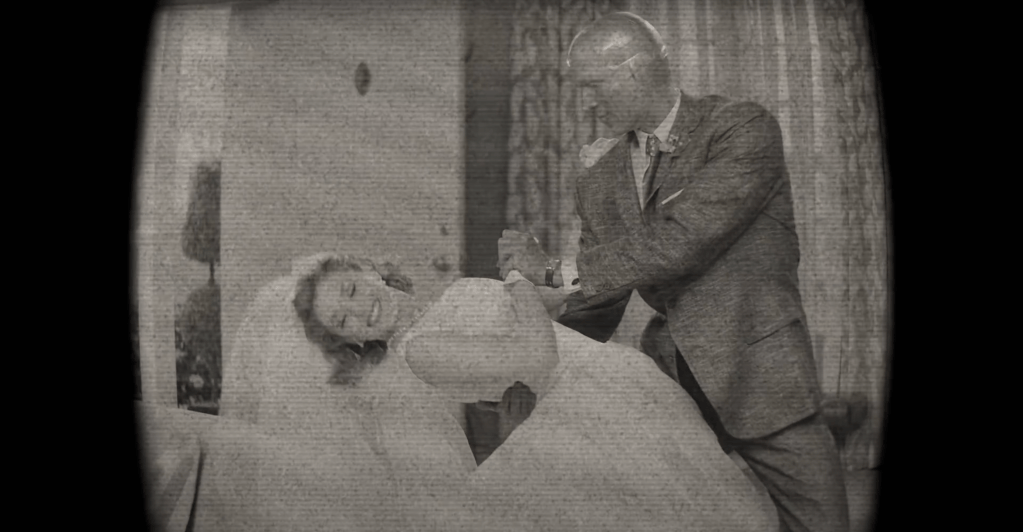
Wanda imagines a world based on conventional gender roles. Still from WandaVision.
In WandaVision, Wanda Maximoff is exhibiting very human maladaptive coping behaviors in the face of grief. In previous Marvel productions, the audience learns that Wanda has experienced an unfathomable amount of loss. With her introduction to the Marvel universe comes the knowledge that her parents had died in a bombing of her home country. In the Age of Ultron Avengers movie, Wanda’s fraternal twin brother, Pietro, is killed in battle. Finally, in Avengers: Infinity War, Wanda watches as her beloved Vision is demolished by Thanos in his pursuit for the infinity stone attached to Vision. In the wake of these traumatic losses, Wanda is forced to confront her pain as she tries to figure out how to navigate a world that has been so cruel to her.
Trauma is, by one definition, an event outside the range of the human experience. By curating a world without trauma in WandaVision, Wanda is harnessing her superhuman powers in an attempt to control things that are normally beyond human control. For Wanda, a griefless world looks like television. In her younger days, Wanda learned about American culture and life by watching television shows like The Dick Van Dyke Show and The Brady Bunch. The world that Wanda creates in Westview, New Jersey is a projection of what she has seen and learned from these and different traditional American television shows. As a result, Wanda’s vision of a “perfect” world looks like one with traditional gender roles as an embodiment of a happy family and social life.
In older sitcom shows, gender roles are both prominent and clear cut. Typically, the men are portrayed as helpless breadwinners who prioritize things like beer and sports while the women are portrayed as too smart to be stuck in their housewife and motherly duties. In Episode 1: “Filmed Before a Live Studio Audience,” Wanda and Vision assume these very traditional gender roles in their efforts to entertain Vision’s boss and his wife for dinner. The episode is shot in a “classic sitcom three-camera soundstage setup” (Vulture). Wanda and Vision interact in a slightly awkward, intentionally stiff way throughout the episode, something that is very similar to sitcoms like Bewitched. Wanda assumes the traditional role of “housewife” as she brainstorms ways to satisfy Vision on their upcoming anniversary and, as the episode progresses, scrambles to prepare the food for dinner in an I Love Lucy style. Vision, on the other hand, assumes the traditional role of the husband who provides for the family by working a desk job. Although Wanda and Vision both assume these very traditional roles, they simultaneously poke fun at many of the sexist conventions of the time. By doing so, WandaVision both masters the concept of a traditional sitcom and calls out the sexism that existed in the shows that Wanda used to learn about American life.
In Episode 8: “Previously On,” WandaVision slightly steers away from the sitcom archetypes and style to dive deeper into Wanda’s traumatic past. In an effort to learn about the origin of her powers, Wanda’s co-character Agnes forces her to confront her grief and the reality of what she has experienced. Agnes walks Wanda through memories of Sokovia and her family, the HYDRA base where Wanda was kept as she developed her powers to help the Nazi-adjacent, her relationship with Vision, and eventually reveals the truth of her curation of Westview. This episode demonstrates a key idea: grief is inescapable. Even Wanda, someone with otherworldly powers, is incapable of escaping her grief and trauma for good. Wanda’s creation of Westview and, as the audience later learns, the version of Vision living there with her demonstrates the extent that people will go to seek remedy in the face of trauma.
On its surface, WandaVision is a show based on familiar, traditional sitcoms and the life of a grieving Avenger. However, the sitcom acts as a veil for the show’s depiction of some very complex feelings: denial, anger, depression, loneliness, struggle, and, in the end, a form of acceptance. For Wanda, escaping grief means living out her life as a character on a sitcom. However, the show eventually reveals that this escape is not possible; Wanda has to shut down her sitcom and curated reality and come to terms with her trauma. Although not everyone has the power to curate their own worlds in the face of grief, Wanda is demonstrating what it means to be human and to process the pain we feel.
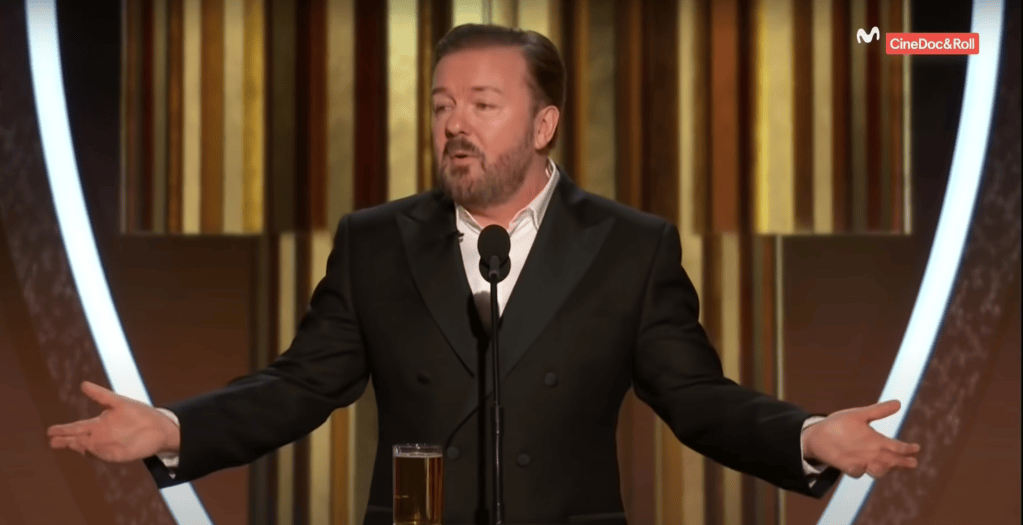
Ricky Gervais has been a favorite Golden Globes host since his debut in 2010. He is known for his unfiltered jabs at celebrities and members of the Hollywood Foreign Press Association (the non-profit organization composed of around ninety photographers and journalists who vote for the awards). While most of Gervais’ jokes can be written off as “distasteful” to some and “wickedly funny” to others, they have progressed over the years from harmless roasts to full-on critiques of the Hollywood Foreign Press (HFPA). Gervais’ earlier consecutive hosting years (2010, 2011, and 2012) tread lightly around the association he represents. The host made cracks about mostly himself, Mel Gibson, other individual celebrities, and limited his jabs at the Globes to individual lines. For instance, Gervais quipped that “One thing that can’t be bought is a Golden Globe…officially.” He included some off-color remarks about the Globes and even hinted that the President of the HFPA warned him about going too far. Gervais constantly repeated “I’m not doing this again,” so he always found a way to push the envelope despite claiming that he didn’t care. His performative passiveness didn’t stop him from critiquing the organization and Hollywood in later years. In 2016, Gervais kept pushing the envelope further.”[The Golden Globe] award is, no offense, worthless.” Four years later, in 2020, he pushed harder. He reminded people that he does not give a shit about how people react to him or his critique. In the last two hosting gigs, Gervais increasingly highlighted serious Hollywood issues, including the lack of representation in film, female pay, celebrity hypocrisy, and the acceptance of bribes by various show producers.
Gervais delivering his opening monologue at the 2020 Golden Globes. Image taken from Youtube.
It is increasingly evident that Ricky Gervais, and possibly the audience who loves him, doesn’t care about the Golden Globes anymore and are fully aware of the issues within the organization. There is little to no talk on social media about the Golden Globes or the lack of a 2022 show. The Globes didn’t matter this year. According to Gervais, they only mean anything to the stars themselves. The same stars he called hypocrites for coming to the show in limos. That being said, even some celebrities don’t think the Golden Globes matter anymore. The 2022 winners barely addressed that they won after being announced on Twitter. The Golden Globes, and the war against them, offer us two questions we should be asking ourselves. What makes The Golden Globes matter (if they ever did)? If we don’t care anymore about awards shows or the sanctity of the HFPA, should we care about representation and integrity within the organization?
Maybe it’s better to ask whether or not the Golden Globes matter to us? Do they matter to the HFPA? Yes. Do they matter to directors, actors, and other moviemakers? Maybe. Do they matter to the public? That’s unclear. If you ask some of my colleagues in Clemson’s World Cinema department, they love award season. However, most of America seems to be opting out of watching the awards shows, and many are saying that the entire award industry is dying. Whether or not you watch these shows or check the winners the following day, does it actually affect the movies you watch? You may watch a film because it won something. More than likely, if you are like me, you go to your friends, family, or streaming services for movie recommendations, not the Oscar or Golden Globe website. Furthermore, Gervais has been a hosted five times and is a favoritebecause he does nothing but make fun of the entire show. So for those who had been watching the shows, did they watch because they cared about the awards or because they liked to listen to someone make fun of them? There are people out there who care and people who don’t, but if there is to be a reform in the Golden Globes, any award system for that matter, organizations need to determine what people are paying attention to.
Leading into my second point, if award shows don’t matter to the people, do we care if they make a reform? The HFPA announced that it added members to its party who were people of color and changed some of their bylaws. They also announced their first Chief Diversity, Neil Phillips. NBC even responded by saying they would possibly air the Golden Globes in 2023. Will that change the outcome of their 2023 audience? Who knows. It might not even be worth their time. Gervais has been increasingly making fun of the corruption since 2010. It took ten years for NBC to call out the Golden Globes, and by the time they did, no one missed the show. If people no longer look to awards shows to see who the best actor or actress is or what to add to their watchlist, we probably need to look elsewhere for Hollywood reform. The lack of representation of people of color is not exclusive to the Golden Globes. The Oscars, studios, budgets, talent, and every piece of the entertainment industry lacks people of color and women. However, there is an improvement, and we are slowly getting a more diverse industry.
I don’t doubt that Ricky Gervais and NBC calling out the Golden Globes isn’t necessary, but maybe we should hold every aspect of Hollywood as accountable as they held the Golden Globes. Perhaps the Golden Globes and its critics are the first steps to a more progressive system.
by James N. Gilmore, Malaysia Barr, Eliza Moore, Marie Quaranta
Joe Goldberg as ‘knowledge predator,’ stalking Beck’s managed public identity in You
Introduction: The Knowledge Predator
For this collaborative post, we performed a textual analysis of the first season of You during our Collaborative meetings over a three-week period. This idea sprang from a desire to work on refining textual analysis skills we’d started working on in our first series of the semester, on the politics of ‘apolitical’ television. Given the recent release of You’s third season, the show is something that was on all of our minds and something we’d discussed as a potentially exciting media text to analyze.
We started with a relatively straightforward question to guide our analysis: How does the first season of You represent the relationship between social media and surveillance?
After viewing just one episode, though, we realized this question was pretty limited and wasn’t accounting for the ways You represented the relationship between social media and surveillance as just one part of a larger discourse on identity management and the ways we try to construct and perform particular identities and ideologies online. Further, the focus on surveillance in-and-of-itself did not quite acknowledge how abuse and violence are core parts of the show, in particular how online performativity can become targeted by abusive men.
As we moved through the season, we came to see You as actually quite concerned with Michel Foucault’s conception of power/knowledge–that those who are in power are able to set conditions of knowledge. Likewise, people who aspire to have power over others use knowledge as a means to do so.
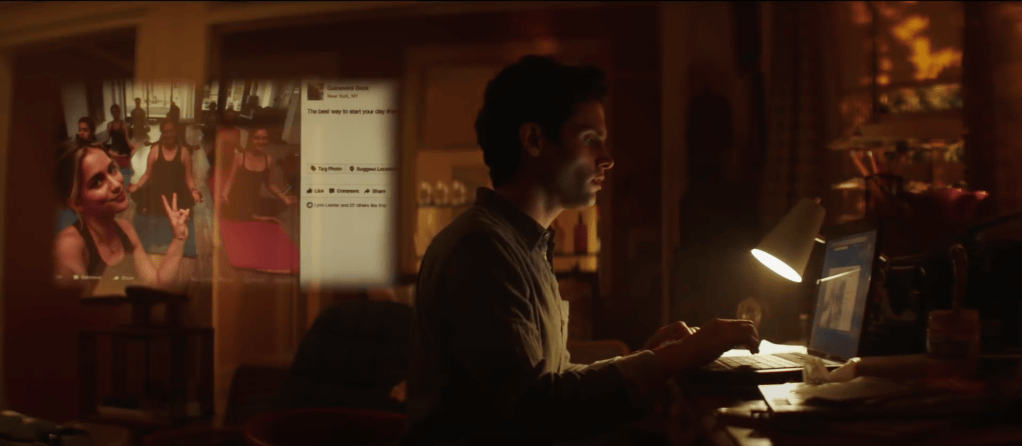
In You’s Pilot, bookshop manager Joe Goldberg meets and becomes infatuated with MFA student and aspiring writer Guenivere Beck. Joe believes immediately that he and Beck are destined to be together, and he sets out to learn everything he can about her, first through social media and then through progressively intimate stalking. He uses the information he gathers to insinuate himself into her life and perform as the person he believes she wants. Meanwhile, Beck also hides important parts of her personal life, using social media to carefully craft an understanding of her worldview and manipulate her way into particular social circles.
We came to define Joe as a knowledge predator. His stalking of Beck begins as a sort of pleasure, a particular form of voyeurism and scopophilia that comes not just from looking at her body but from knowing what she is doing and where she is at all times. In this way, Joe comes to embody a process of power/knowledge, a way of gaining power over Beck based on how he learns and uses knowledge about her everyday life.
Being a “knowledge predator” has, for Joe and for You, at least four distinct phases:
Voyeurism: Learning about Beck is a pleasurable activity, which occasionally translates into sexual pleasure or fantastizing about Beck while viewing her. This is a game for Joe, where learning about someone doesn’t simply make him desire them more: the looking and the learning are themselves forms of pleasure.
Control: Once Joe and Beck are dating, he uses the knowledge he’s learned to try and manipulate her. He buys the same books she has in her apartment, he acts similarly to men he’s watched her sleep with, and he works hard to cultivate a ‘perfect’ sense of himself. This is all meant to draw Beck further into Joe’s life, where he is able to more easily monitor her comings and goings. This is exemplified by Joe stealing Beck’s phone and using it to spy on her text messages and scheduled appointments, and in turn using what he’s learned to vary his performance.
Abuse: This form of control, while Joe justifies it as a way of being romantic, eventually becomes abusive. Joe begins following Beck and becomes more forceful with her, leading her to break up with him for a time. Joe acts violently towards Beck’s friends, he stalks her therapist to find out if Beck is cheating on him, and he deploys other strategies meant to keep Beck’s world small and under his thumb. This is, again, largely played out along the axis of power/knowledge, where Joe understands the value of knowledge as a way to manipulate other people.
Violence: Eventually, Beck figures out what Joe has been doing, and that he has murdered multiple people to keep her tied to him. Because Beck learns this knowledge, however accidentally, Joe kills her as she tries to flee.
In tracing this arc, we came to see You as a complex story about gendered violence, abuse, and identity management alongside its depictions of surveillance and stalking through digital technology. Our idea of a “knowledge predator” offers one way of examining how the relationship between knowledge and power manifest in regards to romantic relationships and digital technology. While perhaps a far cry from how Foucault developed the term out of his archaeology and genealogy of different institutions, using it as a through-line alongside questions of identity and performance as we analyzed You provided a useful prism for analyzinng how power/knowledge operates as a form of control and manipulation in interpersonal relationships.
While the remainder of this post focuses more on the themes of identity management and performance, the idea of the knowledge predator as a figure sitting at the intersections of power, knowledge, and control provides an underpinning to our textual analysis that situates You as a critical text which is actively questioning how knowledge about other people gets constructed and how this knowledge can get deployed for abusive and violent ends.
The analysis below focuses on six characters–three major and three minor–from the first season of You, and how they embody the theme of identity management: the conscious performances, both online and off, of how we communicate our personalities, desires, and histories. We tried to identify the characters within archetypes and overall themes of what they contribute to the show’s ideas, and selected relevant examples to explore these ideas. The sections here, patchwork though they are, point to how these characters are all bound up in complicated relationships built on how they choose to construct, perform, and manage their identities.
Identity management in You
Joe (The Narrator)
As season one of You unfolds, we are guided with the narration of main character Joe Goldberg, a voice of manipulation and obsession. From the outside Joe seems like a normal, nice guy. He works in a bookstore and is seemingly harmless in his interactions with other characters. But as Joe’s narration reveals his thoughts and intentions with Beck, we become aware of his uncontrollable obsessiveness.
We first see Joe’s obsessive nature in his desire for any form of knowledge of Beck. Whether it is collecting information from her social media or stalking her outside of her apartment, ultimately Joe is a predator. Joe not only preys on Beck’s information, data, and location, but he also preys on her identity. He uses this information to make assumptions about Beck and craft a story in his mind for who he thinks she is. This obsessiveness consumes his thoughts as he convinces himself that anyone that holds a piece of Beck’s identity is a threat, leading him to acts of violence. His violence begins as his “way of protecting Beck”, leading him to murder first Benji (her boyfriend), then Peach (her best friend), and eventually Beck herself. While his murder of Beck is obviously not out of intentions to protect her, it expresses Joe’s spiral when he longer can hold any sense of control over her. His spiral of obsessiveness leads to an outburst of violence, showcasing his inability to deal with anything outside the realm of his control.
Joe as the narrator also reveals that he is manipulative. He manipulates situations and information to make himself appear as a necessary “savior” in Beck’s life. While he manipulates Beck and her surroundings, his narration exposes he even manipulates his own thoughts to convince himself he is doing acts of “good” for Beck. This is seen when Joe assaults Beck’s friend Peach while she is runs in the park. In voiceover, he narrates to himself his need to get rid of Peach because of her “threat” to Beck saying “it’s brave what I would do for you” to later convincing himself that he isn’t violent saying “I would never do this I would never hurt a woman”. Joe is driven by control to a point where he can manipulate his own thoughts. His need for control leads him to a need for knowledge, eventually leading him to violent acts, resulting in Bec’s downfall with many others as collateral damage.
While Joe Goldberg may appear and present himself as an “ordinary” guy, viewers are brought into his true intentions through his narration: control. Joe as the narrator allows viewers to receive insight of his predatory nature while outside characters receive no warnings to his surprising acts of violence. This dramatic irony allows us to consider how Joe constructs himself to other characters on the show and understand how this builds his concluding act of violence: the murder of the one he wanted so desperately to protect.
Beck (The Writer)
Beck has two facets within You. On the one hand, there is the narrative she creates for those around her where she is working as her own author and storyteller. On the other hand, from Joe’s perspective and narration, she is a metaphorical book he is trying to understand internally and repair externally. Joe talks about books as things of ‘value,’ and he repeatedly positions Beck alongside and in relation to books, as an object that needs tending and care. Neither the narrative she creates about herself, nor what Joe assumes of her are accurate depictions of the true Guinevere Beck. It seems the ‘real’ Beck has been lost in translation so many times that it is nearly impossible to access her truth.
Let’s begin with the image Beck creates of herself. Based on her social media, Beck is an untroubled, unworried, at peace, and a witty individual who lives a perfectly balanced life in the big city. On social media the only time Beck’s life is a mess is in a cute way, which does not properly reflect her true physical and emotional stress. She is struggling to make ends meet, feels out of place with her friends, and lacks confidence in her writing. To her followers, the image she creates through Instagram and Twitter gives her some kind of reassurance that on the outside she seems fine even if she is struggling on the inside.
The image Beck creates with her friends and the people physically around her adds another dimension to the narrative Beck writes for herself. She spends money she doesn’t have to keep up with her high society friends, who in reality have little in common with her. To them, her intelligence and creativity as a writer gives her a unique value they lack in their own life, but unbeknownst to them writing is her greatest struggle. The most egregious discrepancy from the life Beck creates for herself and the deeply hidden reality is the story of her father. Everyone is under the impression that Beck’s dad died from an overdose when she was a kid, when in reality he survived and started over with a new family. She has even blocked him on social media, writing him out of her digital identity altogether.
When Joe first sees Beck she is like a pretty book cover that he uses to make assumptions about the material on the inside. Upon further investigation, she is far more complicated and filled with plot twists that he could never expect, which leaves him enthralled in her story and desperate to fix and protect the outer image, just as he is shown repairing rare books throughout the course of the season. From Joe’s perspective, Beck is an object, one of his rare book editions, a love that is fragile and unique and must be protected. However, Beck is not a book, even if she ends up that way after being trapped in Joe’s cage. Even though Joe thinks he knows her, he only knows the story she has told him and the picture she allows him to see. Which leaves Joe content to close her chapter in his book when the story goes awry.
Peach (The Repressed)
As Joe fights to narrate his story and Beck desires to put her own story into words, there is much to be said aboutPeach Salinger. As one of Beck’s closest friends, she played a major role when it came to how Joe fit her into the narrative he was creating for himself about Beck. At first glance, it seems as though Peach is a typical rich, snooty, and mean friend. In later episodes, however, it is revealed that Peach is gay and has an obsessive crush on Beck. We see this in episode five, as Joe is stalking Peach’s everyday routine. He manages to swipe her bag and finds a racy photo of Beck inside her journal (19:06-20:44). Scenes later, Joe hacks into Peach’s laptop and finds even more intimate photos of Beck (27:02-27:56).
This revelation changes Peach’s representation considerably. Instead of viewing her as a character straight from Mean Girls, she is positioned as someone who is in conflict with who she really is. Until her death, Peach portrayed herself as put-together and well-off, both financially and socially.. But underneath the surface level, she was actually repressed and closeted, afraid to live her truth because of pressures she felt from her family to live a particular identity. Because Peach’s family would not be accepting of her sexuality, she locked that part of her away. Instead what manifested in its place was a manipulative and controlling person, specifically within her friendship to Beck.
We see this in episode five, when Beck tells her that she is getting connected with a literary agent. Instead of rejoicing for her friend, Peach takes it into her hands to remove the agent that her school has given her and instead connects her with someone she knows. She then tells Joe (18:39-18:41), “She’s lucky she has me. Beck rarely knows what’s best for her.” In saying this, Peach unknowingly identifies with her enemy- Joe. Both feel that they know what is best for Beck and can control her. However, Beck differs greatly from Joe because while Joe manipulates and controls Beck’s life in a private, sneaky manner- Peach does this openly to prove that she is the alpha female in Beck’s life.
This controlling narrative increases after she gets attacked in the park by Joe. After the incident, Peach attempts to isolate Beck and takes her to her family’s estate in Connecticut. While Peach claims she needs to recuperate from her attack, her plan is really to woo Beck into going to Paris with her. Yet- just like her sexuality- she represses her actual plan by buying Beck nice things and attempting to get her drunk and high. When she and Beck kiss in episode six, it causes Beck to leave the room and reject Peach’s advances.
When the morning comes and Beck confronts her about her sexuality, Peach then decides to return to her default setting: repress her true feelings and act out of meanness. This repression is what leads her to her downfall: Joe tries to manipulate Peach based on the knowledge he’s gained about her. After they both wrestle over a gun, Joe kills Peach, removing another perceived ‘threat’ from his relationship to Beck.
Annika (The Influencer)
One of Beck’s other friends, Annika, is represented as a body-positive social media influencer who has multiple brand partnerships and a large following. The job of influencer is a new one that came to life in the age of the internet and social networking. Annika was able to transform herself and her story through social media influence. Annika no longer had to be just Peach’s ‘overweight’ sidekick but instead created a following of her own as a body positive influencer. Her status as an influencer gave her a newfound power in her dynamic with Peach. Her social media following, even while most were anonymous strangers, gave her a sense of reassurance for her crafted persona that was lacking in her everyday life.
On social media, Annika had carefully crafted herself to demonstrate confidence, positivity, and perseverance. Annika created her posts to seem carefree and natural, yet based on what we see of her behind the scenes, Annika is far from the image she creates. Peach still has the power to tear Annika’s confidence down when they are in person. Annika is far more hesitant to respond and maintain her strength when the approval of thousands is not echoing around her.
The most pivotal moment in Annika’s storyline is when she posts an unflattering picture with Peach, all under Joe’s suggestion and manipulation, with the caption “Bitches being our most authentic selves.” In response to this, an anonymous account, clearly presumed to be Peach’s retaliation, responds with a video of Annika making a racist statement about black men and white men responding to her curvaceous figure. Peach was able to destroy Annika with the very thing that once gave her happiness and power. The storyline demonstrates the fragility of a false–or, at least, highly constructed–identity and the fickleness of a social media following. The image one creates for themselves, as Annika did using social media, may take ages to develop and properly curate, but can all be destroyed with one inconsistency or mistake.
Candace (The Ghost)
Joe Goldberg’s ex-girlfriend Candace certainly plays a role in revealing his identity as a manipulative predator, as she becomes “the ghost” for Joe throughout eason one. While Candace appears primarily in Joe’s flashbacks and hallucinations, it is evident she is Joe’s “ghost” because the essence of her is constantly haunting his mind, only pushing him closer to his obsession with Beck.
It is clear Joe is filled with desire and control. While Candace may have not been physically present, she certainly held a form of control over Joe, as he is unable to erase her from his mind. This only drives him further in pursuance of control over Beck, using Beck to fill a void left by Candace. Joe often sees Beck and imagines Candace. He sees Candace, but is constantly reminding himself that Beck isn’t like her, while Candace is still very evidently on his mind. Several scenes throughout the season show Joe looking at Beck and seeing Candace. While Candace may be “the ghost” of the season, Beck’s curiosity about what happened to her led to Beck discovering Joe’s violent actions becoming his prisoner.
In the final episodes of season one, Beck decides to research what really happened with Candace. When she cannot get a clear answer, Beck becomes increasingly suspicious of Joe and begins investigating him, ultimately finding several of Joe’s horde of stolen items (including some of Beck’s underwear and some unidentified human teeth) . While Candace had no true physical presence for almost the entirety of the show, her role as “the ghost” is vital in driving both Joe and Beck into spirals for information.
Karen (The Detox)
As Candance is the ghost, Karen Minty might be considered “the detox”. Karen is a friend of Claudia, Joe’s neighbor. She becomes Joe’s “rebound” girl after he and Beck break up. Karen can be positioned as ‘the detox’ for several reasons. The first reason is that she literally helped Claudia detox from drugs in the eighth episode. As a nurse, Karen is trained on how to help sick people. So when Claudia was detoxing from drugs, she took great efforts to help her friend come back to her normal self. Karen also helps Claudia when it comes to her relationship with Ron. Ron is abusive to Claudia, and has never been great to her son Paco. In an attempt to keep him away at one point, Karen chases Ron with a baseball bat. Although Claudia goes back to Ron, she does successfully kick her drug habit with help from Karen.
As she helps Paco and Claudia, Karen is also unknowingly helping Joe out of his addiction to Beck. Although Karen serves as the rebound girl, Joe is purposefully using her to attempt to get over his obsessive love towards Beck. Joe sees Karen as good for him, because he believes that she will help him break his obsessions with Beck. Despite this, he still points out her flaws (like her use of the word “babe” and the things she watches on television). Even in him seeing her flaws, Joe desires not to hurt her at all. Even when he cheats on her with Beck, Joe still feels that Karen is too good. For Joe, she served as a failed detox because he ends up dumping her to go back to Beck. This matters because it shows viewers that Joe’s obsessive tendencies are compulsive and no matter what he does, he cannot stop them. This reaffirms Joe as a predator and shows that he cannot operate in a normal way, even in his failed relationship with Karen.
Joe and Karen’s relationship ends, but not without Karen serving as an attempted detox for Beck. At the very end of the eighth episode, Karen purposefully runs into Beck. She tells her, “Just be careful” (43:29). This is her attempt to warn Beck about Joe’s suspicious behavior and obsessive tendencies. Karen is completely unaware of the fact that Joe has killed, but she knows that something is off as she mentions Candance in her encounter with Beck. Despite Beck being the one who cheated on Joe while he was with her, Karen still seeks to do good to her- as a good detox should.
Karen may have a small role, but her role as the detox is important as she works to help people- even though Joe rejects her in favor of embracing his addiction to Beck.
Conclusion: Image creation as a violent act
Taking together this arc of the knowledge predator as well as the six different ways we analyzed identity management and different archetypes in the show’s first season, we found ourselves returning again and again to the underlying theme of self-creation, or how we try to create narratives for ourselves. On You, characters’ attempts to fashion their own image only leads to violence. While dramatic for the sake of producing a thriller and suspense show, the writing on You is not particularly kind to the many ways people try to perform, narrate, and shape their senses of who they are publicly.
This is perhaps a reaction to the increasing reality that private life is lived on public spheres of all sorts, and lives can be peered into through a variety of screens, from Beck’s enormous open apartment windows to the cracked screen of her smartphone. These screens, which are omnipresent in You and also include the clear plastic of Joe’s rare book preservation center/human prisoner cage, indicate some of the ways these characters are trapped. They all try to wear masks of various sorts, but these masks are all shown to be untenable, impossible to keep on for too long a time.
Finally, we reflected on what we gained through doing such a lengthy textual analysis of a single season. All of us agreed that going episode by episode allowed for a more careful understanding of character behavior and relationships, the ability to track themes and ideas, and a revealing of different symbols that emerged. We were able to track, for instance, a mallet that Joe uses to repair books, assemble a bed for Beck, murder Benji, and break Beck’s phone after taking her captive. We were able to note how window screens were used as sites of surveillance. We were able to untangle how Joe constantly revises his own narrative, how Beck manipulates information, and how technology moves in and out of the main narrative.
Most importantly, though, this kind of collaborative writing allowed us to brainstorm freely and build off each other’s contributions in conversation. This post only represents a small handful of the ideas we discussed and sequences we analyzed over the course of three weeks. The value of collaborative textual analysis, at its core, seemed to be the ability to map complexities within the show, and use each other’s vantage points to add greater dimensionality to the map of meaning.
Love and Hip Hop is a reality show franchise that explores the behind the scenes lives of some of hip hop and R&B’s favorite singers and rappers with locations from Miami to Hollywood. One franchise, Atlanta, has sparked much conversation over the years. In its tenth season- it shifted gears and focused heavily on social and political issues that America is facing.
Season ten of Love and Hip Hop: Atlanta was in production during the severe lockdown and quarantine of COVID-19 pandemic. While the show discusses COVID-19, it devotes more focus to another serious topic that touched many during the pandemic: the 2020 Black Lives Matter Protests. These protests sparked nationwide unrest after the killing of George Floyd by a white police officer, Derrick Chauvin. As the verdict for the Chauvin Trial neared, Love and Hip Hop captured the moments leading up to the verdict.
Love and Hip Hop: Atlanta showed the cast’s reaction to the verdict during the first moments of the sixth episode. Each major cast member could be seen through home videos displaying anxious and fearful looks into their personal recording devices. By allowing the home recordings to be shown, it gives a more reflective feel. The scene starts off with a sling song entitled “I Can Feel the Change” by Celeste that immediately draws viewers in with its slow and reflective lyrics. News footage from CNN is shown as many of the cast members reacts. One cast member, Lil Scrappy voiced his opinion of the verdict saying, “My song and daughter now have a chance in this world.” Another cast member, Karlie Redd, said “We won.” Other cast members had tears in their eyes and some shouted and clapped for joy. The scene ended with photographs of George Floyd, Eric Garner, Sandra Bland, Breonna Taylor, and Ahmaud Aubrey being shown.
This moment of the show is important because unlike other reality shows (Love Island, Big Brother, and Survivor), Love and Hip Hop: Atlanta decided to represent the seriousness of race relations in America. Because the show caters to a minority audience, their approach to episode content and format was different. The scene, lasting roughly two minutes, was introduced at the beginning of the episode. To viewers, this shows that VH1 was putting these issues and struggles literally at the forefront of Love and Hip Hop, acknowledging how important they are in everyday life.. Many of the show’s cast spoke directly about the verdict, but huge emphasis was placed on the black men of the show. Lil Scrappy, Mendecees, and Kirk spoke longer than the women about the conviction and in great depth. The show’s producers allow this moment to play out in great length because they are connecting and emphasizing the effect that police brutality has on the black man.
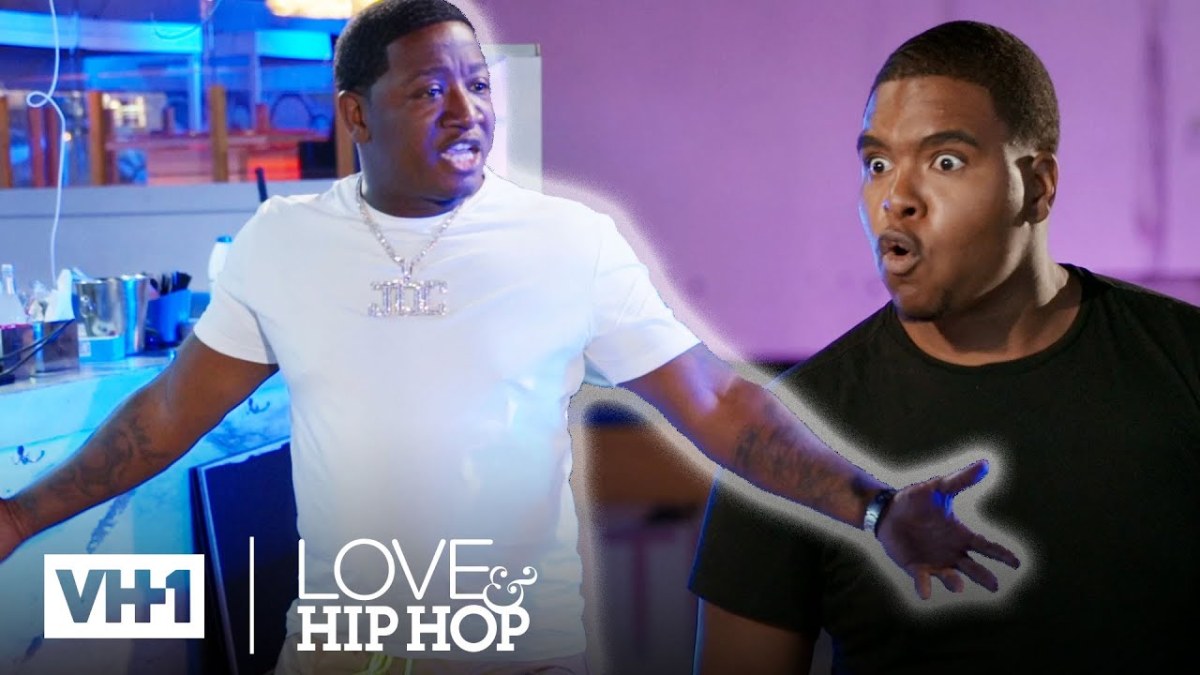
In another moment, Love and Hip Hop: Atlanta continues their emphasis on the black man and societal pressures in the eighth episode of the tenth season. This episode explores the complicated relationship between rapper Yung Joc and his son, Amoni. The scene starts with intense music amping up the meeting of Yung Joc and Amoni in Joc’s closed nightclub. The camera switches frames between Joc and Amoni, mimicking the classic showdown scene from Western films. The conversation between the two men revolves around Joc’s desire to keep his son from bad influences, but fails when his son’s newfound “friends” end up coming to Joc’s club and causing an altercation. This altercation turned deadly when one person was killed. In this one scene, Yung Joc and his song get into a heated argument that turns physical. Yung Joc says in his confessional, “In today’s climate it’s harder being a black man trying to raise a black son,” He then says to his son, “I want you to be the best you.” Yung Joc’s desire to establish positivity can be shown in his words. He doesn’t want his son to live up to the stereotypical expectations of themselves that many black men deal with. They are expected to either join gangs, be in jail, or have an early death. By airing this moment, Love and Hip Hop: Atlanta shuts down the notion that black men in America do not have high expectations for themselves or their children.
After this episode aired, there was much discourse on Twitter about what transpired between Yung Joc and Amoni. Although there was some backlash on how Yung Joc handled the situation with Amoni, there was also a lot of positive feedback:
“Young Joc did what any real father would do. Either his son get it or he doesn’t *insert shrug emoji*. Life is hard out here!!! Especially for a black man.”
“Wow. Catching up on #LHHATL and the conversation between Young Joc and his son. Sheesh. These kids need to realize they should cherish the advice parents pass along to them. Hanging around people who shoot at folks will land you in a world of trouble.”
“I’m all for Young Joc putting that Madea fear into his son’s ass!! Boy listen to yo father! He trying to tell yo ass something!! #LHHATL”
Love and Hip Hop: Atlanta’s focus on black men and their relationships and societal pressure is important because it focuses on real discourse. Many reality shows are scrutinized for their “scripted” plots and becoming more and more dramatized. However, Love and Hip Hop Atlanta goes against this stereotype by representing an important national social and political issue throughout a season. Their desire to live outside the box and create real content for reality TV is starkly different from other reality shows like Big Brother and television shows like Gilmore Girls. Instead of ruling out the minorities, Love and Hip Hop decides to take on minority faceted issues. They allow pedagogic moments to stand in place of moments that could be labeled as “entertainment.” This is shown through the audience reaction to Yung Joc and Amoni’s argument. Many fans of the show empathized and understood Yung Joc’s perspective. This shows that Love and Hip Hop is not just concerned with their ratings, but concerned with actually allowing their audience to truly connect with the messages they are sending.
To conclude, Love and Hip Hop Atlanta is a fiery franchise that not only seeks to entertain its audience but to teach them on social and political issues. Because the show caters to the black and brown diaspora of America, it’s focus on issues that affect those communities stands out. This is because the diaspora of black and brown people in the U.S comes from a long and complicated history filled with those people fighting to have a voice for themselves. VH1 recognizes the voice of those who have previously been forced into silence. That makes the Love and Hip Hop franchise so profound because it does not seek to further box in already marginalized groups. Instead it desires to to break social and cultural barriers to engage its audience for teachable moments that will last beyond the one hour per week running time.
Debuting in 2000, Gilmore Girls has captured the attention of many viewers for the past two decades. Set in the quaint town of Stars Hollow, Gilmore Girls focuses on a single mother (Lorelai) and her daughter (Rory). The show follows both characters’ lives and their day-to-day struggles with men, the town, their family, and each other. While it centers around the two women, Gilmore Girls also emphasizes the small-town culture of Stars Hollow and its utopic atmosphere. In 2016, Netflix developed Gilmore Girls: A Year in the Life, an addition to the original running. A Year in The Life features most of Stars Hollow’s prominent main characters while giving a scope into both Lorelai and Rory’s life years after the original series ended. It contains four hour and a half long episodes, each representing one season of the year. It delves into Rory’s failing career as a journalist as well as her complicated love life. It also gives insight to Lorelai’s hotel business, and her love life with partner Luke as well.
While Gilmore Girls was well received by the public, A Year in the Life was not as much of a hit as the original series. This post engages A Year in the Life to argue the show emerged in an age of intersectionality and cultural awareness but appears to be stuck in the colorblindness of the early 2000s. A Year in The Life’s refusal to address the societal and cultural issues congruent with 2016 emphasizes its effort to remain apolitical. While the show’s overall colorblindness was considerably par for the course in the late 1990s and early 2000s, its ongoing representation in 2016 feels ideologically and representationally anachronistic. Put another way, remaining a-political in 2016 is itself a political statement.
In order to explore this idea, this post will focus on how the show centers whiteness. Considering the conversation around race at the time of A Year in the Life’s production, the disregard of racial issues in Stars Hollow disconnects the town from larger social, cultural, and political concerns, converting it into a social idealist space that does not acknowledge racial disparities.
Stars Hollow is a primarily white town with few people of color. The creation of this fictional, white-washed town only re-enforces a white social idealism. Stars Hollow was based off of three small towns in Connecticut: Wallingford, Essex, and Washington. According to census data, Essex and Washington are 94% white and Wallingford is slightly over 90% white. This whiteness bleeds into the show itself, and the ways show runner Amy Sherman-Palladino avoids painting Stars Hollow colorfully.
While there are a few characters of color, they serve primarily to support Rory and Lorelai, two white women. Take Lane for example, who aids Rory’s character development. While she is Korean and may add some diversity to the show, her token-casted character has little character evolution. The same could be said for other characters of color such as Michelle, Gypsy, and Lane’s mother Emily. Not only are these characters stagnant, but their race is also not addressed in the series. Sherman-Palladino’s refusal to address race in 2016 is aiding in centering the white main characters. They all support a white character’s role in the show in some form. Especially considering the conversation around racial issues in 2016, it is clear A Year in The Life intentionally avoids any form of racial conversation.
The year of 2016 was by no means an uneventful year. The events surrounding the Ferguson Trial pushed white Americans to look more at racial disparities while an election spurred a tense political climate. It is difficult to imagine that the characters in Gilmore Girls would even be able to remain a-political in 2016, especially the characters of color. It seems that A Year in The Life is unable to address its own politics in the divisive swarm of 2016. This mentality of neutrality only pushes the 2000s colorblindness apparent in the original series.
This may have been able to fly in the early 2000s with the original running of Gilmore Girls, but A Year in the Life continues the ideals of a colorblind world centering around the struggles of white main characters. What is this saying about privilege? While Lorelai and Rory do face struggles (Rory struggles to find a job, for instance), the show does a poor job in recognizing their privilege as two able bodied, white women from a background of wealth. The series’ apolitical ideology is making a statement about colorblindness by averting Rory’s white privilege and recreating a white social idealism. Rory has a journalism degree from Yale that was paid for entirely by her wealthy grandparents; a privilege opening countless doors of opportunities for her future. Yet the show depicts her in a world of struggles and closed-doors. While obviously any person will face struggles in life, the show refuses to even touch on the privilege Rory attains. This only serves to centralize a white narrative, leaving no room to address disparities among the characters of color.
The show provides specific instances where it constructs a particular narrative for where people of color belong in A Year in the Life. Most characters of color hold a working class position in which a white character is in authority, and often disrespects them. One example of this is Emily’s (Loreli’s mother) interaction with her Hispanic maid. Emily is trying to converse with her and becomes flustered because she can’t understand the maid who is speaking Spanish. She then asks for someone to retrieve the gardener in order to interpret the maid for her. This scene takes place in Emily’s home, with Loreli present. Throughout the entire series, Emily is known for her pretentious nature and unreachable standards. She repetitively fires and rehires maids, most of them being women of color. While this specific interaction may have been intended to poke fun of Emily, it emphasizes the shallow narrative afforded people of color in A Year in the Life. These women are often sidelined, mistreated, and stereotyped. They exist in relation to Emily only to serve her and obey her daily wishes. A similar example exists in episode three, in which Rory’s friend Paris becomes flustered when speaking about her Hispanic nanny. She complains that she hasn’t “paid off the last nanny” (inferring she would potentially fire the current one) and is frustrated that the current nanny hasn’t brought her kids downstairs because she didn’t want to walk up the stairs herself. Although the show is painting Paris in a harsh way, the crude remarks go seemingly unnoticed by the other characters. In A Year in the Life, women of color are depicted primarily as support to white families. These examples may even push beyond the show’s colorblindness by reinstating a world in which people of color are there only to hold working class positions. These roles only push the original running’s shallow narrative for people of color.
A Year in The Life certainly did not have as much of a following as the original running, with some calling it “a slap in the face to “Gilmore Girls” fans.” Fans found it monotonous with similar dialogue and recurring events that needed to remain with the original running. Perhaps the public’s response to A Year in the Life emphasizes its stagnant nature, and inability to advance with the times.
It is clear that Gilmore Girls is a colorblind show, with little diversity and limited narratives for people of color. Revolving around two white women with a background of wealth, Gilmore Girls retains an apolitical ideology, avoiding conversations which may be potentially controversial to an imagined mainstream audience by pretending those conversations do not exist. While this may be congruent with most popular television of the early 2000s, 2016 offered an opportunity for the producers to promote a more diverse and representative Stars Hollow in A Year in The Life. Sherman-Palladio certainly had a chance to redeem the white-centered world in Gilmore Girls, but A Year in The Life continues the original running’s idealism of a white-centered world through its refusal to address any character’s race. As awareness regarding racial, cultural, and social issues are continuously being pushed in our world today, a-political programming is, then, not a-political at all. It demonstrates a commitment to avoid, rather than to confront important issues. If television continues to divert from addressing racial issues, it will only continue to center whiteness.
This semester in the Collaborative, we are trying something new and launching this blog, Culture Critically. This is our first series. As is the tradition of the Collaborative, students decide together what they want to write about and explore together. This semester, we are fortunate to have three excellent students: Malaysia Barr, Eliza Moore, and Marie Quaranta. You’ll be reading sole-authored writing from them as well as a collaboratively-written summary at the end of this series.
These students were initially drawn to questions of reality television, and to what degree reality television was engaging explicitly with major sociopolitical concerns of this present moment. Each student identified a television show that mattered to them: Marie selected Big Brother because she has long been interested in the interplay between the “live feeds” of the house and the heavily produced episodes that shape how contestants are understood. Malaysia selected Love and HipHop: Atlanta because of the ways it projects itself for a diverse audience based largely in the intricacies of black lived experience; in this way, it is unlike many more popular or mainstream shows in that it willingly confronts major sociopolitical issues like the killing of black men by the police. Eliza selected Gilmore Girls to move us away from just focusing on reality television and to consider more traditional television programming, as well; in particular, she examined the 2016 sequel miniseries A Year in the Life for the ways it ‘holds over’ the colorblind ideology of the 1990s and early 2000s and makes the show feel socially asynchronous to contemporary conversations.
In mapping out and writing these respective papers, I was motivated to consult Laurie Ouellette and James Hay’s excellent book Better Living with Reality Television. Their work on the educative and public functions of reality television has been meaningful to how I teach this genre in multiple courses, and it felt useful to think about how reality’s civic functions also entail the obfuscation of particular politics both within the show and against the contextual circumstances of a program’s production and broadcast. We decided the best strategy for our posts was to use close reading of key moments and sequences from the series we selected, and to bolster those close analyses with some consideration of reception, which entails a mixture of news reports and social media chatter. This discourse was treated as largely secondary, as a means to support the analysis developed of the programming itself.
The contributions to this series all come from a desire to frame how “being apolitical” is itself a political choice, a decision not to engage in prevalent issues that shape the daily practices of many viewers of these programs. Be it in the ways Gilmore Girls centers white women or the ways Big Brother’s producers try to rehabilitate racist contestants through editing, the elision of politics has consequences for how. It is not—and, certainly, never has been—possible to disarticulate politics from entertainment, from consumption, and from daily life, a lesson that has been key to cultural studies’ commitments to mapping cultural politics.
The posts in this series offer some provisional analysis and pathways for considering how we might use carefully attenuated textual analysis to examine the distinct ways politics both appears in and disappears from television programming. We are pleased to present this work and hope you will enjoy reading it.