
Is There Any Value Left in the Grammys? The Weeknd’s boycott and the ongoing battle for representation

by: Eliza Moore

For over 60 years, the Grammys have encapsulated American viewers with everything from flashy performances to heartfelt speeches. The 2021 Grammys show brought about a significant amount of conversation from both celebrities and the public regarding racial representation.

The Grammys have a history of centering whiteness, and lacking diverse representation. Both the nominating committees and nominations have historically lacked racial diversity, as well as a lack of women nominations. While there has been some improvement, many artists nominated in the hip-hop and R&B categories have made statements about their lack of success in the Grammys. According to New York Times, “the show has alienated more and more hip-hop and R&B stars — like Drake, Kanye West, Jay-Z and Frank Ocean — by failing to give them the most prestigious prizes.”

The  2021 Grammys show aired after years of accusations of bias against black artists within the awards organization. Artists have begun to speak out against the Grammys, with The Weeknd spurring much public discourse regarding a boycott against the 2021 showing. With a chart-breaking record and a superbowl halftime show, The Weeknd is critically acclaimed and widely popular, yet he received zero nominations. 

Historically, the Grammys nomination process has included “anonymous expert committees” who make all the final determinations regarding who is nominated and who receives the awards. This committee has awarded relatively few people of color with Herbie Hancock to be the last Black artist to win album of the year in 2008, and Lauryn Hill to be the last black woman artist to win in 1999. 

The Weeknd’s public boycott was certainly effective, as he was backed by other major artists such as Jay-Z, Frank Ocean, and Kanye West who publicly boycotted the show as well. What does this say about the value of winning a Grammy if so many successful artists of color are clearly not represented? Drake stated that he had to “accept that what once was the highest form of recognition may no longer matter to the artists that exist now and the ones that come after” (https://www.bbc.com/news/entertainment-arts-55084287).

 The Weeknd’s efforts to call attention to the lack of representation in the Grammys were not in vain, as the show invited thousands of new members to its academy, hired a diversity officer, and a new advisory group whose intent is to “amplify Black voices”. Hopefully, these changes will be effective and apparent in the 2022 showing, as inclusivity is better enforced. This has the potential to bring about other representational issues. Are the nomination committees truly representative if women and people of color are “tokened” into the committees to save the Grammys from further boycotts and negative public discourse?

Controversies like these are part of a perceived growing lack of value in award shows such as the Grammys. According to the New York Times, the 2021 viewership fell to 8.8 million, showing a 53 percent drop from the previous year of 18.7 viewers. With the apparent issues regarding racial representation, the process and presentation of the show need to be fully reconstructed. While there certainly are some steps being taken in the correct direction to revise the disparities within the nominating process, I think it will take years before the show reaches complete and true revision. 

The Weeknd’s public boycott of the 2021 Grammys has been successful in bringing awareness to the lack of representation in American award shows. He was not only able to rally the support of many other Grammy-nominated artists, but provoke change within the nominating system.
“No One Cares”: Ricky Gervais, The Golden Globes, and a Call to Action for Hollywood

By: Sara Ciplickas

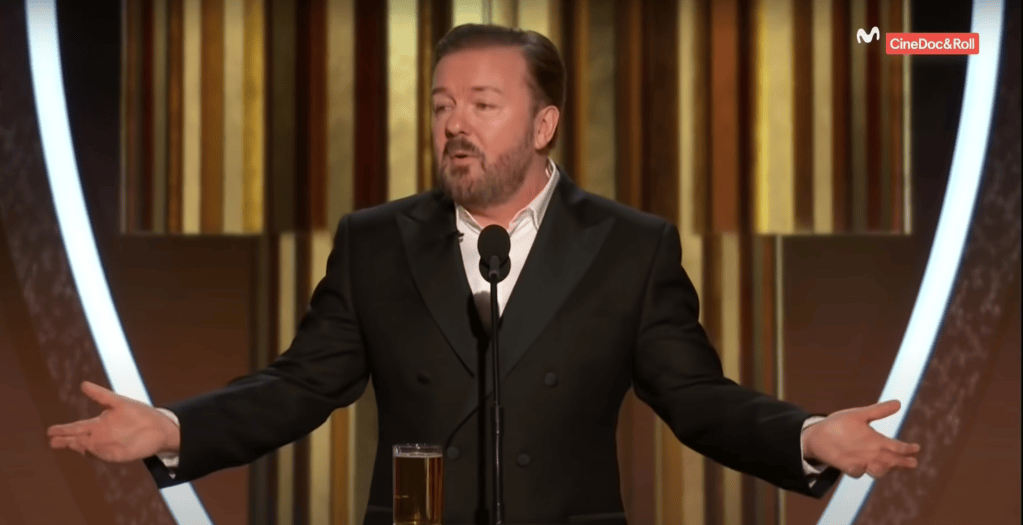
Ricky Gervais has been a favorite Golden Globes host since his debut in 2010. He is known for his unfiltered jabs at celebrities and members of the Hollywood Foreign Press Association (the non-profit organization composed of around ninety photographers and journalists who vote for the awards). While most of Gervais’ jokes can be written off as “distasteful” to some and “wickedly funny” to others, they have progressed over the years from harmless roasts to full-on critiques of the Hollywood Foreign Press (HFPA). Gervais’ earlier consecutive hosting years (2010, 2011, and 2012) tread lightly around the association he represents. The host made cracks about mostly himself, Mel Gibson, other individual celebrities, and limited his jabs at the Globes to individual lines. For instance, Gervais quipped that “One thing that can’t be bought is a Golden Globe…officially.” He included some off-color remarks about the Globes and even hinted that the President of the HFPA warned him about going too far. Gervais constantly repeated “I’m not doing this again,” so he always found a way to push the envelope despite claiming that he didn’t care. His performative passiveness didn’t stop him from critiquing the organization and Hollywood in later years. In 2016, Gervais kept pushing the envelope further.”[The Golden Globe] award is, no offense, worthless.” Four years later, in 2020, he pushed harder. He reminded people that he does not give a shit about how people react to him or his critique. In the last two hosting gigs, Gervais increasingly highlighted serious Hollywood issues, including the lack of representation in film, female pay, celebrity hypocrisy, and the acceptance of bribes by various show producers. 

Gervais delivering his opening monologue at the 2020 Golden Globes. Image taken from Youtube.

If you are an avid award-show-watcher, you may have noticed that the 2022 Golden Globes didn’t air on NBC this year. In 2021, NBC announced that it would not be airing the Golden Globes ceremony. This announcement came out after the Los Angeles Times reported that there were no black members of the HFPA and rumors of bribery from show producers. Furthermore, the 2020 awards received heavy scrutinization due to mostly white winners. These “revelations” generated a massive backlash from actors, publicity firms, and fans. Although this is the first time major stars such as Tom Cruise and networks like NBC publicly addressed the Globe’s problems, the article wasn’t sharing any information that Gervais hadn’t already mentioned in his jokes. 

It is increasingly evident that Ricky Gervais, and possibly the audience who loves him, doesn’t care about the Golden Globes anymore and are fully aware of the issues within the organization. There is little to no talk on social media about the Golden Globes or the lack of a 2022 show. The Globes didn’t matter this year. According to Gervais, they only mean anything to the stars themselves. The same stars he called hypocrites for coming to the show in limos. That being said, even some celebrities don’t think the Golden Globes matter anymore. The 2022 winners barely addressed that they won after being announced on Twitter. The Golden Globes, and the war against them, offer us two questions we should be asking ourselves. What makes The Golden Globes matter (if they ever did)? If we don’t care anymore about awards shows or the sanctity of the HFPA, should we care about representation and integrity within the organization?

Maybe it’s better to ask whether or not the Golden Globes matter to us? Do they matter to the HFPA? Yes. Do they matter to directors, actors, and other moviemakers? Maybe. Do they matter to the public? That’s unclear. If you ask some of my colleagues in Clemson’s World Cinema department, they love award season. However, most of America seems to be opting out of watching the awards shows, and many are saying that the entire award industry is dying. Whether or not you watch these shows or check the winners the following day, does it actually affect the movies you watch? You may watch a film because it won something. More than likely, if you are like me, you go to your friends, family, or streaming services for movie recommendations, not the Oscar or Golden Globe website. Furthermore, Gervais has been a hosted five times and is a favorite because he does nothing but make fun of the entire show. So for those who had been watching the shows, did they watch because they cared about the awards or because they liked to listen to someone make fun of them? There are people out there who care and people who don’t, but if there is to be a reform in the Golden Globes, any award system for that matter, organizations need to determine what people are paying attention to. 

Leading into my second point, if award shows don’t matter to the people, do we care if they make a reform? The HFPA announced that it added members to its party who were people of color and changed some of their bylaws. They also announced their first Chief Diversity, Neil Phillips. NBC even responded by saying they would possibly air the Golden Globes in 2023. Will that change the outcome of their 2023 audience? Who knows. It might not even be worth their time. Gervais has been increasingly making fun of the corruption since 2010. It took ten years for NBC to call out the Golden Globes, and by the time they did, no one missed the show. If people no longer look to awards shows to see who the best actor or actress is or what to add to their watchlist, we probably need to look elsewhere for Hollywood reform. The lack of representation of people of color is not exclusive to the Golden Globes. The Oscars, studios, budgets, talent, and every piece of the entertainment industry lacks people of color and women. However, there is an improvement, and we are slowly getting a more diverse industry.

I don’t doubt that Ricky Gervais and NBC calling out the Golden Globes isn’t necessary, but maybe we should hold every aspect of Hollywood as accountable as they held the Golden Globes. Perhaps the Golden Globes and its critics are the first steps to a more progressive system.