
by Maddy Grumet
In WandaVision, Wanda Maximoff is exhibiting very human maladaptive coping behaviors in the face of grief. In previous Marvel productions, the audience learns that Wanda has experienced an unfathomable amount of loss. With her introduction to the Marvel universe comes the knowledge that her parents had died in a bombing of her home country. In the Age of Ultron Avengers movie, Wanda’s fraternal twin brother, Pietro, is killed in battle. Finally, in Avengers: Infinity War, Wanda watches as her beloved Vision is demolished by Thanos in his pursuit for the infinity stone attached to Vision. In the wake of these traumatic losses, Wanda is forced to confront her pain as she tries to figure out how to navigate a world that has been so cruel to her.
Trauma is, by one definition, an event outside the range of the human experience. By curating a world without trauma in WandaVision, Wanda is harnessing her superhuman powers in an attempt to control things that are normally beyond human control. For Wanda, a griefless world looks like television. In her younger days, Wanda learned about American culture and life by watching television shows like The Dick Van Dyke Show and The Brady Bunch. The world that Wanda creates in Westview, New Jersey is a projection of what she has seen and learned from these and different traditional American television shows. As a result, Wanda’s vision of a “perfect” world looks like one with traditional gender roles as an embodiment of a happy family and social life.
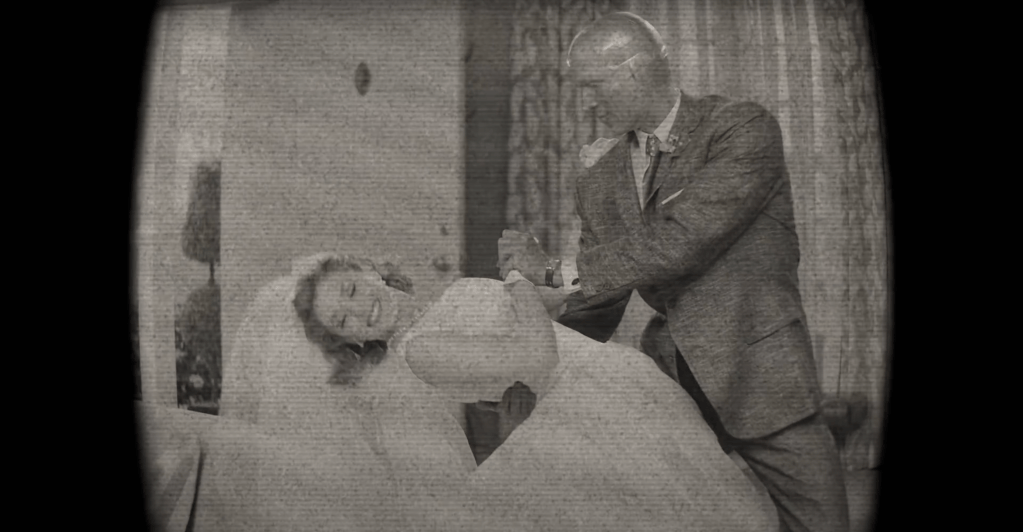
In older sitcom shows, gender roles are both prominent and clear cut. Typically, the men are portrayed as helpless breadwinners who prioritize things like beer and sports while the women are portrayed as too smart to be stuck in their housewife and motherly duties. In Episode 1: “Filmed Before a Live Studio Audience,” Wanda and Vision assume these very traditional gender roles in their efforts to entertain Vision’s boss and his wife for dinner. The episode is shot in a “classic sitcom three-camera soundstage setup” (Vulture). Wanda and Vision interact in a slightly awkward, intentionally stiff way throughout the episode, something that is very similar to sitcoms like Bewitched. Wanda assumes the traditional role of “housewife” as she brainstorms ways to satisfy Vision on their upcoming anniversary and, as the episode progresses, scrambles to prepare the food for dinner in an I Love Lucy style. Vision, on the other hand, assumes the traditional role of the husband who provides for the family by working a desk job. Although Wanda and Vision both assume these very traditional roles, they simultaneously poke fun at many of the sexist conventions of the time. By doing so, WandaVision both masters the concept of a traditional sitcom and calls out the sexism that existed in the shows that Wanda used to learn about American life.
In Episode 8: “Previously On,” WandaVision slightly steers away from the sitcom archetypes and style to dive deeper into Wanda’s traumatic past. In an effort to learn about the origin of her powers, Wanda’s co-character Agnes forces her to confront her grief and the reality of what she has experienced. Agnes walks Wanda through memories of Sokovia and her family, the HYDRA base where Wanda was kept as she developed her powers to help the Nazi-adjacent, her relationship with Vision, and eventually reveals the truth of her curation of Westview. This episode demonstrates a key idea: grief is inescapable. Even Wanda, someone with otherworldly powers, is incapable of escaping her grief and trauma for good. Wanda’s creation of Westview and, as the audience later learns, the version of Vision living there with her demonstrates the extent that people will go to seek remedy in the face of trauma.
On its surface, WandaVision is a show based on familiar, traditional sitcoms and the life of a grieving Avenger. However, the sitcom acts as a veil for the show’s depiction of some very complex feelings: denial, anger, depression, loneliness, struggle, and, in the end, a form of acceptance. For Wanda, escaping grief means living out her life as a character on a sitcom. However, the show eventually reveals that this escape is not possible; Wanda has to shut down her sitcom and curated reality and come to terms with her trauma. Although not everyone has the power to curate their own worlds in the face of grief, Wanda is demonstrating what it means to be human and to process the pain we feel.

