I am an associate professor of media and technology studies in Clemson University’s department of Communication. I am the owner and operator of Culture Critically.
In the summer of 2022, I had the opportunity to travel to Peru. I met with a group of solo travelers and explored the coast and Andean region. Like most people who visit Peru for the first time, I explored significant cities such as Lima and Cusco, hiked Machu Picchu and Mount Vinicunca, and visited the Spanish cathedrals and catacombs. I also explored local villages within the sacred valley and rode ATVs through farmland outside Cusco.
During my stay, my friends and I spoke with many locals who combined English, Spanish, and Quechuan (the language families of people indigenous to the Andean region). While their kindness and hospitality made my trip unforgettable, I was shocked to be invited (or allowed) into so many sacred and private spaces. In addition to visiting Machu Picchu, a sacred Incan city hidden by the Incas in the 1400s, many people invited me into their private homes built during the same time. I was enamored by the relics, dried food, and alters scattered around the single-room houses. It indeed was like stepping into the past, but I often felt like an intruder. As a tourist engaging with this country’s past, I felt a sense of guilt stepping into spaces that white European colonists tried to erase.
Tourism is Peru’s third-largest income source. The country, like many others, took a sizeable economic hit in 2020 when the coronavirus pandemic initiated harsh lockdowns. Around 85% of the people working in tourism lost their jobs. I was more than happy to buy as much as I could pack and thrilled to listen to the people tell stories; however, my trip seemed like a tug-of-war game between tourist sites and private spaces. At times, it was hard to tell which was which. The commodification of culture is not something exclusive to Peru. Many countries optimize their historical sites and traditions to stimulate travel and economic growth. Specifically, indigenous cultures of North and Latin America are commercialized because they are considered to be a variation of the “public domain.” (Think about when someone dressed up as an “Indian” for Halloween or attended a Redskins game.) Contrary to the United States, indigenous culture in Peru, based on my observation, is more integrated into the everyday life of all Peruvians and consumer products and services. Upon reflection, I wondered why it was so uncomfortable for me to experience an indigenous culture outside of museums.
Like the United States, Europeans colonized Peru, and the native people were either enslaved or murdered. Contrasting to the present-day Native-American tribes, the Incan people more successfully preserved their indigenous traditions and ways of life. We, of European descendants, in the United States, do not recognize, participate in, or acknowledge the cultures of Native American descendants. Most Native American culture has been systematically exterminated by the United States government throughout history. In Peru, I could see a difference. History, traditions, art, clothing, and food were acknowledged, used, and appreciated. One way this is done is through the commodification of said traditions. Arguably, the Incan people have survived so long because they have allowed their private traditions to be opened up as tourist exhibitions. As a tourist, I could see the tension between the need to preserve and sell one’s culture, especially when I visited local markets.
Now, this is not as black and white as it may sound. Peru has its fair share of racism and disrespect for indigenous cultures. Additionally, the United States has areas and new laws trying to protect indigenous communities. Both countries have inexcusably disrespected their Native people, and I am not defending the colonists in Peru one bit. However, my time in Peru and the oddness of seeing so much indigenous culture have caused me to reflect on how my own country has handled (and erased) its colonial past.
The balance between the preservation and commodification of culture is blurry. In some ways, by opening up to the public, Indigenous traditions and sites have survived history. My time in Peru exposed to me this tension in how tourism works — as a means of preserving and commodifying, often both at once — in a way I had not previously considered. I still wholly support traveling and learning about different parts of the world and their people. However, the tourism industry’s complexity is not to be ignored. As white European travelers, it is easy to view other, often poorer cultures, as far-removed places to visit and get a glimpse of the ancient world (even if unintentionally). That is not the case. Places like Peru that thrive off tourism are also recovering from previous exploitation. With that comes the responsibility of both seeing the world and understanding why and how certain places use tourism to keep themselves alive.
These quick thoughts are meant to offer a reflection of an idea I’ve been thinking through since spring of 2022, largely when Elon Musk first announced his intention to purchase Twitter. Now that the deal has gone through and Musk owns the company, lots of questions are circulating about leadership, staffing, the company’s future, and its ability to maintain and build a user base. Please read these as cursory, and let’s talk about them in the coming year. Things will undoubtedly continue to change.
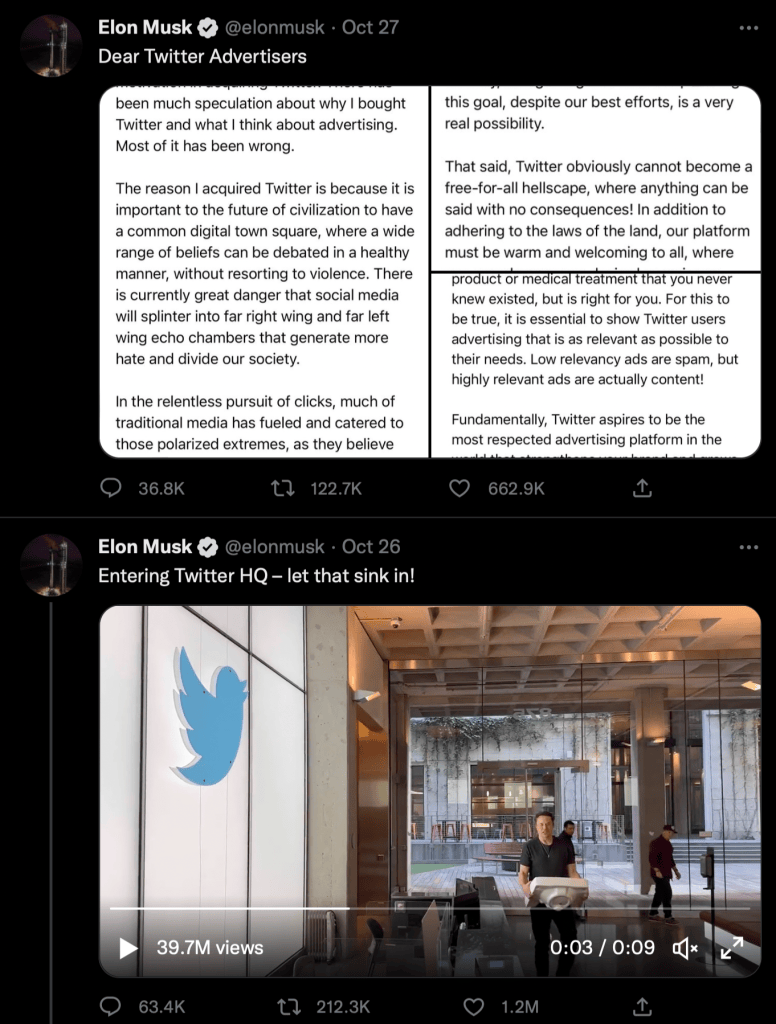
Musk offered two Tweets as the purchase closed and he gained control of the company. In the first, he wrote, “Entering Twitter HQ – let that sink in!” This was accompanied by a 9-second video of him walking into the lobby of Twitter’s headquarters holding a white sink. The pun is something between a Dad Joke and a troll, Musk making light of a sprawling, tumultuous half-year that nearly saw him in court over his bid to purchase Twitter. In the second tweet, he wrote “Dear Twitter Advertisers,” followed by three separate screenshots explaining—to a point—his position on acquiring the company and what he saw as its future. That the letter was pitched to advertisers and not to users is telling, indicating that Musk’s first public statements on the platform are pitched at the mechanism designed to build capital. While I don’t want to walk through these statements in their entirety, I do want to point to three contrasting statements:
“The reason I acquired Twitter is because it is important to the future of civilization to have a common digital town square, where a wide range of beliefs can be debated in a healthy manner, without resorting to violence.” This has long been a conception of contemporary social platforms—the “town square” model that owes something to Habermas’s history of the “public sphere”—but plenty of social media researchers are quick to point out the limitations of this model: As a computational software platform, Twitter simply doesn’t function this way, and the practices of trolling, disinformation, and other modes of concerted attacks mobilized through the platform undermine its possibility to really achieve this rose-colored possibility.
“…our platform must be warm and welcoming to all, where you can choose your desired experience according to your preferences, just as you can choose, for example to see movies or play video games ranging from all ages to mature.” Theories of the active audience aside, Musk is here conflating participation in public discourse with media consumption. A choice to play a video game is quite different from choosing to voice political speech online. There have been lingering questions about Musk’s plans for content moderation and community guidelines on the platform, and this short note does nothing to address how—apart from obeying “the laws of the land” (which land, exactly?)—he understands the intricate relationship between social media and speech. It is always a productive act, not a consumptive act.
“Fundamentally, Twitter aspires to be the most respect advertising platform in the world that strengthens your brand and grows your enterprise.” And this is, really, the main takeaway: the “town square” model is foregrounded because it sounds nice, the false analogy to movies and games only work on the most superficial level, but this is the closest Musk comes to indicating an emphasis in Twitter as a town square that works for the expressions of brands. Musk realizes that, regardless of what happens to the user base of Twitter over the coming 12-24 months, he needs to demonstrate to advertisers a commitment to the money they are willing to spend on targeted advertising, professional analytics, and reach.
So the story is the same as it ever was: The pursuit of advertisers to fund the platform and accrue value. We know this, of course; it’s the entire basis of models like Zuboff’s “Surveillance capitalism,” Smythe’s “audience commodity,” as well as any number of histories of media audience tracking and data collection—in choosing an advertising model that is “free” to use, users become the product, sold to advertisers who demand a return-on-investment and, increasingly, value granular data to understand the work of their social media brand.
But let’s talk about “value.” Because as much as Twitter’s market stock has rebounded over the course of a tumultuous year, it’s about to be taken of the NYSE. Musk’s acquisition is also taking the company private. Meanwhile, Meta—which was once seen as the biggest social network company in the world—has lost 69% of its market value over the last year. While, clearly, the stock market doesn’t tell us everything, Facebook’s rebranding into Meta has done little to build faith in the company. Earlier this month, Zuckerberg announced “legs are coming” to Meta avatars—your character in the company’s virtual reality space doesn’t exist from the waist-down—before some realized the “legs” in the hype video had been faked and created from motion capture for the purposes of the demo. It’s a small, stupid thing, but it encapsulates quite well the company’s ongoing fall from grace.
While my undergraduate students are far from a reliable sample size (about n = 50 per semester), I’ve noticed a precipitous drop in any of them saying they use Facebook and, over the last two years, any of them saying they use Twitter. Instagram and TikTok are more the platforms du jour. But with ongoing discussions about data collection and data security happening around TikTok; as Wired put it last month, “it is unclear whether TikTok poses a unique and specific threat to US national security or if it is simply a convenient proxy through which lawmakers are grappling with larger issues of data security and privacy, disinformation, content moderation, and influence in a globalized tech market.”
And this, to me, is part of what unites that Facebook now feels stale (and Meta seems unappealing to any of my students no matter how many commercials I show them), Twitter’s content moderation and speech regulations are again at the forefront as Musk promises sweeping changes to the company, and TikTok remains a sort of signifier for the perils of data privacy and security: We are at the end of the first “social media” generation.
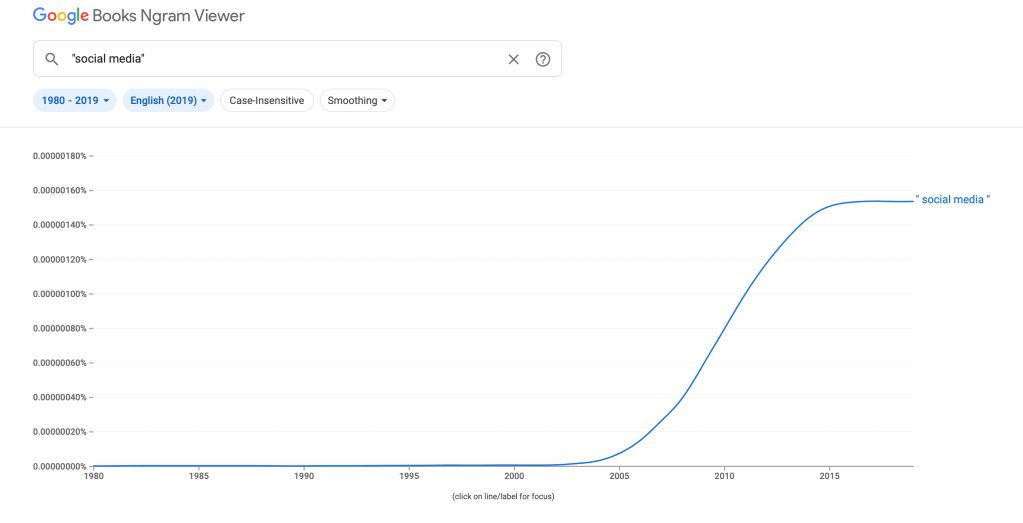
While, clearly, historians of the Internet (as well as anyone active in online networks in the 1980s and 1990s will tell you), the idea of social network websites where people could post and engage each other has been around for much longer (not to mention the arguments occasionally shared from some corners that “all media are social!”), the actual phrase social media was not meaningfully used until about 2004 according to a Google Books Ngram search:
The phrase exploded over a five-year period, coming to dominance as a fully-formed logic of technology and culture by 2010, before slowing down its discursive growth in the last decade. While an Ngram search of a word’s frequency can only tell us so much, it underscores that “social media” arrived at a particular moment. Its lasting legacy may be a recognition that all our media are inherently social, and will retain elements of social connection in future developments, but this also shows us nothing is assured here, and the history of this phrase and its dominant meanings and understandings is still very much up for grabs.
While Geocities was launched in 1994 and LiveJournal was launched in 1999, the founding of Friendster in 2002, MySpace in 2003, and Facebook in 2004 collectively inspired a sedimentation around the idea of social media as a space for online social networking and the sharing of thoughts, photos, and eventually videos.
Twenty years since the founding of Friendster, we find ourselves in a moment that will truly test the future of what the phrase “social media” is meant to indicate, and what its legacy might be. Will Facebook continue to bleed users (and fail to bring younger users into the fold), converting it into a sort of online directory of businesses and community groups? (It’s worth noting that news deserts like the one in which I live still basically only use Facebook to share community news with residents). Can Twitter survive Musk’s acquisition and his plans to center the company as a brand-focused town square? (And will news organizations and politicians continue to use Twitter, legitimating its status as this so-called “town square,” now that it’s a private company again?) As the realities of data extraction become more known and accepted, the political realities of disinformation more part of our ongoing public discussions of social media, are these forever companies? Or, to borrow a line from David Fincher’s The Social Network, has the party ended at 11? Will these companies ultimately fail to make the pivot into “The Next Generation” (Star Trek pun intended) and begin to sputter?
To be clear, I don’t think Facebook or Twitter or Instagram will disappear. They are deeply entrenched in cultural practice. But it is relatively easy, at this point, to imagine Facebook basically being an online directory, a version of the White Pages. It’s easy to imagine Twitter being basically a hub for news outlets, politicians, and public figures to share statements without much of the vibrant, chaotic (and yes, often hateful and horrid) forms of networking which characterized the platform’s first 15 year of public life.
I offer these reflections not because I have an answer, but because I think we need to encourage everyone to start thinking about these platforms as historical entities; they emerged within a particular material, cultural, economic, and technological context, and they have participated in the shifting contexts of the last 20 years. The major players in the social media industry are all at a moment of rearticulation: Formally rebranded into Meta, formally changing ownership and becoming private, these reconnections will undoubtedly spill out into other contextual relationships. Thinking of them as historically situated can give us, I hope, the necessary vantage to have serious conversations about Meta and Twitter in the coming year, as they undoubtedly undergo a series of changes to try and (re)build value.
“Social media” is a historical phrase. Its first moment of articulation shifted how different social and cultural groups engage each other, how political conversations operate, how ideologies are built and challenged, and on and on it goes. These changes are still quite deeply felt, but they are not a guarantor of any sort of future around the phrase “social media” and its broader structures of feeling. We can’t lose sight of that specific historicity as we critique the next moves of these companies and the platforms they operate.
“We are going to live on the Internet,” claims a fictional version of Sean Parker towards the end of The Social Network. But maybe that promised future has already passed, or is already passing. At the very least, life on the Internet is transforming.
Click the link below to listen to our latest episode, exploring the relationships between social media and legal issues, with a focus on how partisan and binary thinking pervades these spaces. Also available on Apple Music and Spotify
On August 8th, 2022 former United States President Donald J. Trump’s home and hotel in The Mar-A-Lago Club in Palm Beach, Florida were raided in search of documents that were believed to be mishandled during Trump’s time in the White House. This was a major event and there is even speculation it could result in the former president having to forgo his desire to re-run for office in 2024 due to his alleged mishandling of government documents. This event has generated significant discourse on various social media sites, specifically Twitter. For this blog post I have examined both a conservative social media influencer and a liberal social media influencer with the hopes of comparing and contrasting their rampant tweets and the backlash or support that proceeded in their respective comment sections to analyze how legal opinion gets formed on social media after new stories come out.
Steven Crowder is a conservative social media influencer that has his own podcast called “Louder with Crowder”. When the news broke out about the search warrant issued against former president Trump, Crowder was extreme in his response and caused a good amount of response in his Twitter comment section. Throughout this section I will analyze a few of his tweets and the responses to them. In Crowder’s initial reaction to the Mar-A-Lago raid, he issued a series of tweets condemning the invasion of Trump’s home and concluded with the statement, “Tomorrow is war. Sleep well.”
This statement was a hyperbole used with the hopes of causing an uproar in response to the Mar-A-Lago raid that could have served to initiate a panic amongst Crowder’s followers or anyone who saw the tweet. Crowder then proceeded the next day to tweet statements such as, “This is one of the darkest days in regards to your personal freedoms,” and “This is one of those days that you’re going to tell your children and grandchildren about,” again engaging his audience in an over-exaggeration to the raid of the former president. This hyperbole can be compared to propaganda where one uses biased and sometimes misleading information to promote their own political beliefs and agendas. With Crowder having just under two million Twitter followers, everything that he posts will at least be seen by thousands of people and when one has the power to deliver a message to this many people it can be very dangerous. For example the capitol riots started off with Trump’s comments on the election and then spread to people on social media where the numbers of people set to storm Washington just continued to rise until the issue became a national security crisis. Something like that can be ignited by a single tweet like the ones that Crowder has put out. The response though to these tweets is a whole other issue in itself that starts in the battlegrounds of the Twitter comment section.
Crowder’s ‘Darkest days’ tweet received 40.1k likes, 4.9k retweets, and 1.1k quote tweets as of September 13th. From going through Crowder’s tweets and scrolling through his comment sections, there is absolutely no shortage of discourse between Crowder supporters and non-supporters.
Surprisingly, the most liked comment of all these says, “My personal freedoms seem pretty chill not gonna lie”. With this being a tweet from Crowder’s page, you would think that the most liked comment would be one in favor of his opinion, but with this tweet it is in fact the opposite. All this does is speak volumes to how bold Crowder’s tweet was. More likely than not, someone who doesn’t follow Crowder or doesn’t agree with his opinions is not going to seek out his account to comment on it, but because of how Twitter pushes certain trending tweets out with its algorithm this person and others were able to see it and they believed the tweet was so outlandish that they had to storm into his comment section to try and disprove whatever he had said. Because Crowder attempted to disprove a national security issue with little evidence to support his claims, it was easy for people to combat him and it has gotten to the point where it’s not even a democratic vs republican issue, but rather one of Trump loyalists vs everyone else. The person who commented that they still have their personal freedoms could be conservative or liberal because not all conservatives are Trump supporters. From diving deeper into the comments, we just continue to see evidence of how subjective Twitter can be, with people hoping for attention through their public comments.
Adam Serwer is a liberal social media influencer who also serves as a staff writer for ‘The Athletic’. Following the raid of Mar-A-Lago, Serwer’s tweets completely differed from those of Steven Crowder, as we should expect from a democrat vs republican. While Crowder engaged in hyperbole by claiming that “Tomorrow is War”, Serwer mostly tweeted only in response to the tweets of others. Instead of taking a brash and what some would call an ‘unhinged’ approach to the way that he influences his audience, Serwer analyzes the matter at hand along with the reactions from others to then formulate his own opinion based upon the articles he has read and the people that he is influenced by. His approach is one that is more tactical and takes a substantial amount of research and knowledge of whatever case it is that he is commenting on which makes sense because of his role with ‘The Athletic’ and his journalist background. His approach can be seen as amore “boring” approach due to the lack of bold statements seen in Crowder’s Tweets, but as it relates to Serwer’s supporters and audience, in general they tend to be much more receptive to his tweets than Crowder’s audience is to his.
Twitter comment sections can get very heated, as evidenced by responses to Steven Crowder. Adam Serwer, however, seems to have plenty of support in his comment section for his stance on Trump’s Mar-A-Lago raid.
Now, it would be inaccurate to say that Serwer has a “better” fan base than Crowder based on the comment sections of one particular case, but it is interesting that not many opposing opinions were seen in Serwer’s comments. As I mentioned earlier, a simple explanation could be that Serwer’s tweets weren’t as unhinged, but it could also be due to the fact that Serwer has 1.6 million fewer followers than Crowder. For example, Serwer’s most liked tweet within 72 hours following the Mar-A-Lago raid received 12.5k likes where Crowder’s received over 40k. The discourse seen in Crowder’s comment section could be seen as a result of his popularity through performative outrage while the lack of discourse in Serwer’s tweets is because he is less emotional in his tweets and his reach isn’t broad enough to have non-supporters running to his comments to refute every tweet that he puts out.
The raid of Donald Trump’s Mar-A-Lago home and hotel is a very important issue that is still ongoing and could be for a while and depending on how the case is ruled the documents found in Trump’s home could jeopardize his chances of re-running for office in 2024. The reaction to this event by political social media leaders on Twitter served to influence and upset those that keep up with them. To dive deeper into the social media aspect of hot current events, I analyzed the tweets and comment sections of Steven Crowder and Adam Serwer. From this I learned that there are different ways to go about spreading information on social media, as Serwer seemed to go with a research based approach whileCrowder utilized a brash and unhinged approach. I also learned that discrepancies in follow count can have an impact on the amount of discourse with an influencer’s comment section as evidenced by the amount of discourse within Crowder’s comments. Because of today’s culture, many people look to these political influencers to then formulate their own opinions. This can be dangerous at times due to the lack of fact checking done by these influencers and, while their views may be objectively correct, all that it ever seems to do is divide the political parties within this nation rather than unify for the achievement of a whole nation.
Photo of Johnny Depp and Amber Heard. Photo by NDTV
On June 1, 2022, millions of people were glued to their streaming devices awaiting the verdict of the six–week long defamation trial between movie star Johnny Depp and former spouse Amber Heard. The trial was high-profile and dramatic, the perfect combination for it to blow up on social media and become the topic of conversation on apps such as TikTok and Twitter. If you showed any interest in the case, it followed you on social media, with the recommendation algorithms constantly pushing case content onto your feed. Even if you did not keep up with the case, you probably had some idea of what was going on. However, the defamation case was misrepresented both in news media and social media and was often reported as a sexual abuse case, causing a major divide between Depp and Heard fans all over the world, as well as creating confusion for indifferent spectators of the case. Social media effectively turned a serious defamation case into a meme-filled virtual circus all while misinforming the public and encouraging people to choose one side or the other based on who they liked better, ignoring what was really important: the facts of the case, and what defamation entails.
Throughout the trial, people began to lose sight of the jury’s task at hand: to determine whether or not Heard had defamed Depp in her op-ed in The Sun published in 2018. Defamation occurs when someone makes a false statement about you which causes harm to your reputation, and Depp sued Heard for making defamatory statements in her op-ed where she described herself as a victim of domestic violence. The jury was responsible to determine four things in order to convict Heard of being guilty of defaming Depp: that the statement was false, that the statement was published, that the statement caused harm, and that the statement would not be considered under free speech. After hearing all of the evidence after six weeks, the jury found Heard liable for three claims of defamation and ordered her to pay Depp $15 million in damages, and found Depp liable for one claim of defamation and ordered him to pay Heard $2 million in damages. Though this verdict pleased many Depp fans and avid watchers of the trial, Heard supporters were furious at the outcome and have since spoken out in articles and social media, with statement such as “Many victims of domestic violence who watched this trial will likely conclude that, if they share their experiences, they will be disbelieved, shamed, and ostracized”. What the writers of these articles fail to realize is that this case was in fact not a sexual abuse trial, and it was not the jury’s duty to determine who was the ‘victim’ and who was the ‘abuser’. It was to determine whether or not Heard had defamed Depp. This misinterpretation of the trial, however, did not begin after the reading of the verdict. It was present throughout the entirety of the trial, with Depp fans blaming Heard and vice versa. Because media narratives tended to frame the case in similar ways to a sexual abuse case, it caused obscure understandings of what the deliberations of the trial were meant to determine. This effectively resulted in misrepresentation and misinterpretation of what the case entailed.
Amy Singer, long-time trial consultant and psychologist, has admitted that the “political-type online mudslinging” between opposing sides in the media made it tough not just for a passerby on the internet to understand what was going on, but also for professionals who were following the trial. Along with expressing this confusion, Singer’s team used a set of social media listening tools to deduce what jurors might be thinking by following social media posts of people with similar demographics and backgrounds. What she ended up finding, however, was beyond just what the jurors might have been thinking. She found that the trial was more like a political debate than a typical legal debate you might hear in conversations concerning abuse or murder cases, as she detected rifts between the two fanbases. She also found that it was a younger crowd who were invested in the case on social media on apps such as TikTok and Instagram, while older people were more concerned with the war in Ukraine.
News media has an enormous influence on our society, as it does not only communicate information, but also offers journalists individual opinions and perspectives on said information. We have long recognized journalists use framing when reporting on any given story, and the frames used during Depp v Heard obscured some of the particular legal issues at play. A prime example of this phenomenon can be seen in the Depp vs Heard defamation case. Many times news media companies want to portray themselves in a specific way, whether that is by promoting a specific political side, or profusely supporting a movement. This can be seen in the overwhelming amount of Pro-Heard articles that popped up after the trial’s verdict, claiming that the #MeToo movement has faced a setback due to the trial ruling. Pro-Depp reports remain largely on social media and are buried in the news media. Many of the articles bashed Depp and his legal team with remarks such as comparing attorney Camille Vasquez to character Regina George from the movie Mean Girls. The same type of misleading reporting on the Pro-Depp side can be seen similarly on different TikTok videos, with content creators accusing Heard of “putting on performance of her life” during the trial. With accounts of the trial on the media largely taking sides, it created confusion and led viewers away from understanding the reality of the defamation suit that was being tried, and into a world of fabricated and glamorized stories that were molded to fit each news outlet’s narrative.
Though the news media failed to provide adequate context concerning the trial, social media seemed to be the bigger perpetrator in distorting trial facts. With fans of both sides flooding apps such as TikTok and Twitter with memes, hashtags, and opinions, social media essentially tried the case in the court of public opinion. Creators went back and forth posting their takes on the trial and creating memes of both celebrities as well as their legal teams and the judge in the trial. There were also a multitude of different hashtags that emerged from the chaos, one of which being #justiceforjohnnydepp which has nearly 7 billion views on TikTok. The fans of both sides were ruthless in their posts, with some people going as far as posing death threats to people involved in the case. However, most of these opinionated posts were not based on the facts of the case and the evidence presented to the jury. They were based more on fandoms and who people decided they liked better, Johnny Depp or Amber Heard. Although the jury did indeed decide the outcome of the case, the future of the actors’ careers will ultimately be based on how they are viewed in the public eye, and both of them were harmed due to content creators going rampant on social media. This meme-filed virtual circus effectively encouraged misrepresentation of the case on social media by the dueling fandoms all while disregarding the legalities of the trial.
Though we have seen high profile cases such as the OJ Simpson murder trial blow up in the media, the Depp vs Heard case was one of the biggest cases since social media has been as prominent as it is today, with Law & Crime’s Youtube page attracting nearly a billion views on content related to the case. The cameras in the courtroom documenting the entirety of the trial is the reason that the case turned into a sensational affair that, in reality, should have been a matter that stayed between the defendant and plaintiff. With the whole world offering their opinions, it is hard to see past the buzz and see the reality: two individuals, neither of which are saints, fighting a legal battle to restore their names that have been plastered all over the media. Not all press is good press, and every main player that was involved in the trial was being talked about in the media, which has affected their lives and will continue to for years to come.
This trial had the opportunity to be a legal lesson for viewers but it instead turned into a war on social media between two ruthless fandoms who did not want to believe that their favorite star was problematic. This effectively created noise that made the trial hard for the public to understand the case, and ultimately distracted everyone following the trial from the legal facts. This analysis of the trials’ presence in the media has shown us how important articulation is between legal proceedings and celebrity culture when it comes to both news media and social media. Without a clear understanding by spectators of how different cases are tried, there is always the possibility that a high profile case could be misrepresented and effectively misunderstood by viewers, thus creating a ruthless environment on social media that negatively affects the outcome of the trial for both parties, no matter the verdict.
In this episode, undergraduate students Brooke Harley and Madison Wilkins join James Gilmore to talk about the media framing around Roe v Wade’s overturning and the renewed criticisms around the Supreme Court’s legitimacy. Part of our series on the intersections of law, culture, and media.
The episode is also available on Spotify and Apple Music.
We often speak of law and culture in one breath. That may be so because both systems play key roles in our society today. Therefore, it is desirable to examine their similarities and the impact they have on one another. Law and culture typically go hand in hand. They impact one another back and forth by creating breaking news stories, the shift in societal norms, and complete cultural resets. However, it is the deep dive that we take to determine how they are perceived in the public eye, and more importantly their ability to simultaneously allow us to understand the public agenda.
Agenda setting is the ability to influence the importance placed on the topics of the public agenda. The study of agenda-setting describes the way media attempts to influence viewers, and establish a hierarchy of news prevalence. Agenda setting today allows for the media to decide what should and should not be seen as crucial information. Somewhere along the way, society became so easily influenced by what was said on television and through social media that we may often utilize it as our only source.
Roe v. Wade has recently hit the headlines once again as the Supreme Court overturned the decision.. A case formed in 1970 managed to make its way back into the public agenda and people have major differences in opinion. According to Oyez, “In 1970, Jane Roe filed a lawsuit against Henry Wade, the district attorney of Dallas County, Texas, where she resided, challenging a Texas law making abortion illegal except by a doctor’s orders to save a woman’s life. In her lawsuit, Roe alleged that the state laws were unconstitutionally vague and abridged her right of personal privacy, protected by the First, Fourth, Fifth, Ninth, and Fourteenth Amendments”.
I believe Roe v Wade has such a powerful position in law and culture because it defies this idea that all “MEN” are created equal as it calls the equality of women in the United States into question. Additionally, it also promotes the more feminist approach now where many see the importance of a women’s right to her own body. While most would take a look at why Roe v Wade was overturned, agenda setting allows us to focus on the media’s ability to influence the importance of the overtun and the direct impacts of this Supreme Court Ruling. Although many saw the decision as a pivotal moment in history, I question if people would’ve still placed such importance if the media had not. The public was definitely moved by the headlines and breaking news stories. Ultimately, bringing forth more emotions and opinions on the topic.
Although agenda setting encompasses influence, each major news network took different routes for the influence of Roe v Wade in the public agenda. The Fox News Agenda Setting of Roe v Wade offers a more conservative approach compared to their media company rivals. Brook Singman of Fox had the opportunity to discuss the Supreme Court ruling with Donald Trump. According to Brooke Singman, when asked whether he feels he played a role in the reversal of Roe v. Wade, after having appointed three conservative justices to the high court, Donald Trump told Fox News: “God made the decision. We end this opinion where we began. Abortion presents a profound moral question. The Constitution does not prohibit the citizens of each State from regulating or prohibiting abortion. Roe and Casey arrogated that authority. We now overrule those decisions and return that authority to the people and their elected representatives”. Fox News saw the overturn as a victory, a long awaited decision in the making. Fox News utilized agenda setting in order to influence the public to see Roe v Wade overturned as a moment of triumph. They did so by evoking emotion and having the public look at the decision through the lense of a pro life citizen. There was great celebration from their viewers and supporters as we saw footage of the supporters in Washington D.C. following the decision. Amongst all the excitement from Fox News watchers, other news networks influenced opinions on Roe v Wade differently and they took a different approach to do so.
Despite the fact that CNN is also a leading news media company, they influenced and see Roe v Wade in a different lense than those of Fox News. CNN viewed Roe v Wade from a more logical perspective and took a more informative approach. They explained the news for what it was and the impact that it has on various states and the governing laws that would be put into place. However, in the breaking news article Biden’s opinion was brought forth on the matter. He claimed that this supreme court ruling casts a “dark shadow” over our country. Therefore, CNN did see Roe v Wade overturned as a loss for our country. According to the writers of CNN, “‘It’s a sad day for the court and for the country,’ Biden said, speaking from the White House, calling for Congress to codify the right to an abortion — something that’s unlikely given the split balance of power in the Senate”. Biden’s perspective was important to CNN as they felt it would influence the public opinion to hear the President of the United State’s state how the Supreme Court’s decision is going to negatively impact our country. In terms of agenda setting, you’ll notice that CNN’s breaking news story offers more visuals of state impacts as opposed to the conservative Fox news that utilized a more emotional video to influence their viewers. CNN and Fox are consistently seen on opposing sides on the other ends of the political scales, but it is crucial to see what a more moderate approach has to say about the overturn of Roe v Wade.
The National Broadcasting Company or NBC is an American-English language commercial broadcast television and radio network. It is the flagship property of the NBC Entertainment division of NBCUniversal, a division of Comcast. NBC tends to take a less political approach to law and culture. According to their news source, “The Supreme Court on Friday overturned the landmark Roe v. Wade decision that guaranteed the right to abortion in the United States, undoing decades of legal precedent and paving the way for around half of all states to ban the procedure”. NBC influenced users to stay in the know by bringing them consistent news on states and further decisions to be made. They did not frame it as a victory or a dark storm cloud, it is simply being shared as news from the perspective of an unbiased individual. Many of the articles that followed the breaking news also cited updates with very nonemotional and uninvolved headlines. These new stories served more as updates and less for political usage.
All things considered, there’s a different side to every story. Whether it’s Fox News, CNN, or NBC, you’ll receive the same news from different perspectives with different influential intentions. There is a reason we often speak of law and culture in one breath. They both work as systems to play key roles in change within our society. Law and culture typically go hand in hand. The evidence of this is shown in our history. Despite the fact that Roe v Wade was put into place decades ago, the culture of this ever changing generation and the opinions of citizens today display a need for change. Whether you are on either side of the aisle, we see people striving for positive impacts. Regardless of what they believe in, we are seeing law and culture on both sides. They impact one another back and forth by creating breaking news stories and the shift in societal norms. Ultimately, they are the reason we are influenced into deciding and understanding what we should perceive as important. As we move forward, we will continue to see these effects in Roe v Wade, and other current events the media deems relevant.
As ordinary people that live in the United States, each and every one of us is affected by both the Law and the Culture that surrounds us every day. In the age of social media and the polarization of liberal and conservative beliefs, we have come to see law and culture intersect in a multitude of new areas. As this particular series takes a deep-dive into Law and Culture and the multitude of discussions surrounding it, I believe that it is worth taking a critical look into one of the sources guiding the laws that impact our everyday lives. The Supreme Court is the highest law-enforcing governing body in the United States. Every aspect of law is dictated by the Court’s decisions and rulings, based on their interpretation of the Constitution and other prior legislation. The Supreme Court was established to be a fundamentally non-partisan body that balances out the very partisan legislative and executive branches of the U.S. government. And yet, after the recent decision to overturn Roe vs. Wade, an influx in reports and commentaries debate whether the Supreme Court has remained a partisan entity. With this discussion comes questions regarding the legitimacy of the Supreme Court as well as whether the Court still serves the public as a whole. After gathering opinions from a variety of sources, I’ve analyzed the discussion from each side of the aisle. Being as though the culture of division in politics is very prevalent in this case, what exactly is being discussed?
With the recent overturning of Roe v. Wade, many socially liberal individuals have become outraged about why and how such a prominent and monumental case could be overruled. In the last four years, three justices were replaced by the same (largely disliked) president, who didn’t even win the popular vote, at the hands of the minority leader of the House of Representatives. This created a base for criticism largely from liberals regarding the legitimacy of the Supreme Court as a non-partisan entity. Many of the conversations surrounds the two most recent appointments to the Supreme Court, and Mitch McConnell’s actions during the hearings in the house. The minority party leader was able to block the previous President Obama’s nomination of Merrick Garland to replace Justice Antonin Scalia, claiming that “No Justice should be appointed during an election year”. Four years later, McConnell pushed his own party’s nominee, Amy Coney Barrett, onto the bench to replace Justice Ginsburg, just five weeks away from the next presidential election revealing that his thoughts about appointing justices during election years had ulterior motives. The liberal ideology towards the Supreme Court is one that is generally described as believing in a “living constitution”, meaning that the constitution should be interpreted during Court rulings to reflect the way people live today, and shouldn’t be strictly adhered to. Being as this differs greatly from the conservative “originalist” ideology about how the constitution should be interpreted, media conversations focus largely on the idea that the conservative point of view is outdated and no longer effective, despite the fact that now two thirds of Supreme Court justices subscribe to a more conservative ideology. Much of the discourse surrounding the difference in party ideologies also includes comments about Donald Trump, a very unpopular president with liberals. These mentions include comments about how Trump claimed that this would happen if he had the chance to appoint justices, likely an attempt to get the public to associate the conservative viewpoint with Donald Trump, creating a negative connotation. Another common criticism of the Supreme Court is that not only are liberals unnerved, but conservative Justices share the sentiment about how bad the Court looks after overturning Roe v. Wade. The liberal media makes sure to emphasize Justice Roberts’ statements regarding how the recent ruling divides the country specifically about how unnecessary it really was. Justice Roberts, who is known to be conservative, has made it known that although he is not upset by the ruling, he fears what it will do to the public’s view and support of the Supreme Court. Liberal-leaning media outlets make an effort to include statements from conservative legislators regarding how the recent ruling divides the country, and has sparked so much conversation regarding the legitimacy of the Supreme Court, and how unnecessary it really was. It’s clear that the discussion and framing of the legitimacy of the Supreme Court from a liberal point of view is meant to be a conversation about whether this branch of the government continues to serve the public the way it should, and whether it remains the non-partisan and non-biased entity that it was always meant to be.
While liberals clearly have their own thoughts and opinions regarding the Supreme Court, there are just as many opposing opinions that come from the conservative side of the aisle. Many individuals that subscribe to a socially conservative ideology saw the overturning of Roe v. Wade as a win and most of the criticism regarding the Supreme Court comes more in support of the branch and targets the liberal discussion. A primary criticism of the liberal media targets the idea that there is only a discussion of the court’s legitimacy because they didn’t get their way in the ruling, with comments made about a minority of the public being so loud in the media, that we think more people are not in support of the decision than are. This sparks discourse from conservatives stating that challenging the Supreme Court and its functioning is a very serious allegation, and risks the public losing trust in the branch based on opinion, rather than the true functioning of the court. In response to the liberal point made that the constitution is outdated and from a completely different time period, conservative media argues that the constitution has supported a well functioning and successful government and nation for centuries, so although it may be old, it does its job. Claims made about how our Constitution and government structure have gotten us through so many historical crises, prove that something must be working. Much of the language used in these conversations uses words like “delegitimize” and mentions of majority versus minority, likely to emphasize how the court is still a legitimate entity, and to point out just how focused on the partisan aspect the liberal media has become. Now the criticism that the conservative media makes directly at the Supreme Court deals mostly with how they should not be influenced by the public’s opinion on certain topics and cases, tying into the conservative belief that the Constitution should be followed explicitly, and the Justices that sit on the bench are the best fit to do so. Generally speaking, the conservative media frames their opinions based on the idea that the court is not operating any differently than it always has, and that liberals should not criticize the branch and jeopardize its legitimacy on the basis of emotion and opinion.
The overruling of Roe v. Wade caused much discourse between cable news networks and has truly reinforced the culture of division surrounding political discussion. Where one side argues, the other will always disagree, and the legitimacy and functioning of the Supreme Court is not an exception to the rule. Conservatives will defend their party while liberals will criticize it and vice versa for as long as the two party political structure exists. However, should one party be able to influence and swing the court’s rulings so much in just four years, the structure of the Supreme Court itself is fundamentally challenged. And although ideally the court should not rule on the basis of opinion, it is clear that recently, it has. The decision about Roe v. Wade sets a very serious and ominous precedent for how easily the Supreme Court can change, and who really holds the power to change it.
For our first series this semester, the students in the Collaborative decided to explore the relationships between law and culture. Our initial conversations around this topic explored how “the law” is not some neutral or everlasting thing, but changes based on shifts in cultural practice, political ideology, and various values and morals, among others. At the same time, the legal domain has tremendous authority to exercise control over everyday life through criminalizing various behaviors or through operationalizing discrimination through the courts.
The posts in this series are all motivated by recent, high-profile legal cases that took place over the summer of 2022. These include Dobbs v. Jackson Women’s Health Organization, which effectively overturned Roe v. Wade and ruled there is no constitutional protection or right to an abortion; Depp v. Heard, which was focused on defamation related to Heard’s claims of “representing domestic abuse;” and the Department of Justice’s seizure of classified materials from former President Trump’s Mar-a-Lago resort in Florida, which is an ongoing legal matter over the handling of classified materials and the power of the FBI to search the materials taken by former presidents at the end of their terms.
For each of these stories, we decided to evade questions of judgment around the legal matters themselves. We do not discuss, in this series, whether the verdict in Depp v Heard was incorrect and damaging, or what the political consequences of the Dobbs decision might be. We have chosen instead to examine issues of media framing around these issues, and how they indicate a constellation between law, media, technology, and culture. Across the four posts, you will note shifting conversations between broadcast/cable news and social media chatter. We illustrate repeatedly how the framing of these issues amplified elements of the stories that made it more difficult to assess what’s going on with the articulation between law and culture, sometimes in ways that made it next to impossible to follow the actual legal arguments, as with the social media conversations during Depp v Heard.
Collectively, then, this series offers a critique of media framing—both on broadcast, online, and social media—of recent high-profile legal cases. We suggest that media frames routinely reproduce ideological and often partisan framing, or they utilize trends in celebrity culture and fandom (as with Depp, Heard, and Trump) to reframe the issues away from the particular legal matter being debated. The effect of this, we suggest, prevents us from collectively having meaningful public discourse about legal processes. We hope these reflections inspire critical reading and attention to how legal matters are discussed in a variety of mediated spaces, so we might be better equipped to assess the ways law shapes culture, and vice versa.
Click the link below to listen to this week’s episode of Culture Critically:
Contents:
Show intro
Story of the week: Amazon’s iRobot acquisition
Main feature: Warner Bros Discovery
Full show script
Culture Critically script
Intro
Hello and welcome back to Culture Critically. We’re a podcast focusing on communication, media, technology, and popular culture, and how these impact the ways we think, know, and live.
I’m your host, James Gilmore, and I’m a professor of media and technology studies in Clemson University’s department of communication.
Today we’re jumping in and talking about the big announcements regarding Warner Bros. Discovery, including the news that HBO Max canceled multiple movies and others from their platform.
As always, Culture Critically is focused on generative and provisional conversation about these ideas. My hope is to get us thinking and talking about important issues.
The Story of the Week
Recently, Amazon acquired iRobot, the company which produces Roomba vacuums. Roomba are the most popular robot vacuum, which automatically navigates a floor and collects dirt
The acquisition has been alarming to privacy advocates, which may come as a surprise to you if you’ve never used a Roomba, or never really thought about how yours works. While early – and, still, less advanced — models of Roomba used sensors to note objects and walls and automatically redirect their path, more advanced models like the Roomba i3 actually use floor mapping to generate and store maps of your room, ostensibly to “help” Roomba learn how to navigate space and remember where things are located. As these Roomba scan spaces, they create maps, which can be stored and given designated areas to focus or avoid cleaning.
As Bloomberg put it over the weekend: Amazon has “acquired a mapping company. To be more precise: a company that can make maps of your home.” At its surface, the acquisition allows Amazon to integrate more of its smart home products together, and paves the way for even more appliances that are integrated.
But, like with Google and Apple, these products are also about turning the home not into a system of automation but also data collection. In a paper I co-wrote with one of my graduate students, Carla White, last year—and which hopefully is close to being accepted for publication!—we argued that products like Google Nest are partly about trying to make self-surveillance feel pleasurable and omnipresent, an ongoing part of domestic practice that changes the way we imagine our homes. Amazon is clearly part of this, too, and as they continue to expand into the so-called Internet of Things marketplace, we need to be mindful of how the very definition of “appliance” may be changing. While we tend to just think of them as a category for domestic goods, it’s worth remembering the early definitions of “appliance” derive from words like attach, adhere, join. What we’re watching—heck, what we’ve been watching with the efforts to make consumer-grade internet-connected home devices popular over the last 10-15 years—is a rearticulation of what appliances are attaching themselves to. They are connected, joined to data collection operations of massive technology and commerce companies, and they are part of the ongoing development of a culture of surveillance within our homes.
Main story: WB Discovery
Our main story in today’s podcast is the announcement that HBO Max and Discovery Plus would merge next year, creating a new streaming platform that comes out of the creation of Warner Bros Discovery, a company merger which took place earlier this year.
Now, this is an early announcement and there’s still not a lot that’s known about what this new streaming platform will be. As the company’s global streaming chief put it: the platform will have “something for everyone in the household,” from developing a decade-long plan for superhero media, housing legacy media offerings like Harry Potter and a steady stream of reality programming from Discovery’s line-up (https://www.washingtonpost.com/business/2022/08/05/hbo-max-discovery-plus-warner/)
Instead of speculating about the future, like how the two platform techs will merge, how content will be organized, and how the platform infrastructure will try to compete with successful platforms like Disney Plus, I want to take this episode to look at a series of recent decisions which tell us something about the chaos that’s guiding WB Discovery’s current approach.
So, in thinking about what’s to come, let’s understand how this streaming platform is related to three decisions that have happened since WB Discovery merged in April:
1 – The decision to gut the CNN Plus streaming news service
2 – The decision to cancel and permanently shelve two movies, specifically Batgirl
3 – The quiet move to remove half a dozen HBO Max exclusive titles from the platform
Now, before I talk about each of these, let’s talk about streaming platforms generally
They market themselves largely on accessibility – the ability for a subscriber to watch whatever they want from a library of thousands of titles, whenever they want. This anytime, anywhere, on-demand culture (as Chuck Tryon called it a decade ago) was how Netflix became such a big—pardon the phrase—disruptor in film and television production. As subscribers could watch entire seasons of television in a day instead of doled out over three-nine months, Netflix grew a massive subscriber base as other companies pivoted to streaming and tried to market their content against Netflix, leading to what’s been called “the streaming wars” between companies like Netflix, Amazon, Hulu, and has expanded to include HBO Max, Peacock, Paramount Plus, Disney Plus, etc etc etc
Okay, but what’s important to understand is that accessibility is a trap (or, at the very least, a misnomer). As I (and countless others) have written about, these are also about data collection and analysis, trying to satisfy the long-held dream of knowing exactly who is watching media and how they watch, from what titles they browse, to how long it takes them to make selections, to how often they actually finish what they start.
Companies like Netflix have long claimed that this allows them to personalize your experiences, or at least to more finely group and recommend content to you. Disney Plus does the same thing, and it’s reasonable to assume HBO Max does some form of it, as well.
So it’s potentially easy to see why WB Discovery would want to bridge HBO Max and Discovery Plus: They can gather even more data from a broader subscriber base OR understand how the same subscribers navigate content across these two platforms. For example, my wife and I are subscribers to both HBO Max and Discovery Plus. If audience data from these two platforms AREN’T shared, or part of the same analysis pool, the company may not know that we binged Property Brothers at the start of the pandemic and I’m a devout watcher of Barry. Those two things don’t necessarily go together, and it’s part of what has historically made understanding audience behavior at scale so difficult. On a pragmatic level, then, the creation of this service makes sense as a way to feed and continue to hone the data collection operations of the platform.
Okay, fair enough. But that also doesn’t explain the bizarre and antiquated charts the company used to explain the “unique and complementary” distinctions between HBO Max and Discovery Plus, saying for instance that HBO Max is “male skew” and “appointment viewing,” while Discovery Plus is “female skew” and “comfort viewing.” It’s a chart that reproduces some of the worst cliches of gendering an audience, most obviously ones which relegate supposed female shows to “comfort” (a synonym for things with lesser quality) and supposed male shows to “appointment” (a synonym for things with higher quality). If the company plans to actually make data-driven decisions, it’s hard to understand how they arrived at this chart, which seems to be locked more in the 1960s than the 2020s in the way it thinks about audiences.
But what about the three decisions the company has recently made regarding canning, shelving, and deleting its existing properties?
First, let’s think about CNN Plus. You may have forgotten about CNN Plus—it was only around for a month. As Axios reported soon after the service shut down (https://www.axios.com/2022/04/26/cnn-plus-pitch-deck-subscribers), the platform stumbled out of the gate and was poised to “burn through $400 million in 2022 alone,” as a summary on The Verge discussed (https://www.theverge.com/23043232/cnn-plus-axios-chat-shut-down-streaming-news) – News has historically been a loss leader for most media companies, and Discovery quickly realized that bifurcating the news audience between cable and streaming was only going to hurt sales for both.
But let’s think about CNN Plus in the context of controlled audience management. The dream may very well have been to eventually move everything onto streaming, allowing producers and network executives to better understand how people watch news, and change their formats and scripts to match that.
More perplexing was the decision to simply cancel and shelve the completed Batgirl movie, which cost $90 million dollars and starred Leslie Grace in the title role with Michael Keaton set to return as Bruce Wayne. As many outlets noted, it’s rare for a studio to simply not release a movie, even if they thought it was bad (look around, there are lots of bad movies released each year).
Rarer still was the decision to simply REMOVE original content HBO Max had produced and exclusively distributed. These include the Anne Hathaway pandemic film Locked Down, the Seth Rogen comedy An American Pickle, the sci-fi romance Moonshot and the Robert Zemeckis movie The Witches. One of the perceived advantages of streaming platforms is the ability for companies to simply stockpile enormous backlogs of content with variable quality.
Moreover, HBO Max didn’t even announce these titles would be pulled. It was folks on Reddit who first noticed and reported on their disappearance.
Instead, Warner Bros Discovery seems intent on writing off these assets. As the company’s CFO put it, the canceled films didn’t, according to a New York Times summary, “fit the combined company’s plan to generate ‘maximum returns’ on its investment in content.” The Times suggests these moves have to do with the $55 billion debt the company was “saddled with” at the end of the merger due to spinning off from AT&T. (https://www.nytimes.com/2022/08/04/business/media/warner-bros-discovery-earnings.html)
So, this is a lot, especially since Warner Bros Discovery only went public in April. In less than six months, the company has canceled what was supposed to be a premier streaming news platform, shelved multiple movies in profitable intellectual property franchises, and removed assets from a platform library.
Let’s not forget that this isn’t even the only bit of turmoil to hit Warner Bros and HBO Max in the last two years. As COVID has battered the movie theater business, Warner Bros made the decision to release all its major movies day-and-date in theaters and on HBO Max in 2021, a decision that some embraced and made others roil. Director Christopher Nolan has said he won’t work with Warner Bros anymore after the way they distributed Tenet, and has taken his Oppenheimer movie to Universal.
What all of this points to is a crisis that comes from several trends coming together:
1 – The crisis in theatrical revenue, which inspired a huge pivot to streaming
2 – The potential downturn in streaming, with Netflix reported losing nearly a million subscribers in the second quarter of this year, the biggest loss in the company’s history
3 – The ongoing swing of mergers and acquisitions, where different company cultures clash as media assets continue to be absorbed into huge telecommunication companies.
And while we can’t say for sure where it’s headed from here, I think it’s safe to say the people running WBD want to tighten the ship, cut costs, and work towards improving audience data collection across the company’s assets.
That’s to say, they’re invested in control, which for me remains the key word for understanding how platforms operate and how companies manage them, even when they make decisions that appear ludicrous.
Conclusion
Alright, that’s our show. Thank you for joining us on today’s episode of Culture Critically.
You can find us on social media, with rebranded accounts:
On Twitter, we’re @culturecriticly and on Instagram we’re @culturecritically
You can find me @JamesNGilmore
Thanks for listening and I look forward to being back with you soon.




 Instead of taking a brash and what some would call an ‘unhinged’ approach to the way that he influences his audience, Serwer analyzes the matter at hand along with the reactions from others to then formulate his own opinion based upon the articles he has read and the people that he is influenced by. His approach is one that is more tactical and takes a substantial amount of research and knowledge of whatever case it is that he is commenting on which makes sense because of his role with ‘The Athletic’ and his journalist background. His approach can be seen as amore “boring” approach due to the lack of bold statements seen in Crowder’s Tweets, but as it relates to Serwer’s supporters and audience, in general they tend to be much more receptive to his tweets than Crowder’s audience is to his.


