
Love and Hip Hop: Black Men and Society

By Malaysia Barr, Senior Communication major

Love and Hip Hop is a reality show franchise that explores the behind the scenes lives of some of hip hop and R&B’s favorite singers and rappers with locations from Miami to Hollywood. One franchise, Atlanta, has sparked much conversation over the years. In its tenth season- it shifted gears and focused heavily on social and political issues that America is facing. 

Season ten of Love and Hip Hop: Atlanta was in production during the severe lockdown and quarantine of COVID-19 pandemic. While the show discusses COVID-19, it devotes more focus to another serious topic that touched many during the pandemic: the 2020 Black Lives Matter Protests. These protests sparked nationwide unrest after the killing of George Floyd by a white police officer, Derrick Chauvin. As the verdict for the Chauvin Trial neared, Love and Hip Hop captured the moments leading up to the verdict. 

Love and Hip Hop: Atlanta showed the cast’s reaction to the verdict during the first moments of the sixth episode. Each major cast member could be seen through home videos displaying anxious and fearful looks into their personal recording devices. By allowing the home recordings to be shown, it gives a more reflective feel. The scene starts off with a sling song entitled “I Can Feel the Change” by Celeste that immediately draws viewers in with its slow and reflective lyrics. News footage from CNN is shown as many of the cast members reacts. One cast member, Lil Scrappy voiced his opinion of the verdict saying, “My song and daughter now have a chance in this world.” Another cast member, Karlie Redd, said “We won.” Other cast members had tears in their eyes and some shouted and clapped for joy. The scene ended with photographs of George Floyd, Eric Garner, Sandra Bland, Breonna Taylor, and Ahmaud Aubrey being shown. 

This moment of the show is important because unlike other reality shows (Love Island, Big Brother, and Survivor), Love and Hip Hop: Atlanta decided to represent the seriousness of race relations in America. Because the show caters to a minority audience, their approach to episode content and format was different. The scene, lasting roughly two minutes, was introduced at the beginning of the episode. To viewers, this shows that VH1 was putting these issues and struggles literally at the forefront of Love and Hip Hop, acknowledging how important they are in everyday life.. Many of the show’s cast spoke directly about the verdict, but huge emphasis was placed on the black men of the show. Lil Scrappy, Mendecees, and Kirk spoke longer than the women about the conviction and in great depth. The show’s producers  allow this moment to play out in great length because they are connecting and emphasizing the effect that police brutality has on the black man. 

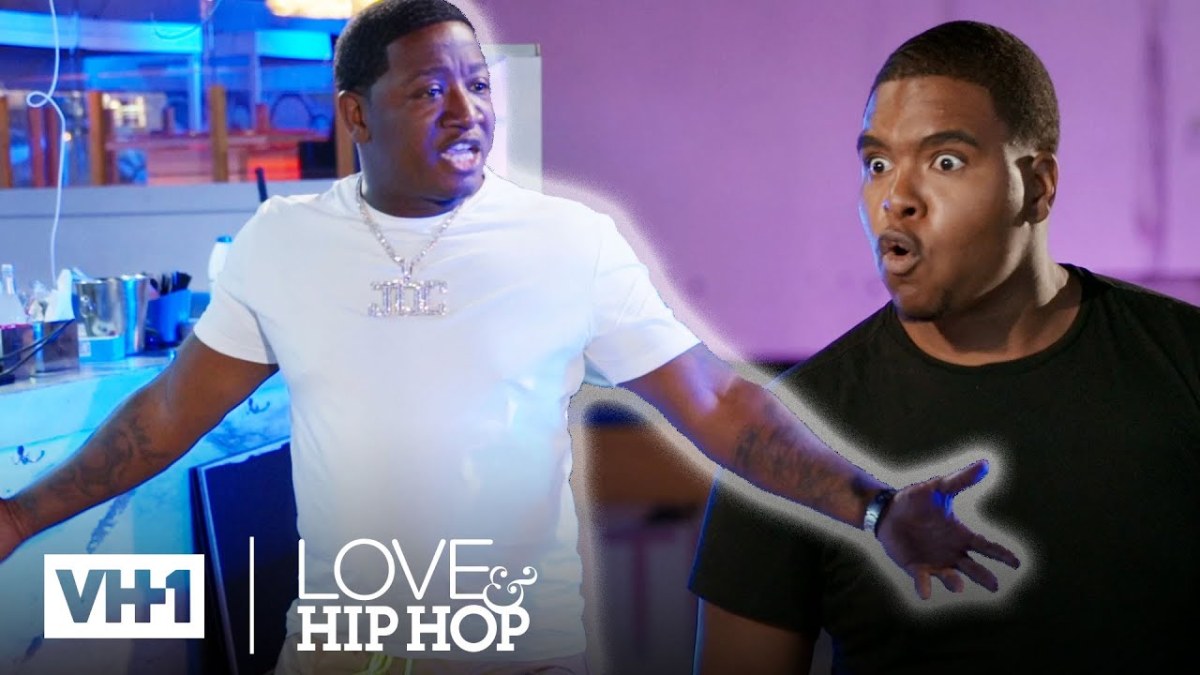
In another moment, Love and Hip Hop: Atlanta continues their emphasis on the black man and societal pressures in the eighth episode of the tenth season. This episode explores the complicated relationship between rapper Yung Joc and his son, Amoni. The scene starts with intense music amping up the meeting of Yung Joc and Amoni in Joc’s closed nightclub. The camera switches frames between Joc and Amoni, mimicking the classic showdown scene from Western films. The conversation between the two men revolves around Joc’s desire to keep his son from bad influences, but fails when his son’s newfound “friends” end up coming to Joc’s club and causing an altercation. This altercation turned deadly when one person was killed.  In this one scene, Yung Joc and his song get into a heated argument that turns physical. Yung Joc says in his confessional, “In today’s climate it’s harder being a black man trying to raise a black son,” He then says to his son, “I want you to be the best you.” Yung Joc’s desire to establish positivity can be shown in his words. He doesn’t want his son to live up to the stereotypical expectations of themselves that many black men deal with. They are expected to either join gangs, be in jail, or have an early death. By airing this moment, Love and Hip Hop: Atlanta shuts down the notion that black men in America do not have high expectations for themselves or their children. 

After this episode aired, there was much discourse on Twitter about what transpired between Yung Joc and Amoni. Although there was some backlash on how Yung Joc handled the situation with Amoni, there was also a lot of positive feedback: 

  • “Young Joc did what any real father would do. Either his son get it or he doesn’t *insert shrug emoji*. Life is hard out here!!! Especially for a black man.” 
  • “Wow. Catching up on #LHHATL and the conversation between Young Joc and his son. Sheesh. These kids need to realize they should cherish the advice parents pass along to them. Hanging around people who shoot at folks will land you in a world of trouble.” 
  • “I’m all for Young Joc putting that Madea fear into his son’s ass!! Boy listen to yo father! He trying to tell yo ass something!! #LHHATL” 

Love and Hip Hop: Atlanta’s focus on black men and their relationships and societal pressure is important because it focuses on real discourse. Many reality shows are scrutinized for their “scripted” plots and becoming more and more dramatized. However, Love and Hip Hop Atlanta goes against this stereotype by representing an important national social and political issue throughout a season. Their desire to live outside the box and create real content for reality TV is starkly different from other reality shows like Big Brother and television shows like Gilmore Girls. Instead of ruling out the minorities, Love and Hip Hop decides to take on minority faceted issues. They allow pedagogic moments to stand in place of moments that could be labeled as “entertainment.” This is shown through the audience reaction to Yung Joc and Amoni’s argument. Many fans of the show empathized and understood Yung Joc’s perspective. This shows that Love and Hip Hop is not just concerned with their ratings, but concerned with actually allowing their audience to truly connect with the messages they are sending. 

To conclude, Love and Hip Hop Atlanta is a fiery franchise that not only seeks to entertain its audience but to teach them on social and political issues. Because the show caters to the black and brown diaspora of America, it’s focus on issues that affect those communities stands out. This is because the diaspora of black and brown people in the U.S comes from a long and complicated history filled with those people fighting to have a voice for themselves. VH1 recognizes the voice of those who have previously been forced into silence. That makes the Love and Hip Hop franchise so profound because it does not seek to further box in already marginalized groups. Instead it desires to to break social and cultural barriers to engage its audience for teachable moments that will last beyond the one hour per week running time. 

Gilmore Girls: A Year in the Life’s Refusal to Address Race

by: Eliza Moore, Communication major

Debuting in 2000, Gilmore Girls has captured the attention of many viewers for the past two decades. Set in the quaint town of Stars Hollow, Gilmore Girls focuses on a single mother (Lorelai) and her daughter (Rory). The show follows both characters’ lives and their day-to-day struggles with men, the town, their family, and each other. While it centers around the two women, Gilmore Girls also emphasizes the small-town culture of Stars Hollow and its utopic atmosphere. In 2016, Netflix developed Gilmore Girls: A Year in the Life, an addition to the original running. A Year in The Life features most of Stars Hollow’s prominent main characters while giving a scope into both Lorelai and Rory’s life years after the original series ended. It contains four hour and a half long episodes, each representing one season of the year. It delves into Rory’s failing career as a journalist as well as her complicated love life. It also gives insight to Lorelai’s hotel business, and her love life with partner Luke as well.

 While Gilmore Girls was well received by the public, A Year in the Life was not as much of a hit as the original series. This post engages A Year in the Life to argue the show emerged in an age of intersectionality and cultural awareness but appears to be stuck in the colorblindness of the early 2000s. A Year in The Life’s refusal to address the societal and cultural issues congruent with 2016 emphasizes its effort to remain apolitical. While the show’s overall colorblindness was considerably par for the course in the late 1990s and early 2000s, its ongoing representation in 2016 feels ideologically and representationally anachronistic. Put another way, remaining a-political in 2016 is itself a political statement. 

In order to explore this idea, this post will focus on how the show centers whiteness. Considering the conversation around race at the time of A Year in the Life’s production, the disregard of racial issues in Stars Hollow disconnects the town from larger social, cultural, and political concerns, converting it into a social idealist space that does not acknowledge racial disparities.

Stars Hollow is a primarily white town with few people of color. The creation of this fictional, white-washed town only re-enforces a white social idealism. Stars Hollow was based off of three small towns in Connecticut: Wallingford, Essex, and Washington. According to census data, Essex and Washington are 94% white and Wallingford is slightly over 90% white. This whiteness bleeds into the show itself, and the ways show runner Amy Sherman-Palladino avoids painting Stars Hollow colorfully.

 While there are a few characters of color, they serve primarily to support Rory and Lorelai, two white women. Take Lane for example, who aids Rory’s character development. While she is Korean and may add some diversity to the show, her token-casted character has little character evolution. The same could be said for other characters of color such as Michelle, Gypsy, and Lane’s mother Emily. Not only are these characters stagnant, but their race is also not addressed in the series. Sherman-Palladino’s refusal to address race in 2016 is aiding in centering the white main characters. They all support a white character’s role in the show in some form.  Especially considering the conversation around racial issues in 2016, it is clear A Year in The Life intentionally avoids any form of racial conversation.

The year of 2016 was by no means an uneventful year. The events surrounding the Ferguson Trial pushed white Americans to look more at racial disparities while an election spurred a tense political climate. It is difficult to imagine that the characters in Gilmore Girls would even be able to remain a-political in 2016, especially the characters of color. It seems that A Year in The Life is unable to address its own politics in the divisive swarm of 2016. This mentality of neutrality only pushes the 2000s colorblindness apparent in the original series. 

 This may have been able to fly in the early 2000s with the original running of Gilmore Girls, but A Year in the Life continues the ideals of a colorblind world centering around the struggles of white main characters. What is this saying about privilege? While Lorelai and Rory do face struggles (Rory struggles to find a job, for instance), the show does a poor job in recognizing their privilege as two able bodied, white women from a background of wealth. The series’ apolitical ideology is making a statement about colorblindness by averting Rory’s white privilege and recreating a white social idealism. Rory has a journalism degree from Yale that was paid for entirely by her wealthy grandparents; a privilege opening countless doors of opportunities for her future. Yet the show depicts her in a world of struggles and closed-doors. While obviously any person will face struggles in life, the show refuses to even touch on the privilege Rory attains. This only serves to centralize a white narrative, leaving no room to address disparities among the characters of color. 

The show provides specific instances where it constructs a particular narrative for where people of color belong in A Year in the Life. Most characters of color hold a working class position in which a white character is in authority, and often disrespects them. One example of this is Emily’s (Loreli’s mother) interaction with her Hispanic maid. Emily is trying to converse with her and becomes flustered because she can’t understand the maid who is speaking Spanish. She then asks for someone to retrieve the gardener in order to interpret the maid for her. This scene takes place in Emily’s home, with Loreli present. Throughout the entire series, Emily is known for her pretentious nature and unreachable standards. She repetitively fires and rehires maids, most of them being women of color. While this specific interaction may have been intended to poke fun of Emily, it emphasizes the shallow narrative afforded people of color in A Year in the Life. These women are often sidelined, mistreated, and stereotyped. They exist in relation to Emily only to serve her and obey her daily wishes. A similar example exists in episode three, in which Rory’s friend Paris becomes flustered when speaking about her Hispanic nanny. She complains that she hasn’t “paid off the last nanny” (inferring she would potentially fire the current one) and is frustrated that the current nanny hasn’t brought her kids downstairs because she didn’t want to walk up the stairs herself. Although the show is painting Paris in a harsh way, the crude remarks go seemingly unnoticed by the other characters. In A Year in the Life, women of color are depicted primarily as support to white families. These examples may even push beyond the show’s colorblindness by reinstating a world in which people of color are there only to hold working class positions. These roles only push the original running’s shallow narrative for people of color.

A Year in The Life certainly did not have as much of a following as the original running, with some calling it “a slap in the face to “Gilmore Girls” fans.” Fans found it monotonous with similar dialogue and recurring events that needed to remain with the original running. Perhaps the public’s response to A Year in the Life emphasizes its stagnant nature, and inability to advance with the times.

It is clear that Gilmore Girls is a colorblind show, with little diversity and limited narratives for people of color. Revolving around two white women with a background of wealth, Gilmore Girls retains an apolitical ideology, avoiding conversations which may be potentially controversial to an imagined mainstream audience by pretending those conversations do not exist. While this may be congruent with most popular television of the early 2000s, 2016 offered an opportunity for the producers to promote a more diverse and representative Stars Hollow in A Year in The Life. Sherman-Palladio certainly had a chance to redeem the white-centered world in Gilmore Girls, but A Year in The Life continues the original running’s idealism of a white-centered world through its refusal to address any character’s race. As awareness regarding racial, cultural, and social issues are continuously being pushed in our world today, a-political programming is, then, not a-political at all. It demonstrates a commitment to avoid, rather than to confront important issues. If television continues to divert from addressing racial issues, it will only continue to center whiteness.

Big Brother: Production and Prejudice

By: Marie Quaranta

Big Brother has been airing on CBS since the summer of 2000. Their long runtime is not reflective of a completely positive experience without controversy. An in-depth analysis demonstrates a long history of strategic production that has enabled various forms of racism on the show. The show aired under George Orwell’s dystopic vision in the novel 1984 that “Big Brother” is always watching. 80 cameras constantly film the guests that live in the house as they compete for a half million dollars. Each week contestants battle in competitions, form alliances, and vote out a fellow castmate. Viewers have the opportunity to pay CBS for access to the livestreams in order to eavesdrop on the houseguests, as host Julie Chen says each episode. The show’s advertising positions the cameras as omniscient and able to capture everything, but what is shown to a television audience is a far more limited, circumscribed view of what happens in the house.

The show airs multiple times a week. In order to produce an episode, the recorded material is filtered down from 24-72 hours of content to a one hour episode. That means for episodes three days apart, the 80 cameras pick up roughly 5760 hours of content and only use .01% of it. While this includes the times contestants are sleeping or performing other banal activities, the deleted material also includes moments where some white contestants have espoused racist viewpoints or used slanderous language to insult other, non-white people competing on the show. In a program that centers around how a group of people interact in a battle for a half million dollars there has historically not been much diversity. Houseguests are routinely broken down into stereotypes or archetypes of their identites: the moronic jock, farmer’s daughter, effeminate gay man, outspoken Latina, angry black woman. The casting does not seem to forget to include a ton of racist white people. Either casting does not do thorough background checks to screen for racism or they intentionally allow these houseguests to get a platform to build drama in the house. It may seem more like coincidence to some, but if casting decisions are made based around archetypes or stereotypes, then the contestants will inevitably reproduce racist ideas on the show itself. 

Moments when racism occurs or race relations are overtly discussed rarely appear in the produced episodes, although some record of them is available in the ‘live feeds.’ As I will discuss in a below section, the live feed cameras are also not always recording; they sometimes switch vantage points between rooms unexpectedly. Producers have been accused of secretly provoking houseguest to play up their racial stereotypes. Microaggressions are ignored. Perpetrators go unpunished and even win their season. This brings the integrity of the programming and producers of the show into question. All of this demonstrates how the show’s desire to present a particular viewpoint of its cast each season is based on producing decisions that obscure or erase how racist ideologies manifest inside the house.

My analysis of Big Brother focuses on three specific seasons, even though racial microaggressions are common in most seasons. The three include season 15 (aired: 2013), seasons 21 (aired: 2019), and season 23 (aired: 2021/current season). These seasons represent two of the most controversial casts as well as the present (and, potentially, future) of the Big Brother franchise. In these examples we can see CBS producers take one step forward and two large steps back in terms of how American racism is represented (or not) within the space of the show.

 Let’s begin with season 15, or as many Big Brother fans regard it, the worst cast of all time. Besides houseguests being generally unlikeable, from the first week it was clear that members of the cast were blatantly racist. CBS had to ask the houseguests early into their stay to kindly refrain from making derogatory comments about their fellow cast members. This warning did not seem to last long, as remarks aggressively continued.

The two main perpetrators of the season were Aaryn and Ginamarie, two blonde white women who try to disguise their racist tendencies behind a pretty face. Their targets: female Asian American contestant Helen, and female African American contestant Candice. I’ve listed below some of the more egregious remarks made about their targets.

In regards to Helen and Asian Americans:

❖  “She should be kissing our ass and serving us some fucking rice.”

❖  “Shut up and go make some rice.”

❖   “I probably look like a squinty asian right now.”

In regards to Candice and African Americans:

❖ “Be careful what you say in the dark, you might not see the bitch.”

❖    “Candice’s blackness is showing now that she is on the block”

❖    “Candice is on the dark side because she already is so dark.”

❖    “Black Candice made the sheets dirty.”

❖    Describing welfare as “n****r insurance”

These comments were not shown on the produced episodes at the time they were said. Live streamers were aware of the horrific comments made by Aaryn and Ginamarie but casual viewers were left in the dark. When it was clear Aaryn was the next target for eviction, CBS produced an edited compilation of the racist remarks to discuss why houseguests were turning against her. Upon her eviction, host Julie Chen had a frank discussion about racism with Aaryn. She claimed she didn’t mean to hurt anyone’s feelings or come across as racist but excused her language as related to how Texans talk. By displacing the blame of her bigotry to her environment and community she is suggesting, however implicitly or accidentally, that racism is culturally ingrained in American society. 

This could have been the end of racism on Big Brother. The problematic cast members lost, were reprimanded, and were not allowed to return to future CBS programming. However, poor casting continued and racist remarks and actions continued to appear on the show. CBS seemed to have switched their methods of handling racist comments, but not necessarily for the better. Six years later, season 21 began and with it came new forms of racism. This season the archetypal “southern gentleman” Jackson Michie became the forefront of the issue. When given power within the house, Michie seemed to target any person of color in an especially malicious manner. In the first episode Michie earned the ability to banish four of his fellow cast members. Viewers immediately called into question his intentions when three of the houseguests nominated for removal were people of color. Michie then spearheaded an alliance that made the first four guests evicted all people of color. This only left two Latina women in the house with the remaining 1o white castmates. Both women were sent packing in the next few weeks.

The racism was not as subtle as just evicting all the people of color from the house. Michie was caught spewing multiple microaggressions about David, an African American competitor, on the live feeds.

❖ “I want to mule kick him in the teeth.”

❖ “I’m gonna find out what makes him tick and torture him.”

❖ “I’m gonna own his soul.”

❖ “You’re not on Bravo or BET.”

❖ Michie made accusations that David had previously been incarcerated without any proof or reasoning.

These comments startled many live stream viewers as they went far beyond the bounds of the competition, as the attacks seemed far more personal. However, unlike season 15 these remarks were completely cut from the produced episodes and never addressed. Due to Michie’s dominance in the game, CBS seemed to be at a crossroads. Michie seemed almost destined to make it to the final two yet he was despised by the most dedicated Big Brother fans. Producers decided to give him the “nice guy” edit to try and smooth over this tension. Despite his actions, he was produced to look like a natural leader and strategic player who had to make some ‘tough’ choices. His comments were not acknowledged until the finale, when Chen asked him about what fans deemed to be racially motivated choices. He responded that he was the least racist person he knows and he is only 24 so he still has a lot of growing to do. Producers gave him a typical narrative that all he needs is time to mature because deep down he is a good person. These decisions largely excuse or elide Michie’s comments as immaturity, something to grow out of, rather than something to be seriously confronted, represented, and discussed.

            In addition to Michie’s highly produced edit, season 21 had much more interference with producers. When Kemi, an African American woman who did not fit the angry black woman stereotype they casted her for and did not give them the drama and aggression they expected, producers quickly urged her to wag her finger and say things like “Uh uh, girlfriend.” Kemi simply stated to her allies that they were trying to portray her as something she is not and that she does not talk like that. The live cameras that are supposed to capture all of these interactions also seem to suddenly move whenever discussing racist behavior in their fellow houseguests. When a few contestants discussed racist remarks made by Michie and his closest ally Jack, the 24/7 cameras suddenly seemed to cut off the feed and switch to another room. These examples demonstrate that producers are having a clear impact on how discussions of racism are shown on Big Brother.

 CBS is one of the last major broadcast networks; as such, they have a large target audience and attempt to make content that will appeal to a mass audience. In doing so, they remove most negative examples of racism and replace them with positive messages and brief conversations. Big Brother is an interesting case study because their live feeds tell a completely different story. CBS tries to take an activist stance when finally addressing major racial issues. What they show is highly produced to have control over the conversation rather than showing the reality of racism in reality TV. However, the majority of racism in contestants still goes widely unseen, which indicates a desire to actively avoid sociopolitical issues and instead present the show as an apolitical game where contestants are strategic leaders rather than ideologically complicated or problematic individuals. Upon analysis it is very clear that producers are in control of every issue of race that is seen and swept under the rug. 

It is also clear to see the producers have struggled to change their whitewashed ways in response to social critique. They are at a crossroads over appealing to masses or taking a societal stance. Season 15 came in wake of George Zimmerman not being held responsible for the death of Trayvon Martin. In turn, CBS actually addressed the racism taking place in the house. The current season, BB23, seems to tell a different story in response to the increase of the Black Lives Matter movement and the death of many like George Floyd, Breonna Taylor, Elijah McClain, and Ahmaud Aubrey. In this season, a very diverse cast and an all African-American alliance formed called the Cookout. Flying relatively under the radar, all six of the cookout members have made it to the final six. Even though all the members did not get along they worked together for a common goal of seeing someone like them finally win the show. Now Big Brother is destined for its first African American winner. This past season has shown the network is capable of creating a diverse cast that doesn’t center around whiteness. It will be interesting to see how next season will be cast. Is Big Brother once again addressing race solely in wake of societal change and pressure? Was the diversity of Big Brother 23 a one time thing? Will producers continue to cast people based on racial stereotypes? How will future racist remarks be addressed? Will racist contestants finally be punished and removed from the CBS house? Most importantly, in what ways will producers sensor and cut racism from live streams to produced episodes? The future of racism on Big Brother is truly up to the producers.

Introduction: The politics of apolitical television

Written by James N. Gilmore

This semester in the Collaborative, we are trying something new and launching this blog, Culture Critically. This is our first series. As is the tradition of the Collaborative, students decide together what they want to write about and explore together. This semester, we are fortunate to have three excellent students: Malaysia Barr, Eliza Moore, and Marie Quaranta. You’ll be reading sole-authored writing from them as well as a collaboratively-written summary at the end of this series.

These students were initially drawn to questions of reality television, and to what degree reality television was engaging explicitly with major sociopolitical concerns of this present moment. Each student identified a television show that mattered to them: Marie selected Big Brother because she has long been interested in the interplay between the “live feeds” of the house and the heavily produced episodes that shape how contestants are understood. Malaysia selected Love and HipHop: Atlanta because of the ways it projects itself for a diverse audience based largely in the intricacies of black lived experience; in this way, it is unlike many more popular or mainstream shows in that it willingly confronts major sociopolitical issues like the killing of black men by the police. Eliza selected Gilmore Girls to move us away from just focusing on reality television and to consider more traditional television programming, as well; in particular, she examined the 2016 sequel miniseries A Year in the Life for the ways it ‘holds over’ the colorblind ideology of the 1990s and early 2000s and makes the show feel socially asynchronous to contemporary conversations.

In mapping out and writing these respective papers, I was motivated to consult Laurie Ouellette and James Hay’s excellent book Better Living with Reality Television. Their work on the educative and public functions of reality television has been meaningful to how I teach this genre in multiple courses, and it felt useful to think about how reality’s civic functions also entail the obfuscation of particular politics both within the show and against the contextual circumstances of a program’s production and broadcast. We decided the best strategy for our posts was to use close reading of key moments and sequences from the series we selected, and to bolster those close analyses with some consideration of reception, which entails a mixture of news reports and social media chatter. This discourse was treated as largely secondary, as a means to support the analysis developed of the programming itself.

The contributions to this series all come from a desire to frame how “being apolitical” is itself a political choice, a decision not to engage in prevalent issues that shape the daily practices of many viewers of these programs. Be it in the ways Gilmore Girls centers white women or the ways Big Brother’s producers try to rehabilitate racist contestants through editing, the elision of politics has consequences for how. It is not—and, certainly, never has been—possible to disarticulate politics from entertainment, from consumption, and from daily life, a lesson that has been key to cultural studies’ commitments to mapping cultural politics.

The posts in this series offer some provisional analysis and pathways for considering how we might use carefully attenuated textual analysis to examine the distinct ways politics both appears in and disappears from television programming. We are pleased to present this work and hope you will enjoy reading it.

Hello and welcome

Written by: James Gilmore

This is an introductory post welcoming readers to Culture Critically. More will be updated and revised in the coming months. For now, all you need to know is that we are the public facing site for work performed in the Collaborative for Communication and Culture, a research collaborative at Clemson University that allows undergraduate and graduate students to work on self-driven works of cultural criticism throughout a semester.

The Collaborative is offered in Clemson’s Department of Communication through a sponsorship with the Creative Inquiry program, which emphasizes undergraduate research opportunities. We are housed in the College of Behavioral, Social, and Health Sciences. Students enrolled in the Collaborative can apply credit towards the senior capstone experience in the COMM BA.

Dr. James N. Gilmore is the director of the Collaborative and launched it in Spring 2020. Dr. Gilmore is an assistant professor of media and technology studies in the Department of Communication. His research focuses on the relationships between technology, culture, and daily life as well as the cultural politics of popular culture. He brings training in the Birmingham tradition of Cultural Studies, and values this space as an opportunity to share provisional work that is developed piecemeal over a series of posts and engagements. This space also allows undergraduates to work on designing, writing, and publishing blog series that strive to communicate academic ideas in an accessible way.

Watch this space for more writing in the coming weeks!