I am an associate professor of media and technology studies in Clemson University’s department of Communication. I am the owner and operator of Culture Critically.
For over 60 years, the Grammys have encapsulated American viewers with everything from flashy performances to heartfelt speeches. The 2021 Grammys show brought about a significant amount of conversation from both celebrities and the public regarding racial representation.
The Grammys have a history of centering whiteness, and lacking diverse representation. Both the nominating committees and nominations have historically lacked racial diversity, as well as a lack of women nominations. While there has been some improvement, many artists nominated in the hip-hop and R&B categories have made statements about their lack of success in the Grammys. According to New York Times, “the show has alienated more and more hip-hop and R&B stars — like Drake, Kanye West, Jay-Z and Frank Ocean — by failing to give them the most prestigious prizes.”
The 2021 Grammys show aired after years of accusations of bias against black artists within the awards organization. Artists have begun to speak out against the Grammys, with The Weeknd spurring much public discourse regarding a boycott against the 2021 showing. With a chart-breaking record and a superbowl halftime show, The Weeknd is critically acclaimed and widely popular, yet he received zero nominations.
Historically, the Grammys nomination process has included “anonymous expert committees” who make all the final determinations regarding who is nominated and who receives the awards. This committee has awarded relatively few people of color with Herbie Hancock to be the last Black artist to win album of the year in 2008, and Lauryn Hill to be the last black woman artist to win in 1999.
The Weeknd’s public boycott was certainly effective, as he was backed by other major artists such as Jay-Z, Frank Ocean, and Kanye West who publicly boycotted the show as well. What does this say about the value of winning a Grammy if so many successful artists of color are clearly not represented? Drake stated that he had to “accept that what once was the highest form of recognition may no longer matter to the artists that exist now and the ones that come after” (https://www.bbc.com/news/entertainment-arts-55084287).
The Weeknd’s efforts to call attention to the lack of representation in the Grammys were not in vain, as the show invited thousands of new members to its academy, hired a diversity officer, and a new advisory group whose intent is to “amplify Black voices”. Hopefully, these changes will be effective and apparent in the 2022 showing, as inclusivity is better enforced. This has the potential to bring about other representational issues. Are the nomination committees truly representative if women and people of color are “tokened” into the committees to save the Grammys from further boycotts and negative public discourse?
Controversies like these are part of a perceived growing lack of value in award shows such as the Grammys. According to the New York Times, the 2021 viewership fell to 8.8 million, showing a 53 percent drop from the previous year of 18.7 viewers. With the apparent issues regarding racial representation, the process and presentation of the show need to be fully reconstructed. While there certainly are some steps being taken in the correct direction to revise the disparities within the nominating process, I think it will take years before the show reaches complete and true revision.
The Weeknd’s public boycott of the 2021 Grammys has been successful in bringing awareness to the lack of representation in American award shows. He was not only able to rally the support of many other Grammy-nominated artists, but provoke change within the nominating system.
Ricky Gervais has been a favorite Golden Globes host since his debut in 2010. He is known for his unfiltered jabs at celebrities and members of the Hollywood Foreign Press Association (the non-profit organization composed of around ninety photographers and journalists who vote for the awards). While most of Gervais’ jokes can be written off as “distasteful” to some and “wickedly funny” to others, they have progressed over the years from harmless roasts to full-on critiques of the Hollywood Foreign Press (HFPA). Gervais’ earlier consecutive hosting years (2010, 2011, and 2012) tread lightly around the association he represents. The host made cracks about mostly himself, Mel Gibson, other individual celebrities, and limited his jabs at the Globes to individual lines. For instance, Gervais quipped that “One thing that can’t be bought is a Golden Globe…officially.” He included some off-color remarks about the Globes and even hinted that the President of the HFPA warned him about going too far. Gervais constantly repeated “I’m not doing this again,” so he always found a way to push the envelope despite claiming that he didn’t care. His performative passiveness didn’t stop him from critiquing the organization and Hollywood in later years. In 2016, Gervais kept pushing the envelope further.”[The Golden Globe] award is, no offense, worthless.” Four years later, in 2020, he pushed harder. He reminded people that he does not give a shit about how people react to him or his critique. In the last two hosting gigs, Gervais increasingly highlighted serious Hollywood issues, including the lack of representation in film, female pay, celebrity hypocrisy, and the acceptance of bribes by various show producers.
Gervais delivering his opening monologue at the 2020 Golden Globes. Image taken from Youtube.
It is increasingly evident that Ricky Gervais, and possibly the audience who loves him, doesn’t care about the Golden Globes anymore and are fully aware of the issues within the organization. There is little to no talk on social media about the Golden Globes or the lack of a 2022 show. The Globes didn’t matter this year. According to Gervais, they only mean anything to the stars themselves. The same stars he called hypocrites for coming to the show in limos. That being said, even some celebrities don’t think the Golden Globes matter anymore. The 2022 winners barely addressed that they won after being announced on Twitter. The Golden Globes, and the war against them, offer us two questions we should be asking ourselves. What makes The Golden Globes matter (if they ever did)? If we don’t care anymore about awards shows or the sanctity of the HFPA, should we care about representation and integrity within the organization?
Maybe it’s better to ask whether or not the Golden Globes matter to us? Do they matter to the HFPA? Yes. Do they matter to directors, actors, and other moviemakers? Maybe. Do they matter to the public? That’s unclear. If you ask some of my colleagues in Clemson’s World Cinema department, they love award season. However, most of America seems to be opting out of watching the awards shows, and many are saying that the entire award industry is dying. Whether or not you watch these shows or check the winners the following day, does it actually affect the movies you watch? You may watch a film because it won something. More than likely, if you are like me, you go to your friends, family, or streaming services for movie recommendations, not the Oscar or Golden Globe website. Furthermore, Gervais has been a hosted five times and is a favoritebecause he does nothing but make fun of the entire show. So for those who had been watching the shows, did they watch because they cared about the awards or because they liked to listen to someone make fun of them? There are people out there who care and people who don’t, but if there is to be a reform in the Golden Globes, any award system for that matter, organizations need to determine what people are paying attention to.
Leading into my second point, if award shows don’t matter to the people, do we care if they make a reform? The HFPA announced that it added members to its party who were people of color and changed some of their bylaws. They also announced their first Chief Diversity, Neil Phillips. NBC even responded by saying they would possibly air the Golden Globes in 2023. Will that change the outcome of their 2023 audience? Who knows. It might not even be worth their time. Gervais has been increasingly making fun of the corruption since 2010. It took ten years for NBC to call out the Golden Globes, and by the time they did, no one missed the show. If people no longer look to awards shows to see who the best actor or actress is or what to add to their watchlist, we probably need to look elsewhere for Hollywood reform. The lack of representation of people of color is not exclusive to the Golden Globes. The Oscars, studios, budgets, talent, and every piece of the entertainment industry lacks people of color and women. However, there is an improvement, and we are slowly getting a more diverse industry.
I don’t doubt that Ricky Gervais and NBC calling out the Golden Globes isn’t necessary, but maybe we should hold every aspect of Hollywood as accountable as they held the Golden Globes. Perhaps the Golden Globes and its critics are the first steps to a more progressive system.
Protestors beat Capitol officers with weapons including a wooden plank with an exposed nail during the January 6 Capitol Riots. Still image taken from video shared to Facebook.
Note: This post was written for the anniversary of the January 6 attack on the Capitol, which the Collaborative researched in the Spring 2021 semester. This post is meant to reflect on our research and what it might offer.These thoughts may appear scattered and incomplete, but so it goes.
Last year, January 6 was the first day of classes for our spring semester. I logged onto a Zoom meeting with the students in my Collaborative for Communication and Culture. We introduced the course and we began brainstorming things to research for the spring semester. We talked generally about the election fraud conspiracies and the “Stop the Steal” movement, but we didn’t leave that first meeting deciding to focus our energies there. We put a pin in it and said we’d pick up the conversation the next week. This was at about 10 in the morning, before things had really spiraled out of control in DC.
That night, one of the students emailed me: “I think I know what we need to research now.”
Over the spring semester, a team of undergraduate researchers and I closely analyzed approximately 200 videos totaling over 12 hours that were distributed over seven different digital platforms—Facebook, Twitter, Snapchat, DLive, Twitch, Parler, and Periscope. We examined the content of these videos—what sorts of actions are represented within them—but also and just as importantly we considered the form of the videos. In other words, we thought about the participants as videographers, purposefully documenting and sharing the events of the day to their followers and networks online.
Much like every form of dissent over the last decade and a half, the Capitol Riots were very clearly drawing on networked public sphere models that scholars like Zeynep Tufekci have been charting for some time. Stop the Steal was coordinated and organized through online sharing of conspiracies and mobilization. This did not just happen through top political elites like the former president but through ongoing concentrated efforts of far-right organizations to first spread a lie (a lie which may have been earnestly believed among many of its proponents, but a lie all the same) and then mobilize people around that lie. Participants in DC were dialoging with online supporters throughout the day. In this ‘networked public sphere,’ filmed testimonials of all sorts were massively important for helping online observers feel like they were part of the action, as well as narrating what was happening and where throughout the day.
If you’ve paid any attention to the reporting on the Riots over the last year, you know this. Smartphone metadata has been instrumental in mapping where participants were and how the events unfolded. The footage shot on these phones and shared online has been part of nearly every news report and documentary produced, including the arguments made during the impeachment trial against the former president.
So what was this documentation—this mediation—of the Capitol Riots trying to accomplish? This is the question my undergraduate researchers and I wanted to answer.
The simple answer—and an answer that’s not much of a surprise if you study documentary filmmaking or protest networks generally—is that they wanted to craft a narrative.
When Trump addressed the crowd on January 6, he said the following: “Fight like hell, and if you don’t fight like hell, you’re not going to have a country anymore.” The House impeachment trial seemed more focused on Trump’s use of ‘fight’ as a directive and other rhetorical choices that rose to the level of incitement. What seems as important—maybe even more so—to us is that second line, “you’re not going to have a country anymore.” It parrots, in its own way, a lot of the videos on Parler encouraging people to join Stop the Steal. One video, a sort of ‘hype trailer’ to get people excited for the event, ended with the tagline “Fight for Trump. Save America. Save the World.”
In other words, Trump’s—and far right social media’s—directives were pitched in the language of nationalism. At stake here was the country itself, which needed to be unified around and through Trump and his supporters. The role of the videos we analyzed, then, were also to help produce this narrative, either through documenting the work of other participants, or through the narration of the videographers themselves who were commenting on what they were seeing.
While somewhat reductive, we saw two major narratives emerge in the videos we analyzed: The Riot as a form of collective action, and The Riot as a form of political revolution. In the former, videographers draw on images of the crowd or consciously highlight their place within the crowd to frame it as a movement of “the people,” broadly defined. In the latter, participants draw on speech, song, and other modes of communication that directly underscores the nationalist sentiments motivating many participants, while placing Trump as the leader of the nation and emphasizing the role of “the people” as agents of revolution. To put it another way, the Riot acts as a violent embodiment of the populist-nationalist sentiments that have pulsed through Trumpism since the early days of his candidacy.
To focus in here on some of the ways this nationalism made the Riot a sort of political revolution or insurrection, consider the prominence of chants like “1776,” “We the People,” and “Whose house? Our house” — all of which center a people-led revolution explicitly invoking the American Revolution, while others like “We are Trump” and “Fight for Trump” focus instead on Trump as the sort of figurehead of this movement. The lines between Trump and the nation blur across the videos, and the chants themselves narrativize the purpose of the Riot.
I still think about one video more than any other. It was shared to Facebook.It is shot from about thirty feet from the Capitol doors. Police officers use riot shields to form a barrier and push back the crowd. A woman on a bullhorn at the front of the crowd calls out: “Everyone, we need gas masks. We need weapons. We need strong, angry patriots to help our boys.” One man passes another an aluminum bat; that man brings the bat high above his head and crashes it down onto an officer’s riot shield. Another throws a fire extinguisher at the police officers. The woman continues: “It’s 1776, and we the people will never give up.” She calls for “we the people” to “stand up for ourselves,” during which time shoes, debris, and poles are hurled towards the officers. Then, one individual holds up a wooden board with a long nail taped to it. They bring the nail down once, twice, and again as more bats swing and the crowd surges.
Shot from behind, the image is shaky and somewhat hard to discern at points what’s happening. The person shooting the video is in the thick of the crowd. At the same time, it’s harrowing. The violence of the participants, the intensity with which they wield bats, poles, and other weapons, complements the dozens of people who hold up phones or mounted GoPro cameras to record what’s going on. It’s a disturbing, intense video that brings together all the threads we saw in our analysis.
The camera does its own kind of violence, working to build the narrative and the support for these actions.
Our documentation and analysis of these videos was meant, then, as a way to sap whatever power they might have, to point to them and show the work they are trying to do. The Capitol Riot was not a successful insurrection, at the end of the day, but these videos still have their own power and force. They are part of broader operations aimed at gaining political, ideological, cultural, and state power, and legitimizing that through violence. These mediations are part of that violence.
The Capitol Riots were aimed at violently overthrowing the democratic process. To suggest otherwise in any way is to refuse to examine the trove of evidence—a trove the participants themselves generated over the day. The participants themselves actively worked to frame their actions as a political revolution, an attempt to stage a war on the Capitol itself and its occupants, to go so far as to “Hang Mike Pence,” as many participants chanted throughout the day. Their videos provide traces of what happened, to be sure, but these videos are ALSO part of how they built their narrative. We must continue to examine them as part of complex ideological networks.
by James N. Gilmore, Malaysia Barr, Eliza Moore, Marie Quaranta
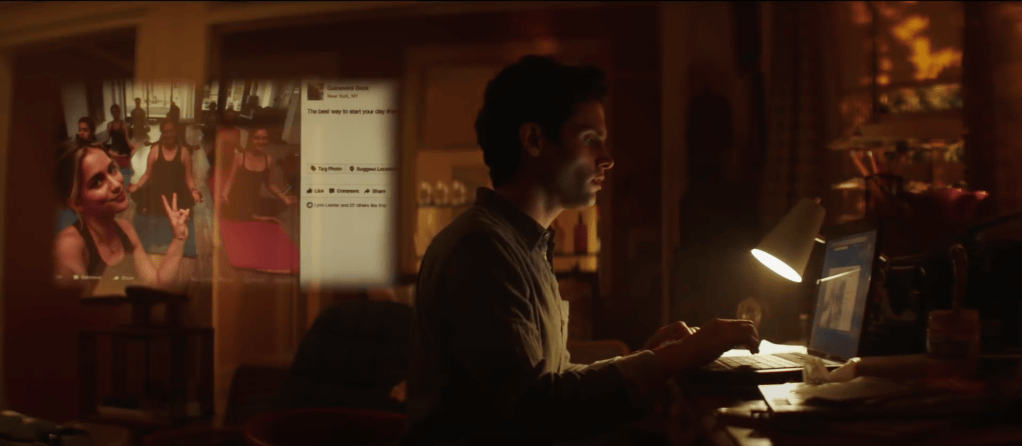
Joe Goldberg as ‘knowledge predator,’ stalking Beck’s managed public identity in You
Introduction: The Knowledge Predator
For this collaborative post, we performed a textual analysis of the first season of You during our Collaborative meetings over a three-week period. This idea sprang from a desire to work on refining textual analysis skills we’d started working on in our first series of the semester, on the politics of ‘apolitical’ television. Given the recent release of You’s third season, the show is something that was on all of our minds and something we’d discussed as a potentially exciting media text to analyze.
We started with a relatively straightforward question to guide our analysis: How does the first season of You represent the relationship between social media and surveillance?
After viewing just one episode, though, we realized this question was pretty limited and wasn’t accounting for the ways You represented the relationship between social media and surveillance as just one part of a larger discourse on identity management and the ways we try to construct and perform particular identities and ideologies online. Further, the focus on surveillance in-and-of-itself did not quite acknowledge how abuse and violence are core parts of the show, in particular how online performativity can become targeted by abusive men.
As we moved through the season, we came to see You as actually quite concerned with Michel Foucault’s conception of power/knowledge–that those who are in power are able to set conditions of knowledge. Likewise, people who aspire to have power over others use knowledge as a means to do so.
In You’s Pilot, bookshop manager Joe Goldberg meets and becomes infatuated with MFA student and aspiring writer Guenivere Beck. Joe believes immediately that he and Beck are destined to be together, and he sets out to learn everything he can about her, first through social media and then through progressively intimate stalking. He uses the information he gathers to insinuate himself into her life and perform as the person he believes she wants. Meanwhile, Beck also hides important parts of her personal life, using social media to carefully craft an understanding of her worldview and manipulate her way into particular social circles.
We came to define Joe as a knowledge predator. His stalking of Beck begins as a sort of pleasure, a particular form of voyeurism and scopophilia that comes not just from looking at her body but from knowing what she is doing and where she is at all times. In this way, Joe comes to embody a process of power/knowledge, a way of gaining power over Beck based on how he learns and uses knowledge about her everyday life.
Being a “knowledge predator” has, for Joe and for You, at least four distinct phases:
Voyeurism: Learning about Beck is a pleasurable activity, which occasionally translates into sexual pleasure or fantastizing about Beck while viewing her. This is a game for Joe, where learning about someone doesn’t simply make him desire them more: the looking and the learning are themselves forms of pleasure.
Control: Once Joe and Beck are dating, he uses the knowledge he’s learned to try and manipulate her. He buys the same books she has in her apartment, he acts similarly to men he’s watched her sleep with, and he works hard to cultivate a ‘perfect’ sense of himself. This is all meant to draw Beck further into Joe’s life, where he is able to more easily monitor her comings and goings. This is exemplified by Joe stealing Beck’s phone and using it to spy on her text messages and scheduled appointments, and in turn using what he’s learned to vary his performance.
Abuse: This form of control, while Joe justifies it as a way of being romantic, eventually becomes abusive. Joe begins following Beck and becomes more forceful with her, leading her to break up with him for a time. Joe acts violently towards Beck’s friends, he stalks her therapist to find out if Beck is cheating on him, and he deploys other strategies meant to keep Beck’s world small and under his thumb. This is, again, largely played out along the axis of power/knowledge, where Joe understands the value of knowledge as a way to manipulate other people.
Violence: Eventually, Beck figures out what Joe has been doing, and that he has murdered multiple people to keep her tied to him. Because Beck learns this knowledge, however accidentally, Joe kills her as she tries to flee.
In tracing this arc, we came to see You as a complex story about gendered violence, abuse, and identity management alongside its depictions of surveillance and stalking through digital technology. Our idea of a “knowledge predator” offers one way of examining how the relationship between knowledge and power manifest in regards to romantic relationships and digital technology. While perhaps a far cry from how Foucault developed the term out of his archaeology and genealogy of different institutions, using it as a through-line alongside questions of identity and performance as we analyzed You provided a useful prism for analyzinng how power/knowledge operates as a form of control and manipulation in interpersonal relationships.
While the remainder of this post focuses more on the themes of identity management and performance, the idea of the knowledge predator as a figure sitting at the intersections of power, knowledge, and control provides an underpinning to our textual analysis that situates You as a critical text which is actively questioning how knowledge about other people gets constructed and how this knowledge can get deployed for abusive and violent ends.
The analysis below focuses on six characters–three major and three minor–from the first season of You, and how they embody the theme of identity management: the conscious performances, both online and off, of how we communicate our personalities, desires, and histories. We tried to identify the characters within archetypes and overall themes of what they contribute to the show’s ideas, and selected relevant examples to explore these ideas. The sections here, patchwork though they are, point to how these characters are all bound up in complicated relationships built on how they choose to construct, perform, and manage their identities.
Identity management in You
Joe (The Narrator)
As season one of You unfolds, we are guided with the narration of main character Joe Goldberg, a voice of manipulation and obsession. From the outside Joe seems like a normal, nice guy. He works in a bookstore and is seemingly harmless in his interactions with other characters. But as Joe’s narration reveals his thoughts and intentions with Beck, we become aware of his uncontrollable obsessiveness.
We first see Joe’s obsessive nature in his desire for any form of knowledge of Beck. Whether it is collecting information from her social media or stalking her outside of her apartment, ultimately Joe is a predator. Joe not only preys on Beck’s information, data, and location, but he also preys on her identity. He uses this information to make assumptions about Beck and craft a story in his mind for who he thinks she is. This obsessiveness consumes his thoughts as he convinces himself that anyone that holds a piece of Beck’s identity is a threat, leading him to acts of violence. His violence begins as his “way of protecting Beck”, leading him to murder first Benji (her boyfriend), then Peach (her best friend), and eventually Beck herself. While his murder of Beck is obviously not out of intentions to protect her, it expresses Joe’s spiral when he longer can hold any sense of control over her. His spiral of obsessiveness leads to an outburst of violence, showcasing his inability to deal with anything outside the realm of his control.
Joe as the narrator also reveals that he is manipulative. He manipulates situations and information to make himself appear as a necessary “savior” in Beck’s life. While he manipulates Beck and her surroundings, his narration exposes he even manipulates his own thoughts to convince himself he is doing acts of “good” for Beck. This is seen when Joe assaults Beck’s friend Peach while she is runs in the park. In voiceover, he narrates to himself his need to get rid of Peach because of her “threat” to Beck saying “it’s brave what I would do for you” to later convincing himself that he isn’t violent saying “I would never do this I would never hurt a woman”. Joe is driven by control to a point where he can manipulate his own thoughts. His need for control leads him to a need for knowledge, eventually leading him to violent acts, resulting in Bec’s downfall with many others as collateral damage.
While Joe Goldberg may appear and present himself as an “ordinary” guy, viewers are brought into his true intentions through his narration: control. Joe as the narrator allows viewers to receive insight of his predatory nature while outside characters receive no warnings to his surprising acts of violence. This dramatic irony allows us to consider how Joe constructs himself to other characters on the show and understand how this builds his concluding act of violence: the murder of the one he wanted so desperately to protect.
Beck (The Writer)
Beck has two facets within You. On the one hand, there is the narrative she creates for those around her where she is working as her own author and storyteller. On the other hand, from Joe’s perspective and narration, she is a metaphorical book he is trying to understand internally and repair externally. Joe talks about books as things of ‘value,’ and he repeatedly positions Beck alongside and in relation to books, as an object that needs tending and care. Neither the narrative she creates about herself, nor what Joe assumes of her are accurate depictions of the true Guinevere Beck. It seems the ‘real’ Beck has been lost in translation so many times that it is nearly impossible to access her truth.
Let’s begin with the image Beck creates of herself. Based on her social media, Beck is an untroubled, unworried, at peace, and a witty individual who lives a perfectly balanced life in the big city. On social media the only time Beck’s life is a mess is in a cute way, which does not properly reflect her true physical and emotional stress. She is struggling to make ends meet, feels out of place with her friends, and lacks confidence in her writing. To her followers, the image she creates through Instagram and Twitter gives her some kind of reassurance that on the outside she seems fine even if she is struggling on the inside.
The image Beck creates with her friends and the people physically around her adds another dimension to the narrative Beck writes for herself. She spends money she doesn’t have to keep up with her high society friends, who in reality have little in common with her. To them, her intelligence and creativity as a writer gives her a unique value they lack in their own life, but unbeknownst to them writing is her greatest struggle. The most egregious discrepancy from the life Beck creates for herself and the deeply hidden reality is the story of her father. Everyone is under the impression that Beck’s dad died from an overdose when she was a kid, when in reality he survived and started over with a new family. She has even blocked him on social media, writing him out of her digital identity altogether.
When Joe first sees Beck she is like a pretty book cover that he uses to make assumptions about the material on the inside. Upon further investigation, she is far more complicated and filled with plot twists that he could never expect, which leaves him enthralled in her story and desperate to fix and protect the outer image, just as he is shown repairing rare books throughout the course of the season. From Joe’s perspective, Beck is an object, one of his rare book editions, a love that is fragile and unique and must be protected. However, Beck is not a book, even if she ends up that way after being trapped in Joe’s cage. Even though Joe thinks he knows her, he only knows the story she has told him and the picture she allows him to see. Which leaves Joe content to close her chapter in his book when the story goes awry.
Peach (The Repressed)
As Joe fights to narrate his story and Beck desires to put her own story into words, there is much to be said aboutPeach Salinger. As one of Beck’s closest friends, she played a major role when it came to how Joe fit her into the narrative he was creating for himself about Beck. At first glance, it seems as though Peach is a typical rich, snooty, and mean friend. In later episodes, however, it is revealed that Peach is gay and has an obsessive crush on Beck. We see this in episode five, as Joe is stalking Peach’s everyday routine. He manages to swipe her bag and finds a racy photo of Beck inside her journal (19:06-20:44). Scenes later, Joe hacks into Peach’s laptop and finds even more intimate photos of Beck (27:02-27:56).
This revelation changes Peach’s representation considerably. Instead of viewing her as a character straight from Mean Girls, she is positioned as someone who is in conflict with who she really is. Until her death, Peach portrayed herself as put-together and well-off, both financially and socially.. But underneath the surface level, she was actually repressed and closeted, afraid to live her truth because of pressures she felt from her family to live a particular identity. Because Peach’s family would not be accepting of her sexuality, she locked that part of her away. Instead what manifested in its place was a manipulative and controlling person, specifically within her friendship to Beck.
We see this in episode five, when Beck tells her that she is getting connected with a literary agent. Instead of rejoicing for her friend, Peach takes it into her hands to remove the agent that her school has given her and instead connects her with someone she knows. She then tells Joe (18:39-18:41), “She’s lucky she has me. Beck rarely knows what’s best for her.” In saying this, Peach unknowingly identifies with her enemy- Joe. Both feel that they know what is best for Beck and can control her. However, Beck differs greatly from Joe because while Joe manipulates and controls Beck’s life in a private, sneaky manner- Peach does this openly to prove that she is the alpha female in Beck’s life.
This controlling narrative increases after she gets attacked in the park by Joe. After the incident, Peach attempts to isolate Beck and takes her to her family’s estate in Connecticut. While Peach claims she needs to recuperate from her attack, her plan is really to woo Beck into going to Paris with her. Yet- just like her sexuality- she represses her actual plan by buying Beck nice things and attempting to get her drunk and high. When she and Beck kiss in episode six, it causes Beck to leave the room and reject Peach’s advances.
When the morning comes and Beck confronts her about her sexuality, Peach then decides to return to her default setting: repress her true feelings and act out of meanness. This repression is what leads her to her downfall: Joe tries to manipulate Peach based on the knowledge he’s gained about her. After they both wrestle over a gun, Joe kills Peach, removing another perceived ‘threat’ from his relationship to Beck.
Annika (The Influencer)
One of Beck’s other friends, Annika, is represented as a body-positive social media influencer who has multiple brand partnerships and a large following. The job of influencer is a new one that came to life in the age of the internet and social networking. Annika was able to transform herself and her story through social media influence. Annika no longer had to be just Peach’s ‘overweight’ sidekick but instead created a following of her own as a body positive influencer. Her status as an influencer gave her a newfound power in her dynamic with Peach. Her social media following, even while most were anonymous strangers, gave her a sense of reassurance for her crafted persona that was lacking in her everyday life.
On social media, Annika had carefully crafted herself to demonstrate confidence, positivity, and perseverance. Annika created her posts to seem carefree and natural, yet based on what we see of her behind the scenes, Annika is far from the image she creates. Peach still has the power to tear Annika’s confidence down when they are in person. Annika is far more hesitant to respond and maintain her strength when the approval of thousands is not echoing around her.
The most pivotal moment in Annika’s storyline is when she posts an unflattering picture with Peach, all under Joe’s suggestion and manipulation, with the caption “Bitches being our most authentic selves.” In response to this, an anonymous account, clearly presumed to be Peach’s retaliation, responds with a video of Annika making a racist statement about black men and white men responding to her curvaceous figure. Peach was able to destroy Annika with the very thing that once gave her happiness and power. The storyline demonstrates the fragility of a false–or, at least, highly constructed–identity and the fickleness of a social media following. The image one creates for themselves, as Annika did using social media, may take ages to develop and properly curate, but can all be destroyed with one inconsistency or mistake.
Candace (The Ghost)
Joe Goldberg’s ex-girlfriend Candace certainly plays a role in revealing his identity as a manipulative predator, as she becomes “the ghost” for Joe throughout eason one. While Candace appears primarily in Joe’s flashbacks and hallucinations, it is evident she is Joe’s “ghost” because the essence of her is constantly haunting his mind, only pushing him closer to his obsession with Beck.
It is clear Joe is filled with desire and control. While Candace may have not been physically present, she certainly held a form of control over Joe, as he is unable to erase her from his mind. This only drives him further in pursuance of control over Beck, using Beck to fill a void left by Candace. Joe often sees Beck and imagines Candace. He sees Candace, but is constantly reminding himself that Beck isn’t like her, while Candace is still very evidently on his mind. Several scenes throughout the season show Joe looking at Beck and seeing Candace. While Candace may be “the ghost” of the season, Beck’s curiosity about what happened to her led to Beck discovering Joe’s violent actions becoming his prisoner.
In the final episodes of season one, Beck decides to research what really happened with Candace. When she cannot get a clear answer, Beck becomes increasingly suspicious of Joe and begins investigating him, ultimately finding several of Joe’s horde of stolen items (including some of Beck’s underwear and some unidentified human teeth) . While Candace had no true physical presence for almost the entirety of the show, her role as “the ghost” is vital in driving both Joe and Beck into spirals for information.
Karen (The Detox)
As Candance is the ghost, Karen Minty might be considered “the detox”. Karen is a friend of Claudia, Joe’s neighbor. She becomes Joe’s “rebound” girl after he and Beck break up. Karen can be positioned as ‘the detox’ for several reasons. The first reason is that she literally helped Claudia detox from drugs in the eighth episode. As a nurse, Karen is trained on how to help sick people. So when Claudia was detoxing from drugs, she took great efforts to help her friend come back to her normal self. Karen also helps Claudia when it comes to her relationship with Ron. Ron is abusive to Claudia, and has never been great to her son Paco. In an attempt to keep him away at one point, Karen chases Ron with a baseball bat. Although Claudia goes back to Ron, she does successfully kick her drug habit with help from Karen.
As she helps Paco and Claudia, Karen is also unknowingly helping Joe out of his addiction to Beck. Although Karen serves as the rebound girl, Joe is purposefully using her to attempt to get over his obsessive love towards Beck. Joe sees Karen as good for him, because he believes that she will help him break his obsessions with Beck. Despite this, he still points out her flaws (like her use of the word “babe” and the things she watches on television). Even in him seeing her flaws, Joe desires not to hurt her at all. Even when he cheats on her with Beck, Joe still feels that Karen is too good. For Joe, she served as a failed detox because he ends up dumping her to go back to Beck. This matters because it shows viewers that Joe’s obsessive tendencies are compulsive and no matter what he does, he cannot stop them. This reaffirms Joe as a predator and shows that he cannot operate in a normal way, even in his failed relationship with Karen.
Joe and Karen’s relationship ends, but not without Karen serving as an attempted detox for Beck. At the very end of the eighth episode, Karen purposefully runs into Beck. She tells her, “Just be careful” (43:29). This is her attempt to warn Beck about Joe’s suspicious behavior and obsessive tendencies. Karen is completely unaware of the fact that Joe has killed, but she knows that something is off as she mentions Candance in her encounter with Beck. Despite Beck being the one who cheated on Joe while he was with her, Karen still seeks to do good to her- as a good detox should.
Karen may have a small role, but her role as the detox is important as she works to help people- even though Joe rejects her in favor of embracing his addiction to Beck.
Conclusion: Image creation as a violent act
Taking together this arc of the knowledge predator as well as the six different ways we analyzed identity management and different archetypes in the show’s first season, we found ourselves returning again and again to the underlying theme of self-creation, or how we try to create narratives for ourselves. On You, characters’ attempts to fashion their own image only leads to violence. While dramatic for the sake of producing a thriller and suspense show, the writing on You is not particularly kind to the many ways people try to perform, narrate, and shape their senses of who they are publicly.
This is perhaps a reaction to the increasing reality that private life is lived on public spheres of all sorts, and lives can be peered into through a variety of screens, from Beck’s enormous open apartment windows to the cracked screen of her smartphone. These screens, which are omnipresent in You and also include the clear plastic of Joe’s rare book preservation center/human prisoner cage, indicate some of the ways these characters are trapped. They all try to wear masks of various sorts, but these masks are all shown to be untenable, impossible to keep on for too long a time.
Finally, we reflected on what we gained through doing such a lengthy textual analysis of a single season. All of us agreed that going episode by episode allowed for a more careful understanding of character behavior and relationships, the ability to track themes and ideas, and a revealing of different symbols that emerged. We were able to track, for instance, a mallet that Joe uses to repair books, assemble a bed for Beck, murder Benji, and break Beck’s phone after taking her captive. We were able to note how window screens were used as sites of surveillance. We were able to untangle how Joe constantly revises his own narrative, how Beck manipulates information, and how technology moves in and out of the main narrative.
Most importantly, though, this kind of collaborative writing allowed us to brainstorm freely and build off each other’s contributions in conversation. This post only represents a small handful of the ideas we discussed and sequences we analyzed over the course of three weeks. The value of collaborative textual analysis, at its core, seemed to be the ability to map complexities within the show, and use each other’s vantage points to add greater dimensionality to the map of meaning.
by: James N. Gilmore, Malaysia Barr, Eliza Moore, Marie Quaranta
Throughout this series, we have been using self-reflective approaches to describe different experiences with religious practice. Rather than offering broader analyses of young adults, we’ve focused on the particulars of our individual experiences. Our inspiration here was, in part, Raymond Williams’s essay “Culture is Ordinary,” which thinks about the concept of culture as much from Williams’s own adolescence as it does from the more abstract vantage point of Marxism’s development
Our goal was to explore the value of individuality and experience in writing about cultural practice, drawing from our own histories, anecdotes, and moments of revelation to “make sense of” difficult ideas about how people negotiate their religious identities in early adulthood through different institutions. Through writing these posts and sharing them with one another, we have affirmed for ourselves the value of using our own lives as the basis of critical engagement with the institutions we live through.
In developing these posts, we also landed on a triad of culture-subculture-counterculture to help distinguish how these cultural practices related to each other. We positioned institutional churches as a dominant “culture,” recognizing the power many of them still hold and the their important place in the lives of many religious people. Our subcultural and countercultural practices exist, then, in relation to the institutional church, which becomes positioned at the center of how religious practice is represented and understood. This triangle of terms is interrelated; each depends on the other and helps demonstrate something of the complexity of cultural practices.
Finally, we realized the through line across the three posts was community, and the ways human relationships—for better or for worse—were crucial factors in shaping what kind of religious practices and communities people wanted to belong to. Regardless of where one is located in this triad—and, indeed, there are certainly many other subcultures and countercultures, not to mention other sorts of cultures we simply didn’t have the opportunity to consider—it seems that these efforts at creating community were, for us, primary drivers in what sustained religious belonging.
We started this series with a discussion about how religion helps people make sense of life and helps create a structure of meaning to the world. While it certainly does these things in many ways, a common thread we’ve identified is that the communal bonds formed through cultural practice are key for young adults looking for belonging. This series was extremely rewarding to produce, as it allowed us a unique opportunity to see what we could do with reflecting on very meaningful elements of our lives and stitch them together into a broader understanding of how people navigate religious communities as a form of culture.
The decline in religion is far more than a statistic. Even though the prevalence of people practicing religion around the world has taken a hit it is not by coincidence or accident. While the motivations for people to leave an organized religion are varied, here is my own. I grew up in a Catholic household. Some might associate this with very strict and conservative parents, however that was far from how I was raised. My mother was something of a hippie who was forced into Catholic school by her Hungarian immigrant parents. Even though she rebelled against religion at a young age she always seemed to come back to it and wanted the same for her children. My mother’s slogan was always, “I’d rather my children rebel against the church than me!” As such, my siblings and I were caravanned to church every Sunday and bible study each Wednesday. I hated it but at least my best friend was also forced to be there.
Everything changed when my parents got divorced. Suddenly my mother also dreaded going to mass each Sunday. We no longer stayed after mass to chat with people and make the rounds. As a child this was amazing: it meant we got to go home and watch cartoons together. However, as I got older my mother opened up about how the entire church shunned her when news of her divorce spread. You would think she had killed her husband the way people looked at her. Other married women shuffled away from her as if her divorce would wear off on them.
I soon began to resent these people who treated my mother so poorly. How could someone preach love and acceptance and then turn their back on one another? I no longer found the teachings to be meaningful, but rather hypocritical. Everything that was preached seemed so out of touch with the way people acted. We must, so this logic went, love thy neighbor but at the same time refuse to accept divorced persons and any member of the LGBTQ+ as a part of our community. Right after my confirmation, an official sacrament accepting responsibility for your faith and destiny, I stopped attending mass, as did the rest of my family.
My family began new traditions instead. It was mandatory that everyone was home on Sunday afternoon and evening to spend time with family. My mother never had to enforce this rule, it was just something we were all happy to do. We had deep conversations at dinner about politics, what we believed in, and our aspirations in life. My family replaced a church service with communing together over food and positivity.
Soon my sister and I became interested in astrology. We loved figuring out what our charts meant and how it could be reflected in our day to day lives. We got the rest of our family involved, and surprisingly they all loved it. It seemed like the cosmic powers somehow really did understand all of us. For my family, astrology became, in a sense, countercultural. It didn’t take the place of religion or subvert it in the way some countercultures do, but it opened up an alternate space, a way of thinking about the world that didn’t reproduce the hypocrisies of organized churchgoing. It seemed like many other people began to see the merits of astrology. I wondered if this had something to do with the growing distrust and distaste for organized religion. For me, astrology did not provide a substitute for religion but rather another way of thinking about the world without the hypocrisy of the institutional church. For the rest of this paper I will try to process why so many people, especially youth like myself, have turned away from institutional forms of religion and turned to their own definition of spirituality and astrology.
Church attendance has been steadily declining in the United States. The trend began long before I, a member of Gen Z, made the switch. Each generation in the U.S. has steadily become less religiously affiliated starting with the Silent Generation. The primary shift away from religion could be attributed to Baby Boomers and some early Gen X growing up in the 70s alongside the final wave of hippie culture. The U.S. was ripe with protest and challenging traditional beliefs at this time. Women, African Americans, Native Americans, the LGBTQ+, and so many more marginalized groups were fighting for equality and acceptance. Anti War sentiments were strong and there began to be a call to action to save the environment. Organized religion did not make many progressive changes at the time. In fact, societal progression often made organized religion take deeper roots in their conservative traditional mindset. There are a lot of parallels between the protest and activism of the 1970s and the 2010s. The years were ripe with political unrest, social movements, distrust in government, and calls for environmental progress. This set the stage for a similar rebellion against organized religion, as institutions of all sorts were not seen as trustworthy, and indeed as interfering with the lives of people.
So why astrology? What would make young people turn to the stars? I can dissect this choice into a few reasons, somewhat based on my own personal experience. To begin, the rise in popularity of astrology was never meant to replace organized religion. The two are not mutually exclusive. However, younger generations may be drawn to astrology over a structured church atmosphere because it is open and accepting. There is no set rule of how to act, look, or practice astrology. You would not be considered a ‘bad’ follower of astrology if you only like to look at your horoscope once a month or whenever it comes up in conversation. People are free to be themselves and let the spirituality of astrology turn into whatever they need. As Malaysia and Eliza noted in their posts, one of the greatest strengths of organized religion is the community it provides. That community is great for those who have not been exiled or disenfranchised from it, like with my own mother. I have not felt welcomed in my church since the day I realized the hidden cruelness of those within the community. This experience is not just mine; it is very common for people who do not fit into the traditional boxes presented by rigid religions.
To replace the community traditional organized religion provided, young people turned to one of the things they know best: technology. Social media has begun a place to form groups of many kinds, and it has given a place for astrology lovers to unite. These short snippets of astrology can easily fit into everyday life without much strain or feeling like a chore. Instead, they have been made to be fun and engaging by youths for youths. Organized religion which seems so often arbitrarily based on the words of an ancient dead man makes turning to the stars no longer seem so far fetched.
Many Instagram pages are dedicated to making aesthetically pleasing astrology posts. Some accounts take a more factual approach with daily readings and explanations of what mercury being in retrograde actually means. The Instagram platform has become a place for astrology experts to share their knowledge and reach millions of people. There are a plethora of smaller accounts posting this content but some of the largest are @horoscopes.astrology (358 K followers), @themoontarot (952K followers), and @costarastrology (1.9 M followers). CoStar’s bio perfectly describes what accounts like this offer: a “hyper-personalized, social astrology experience.” Each facet of your chart is explored and explained on a regular basis to provide guidance, clarity, and goals. Accounts like these are for more of the dedicated practitioners of astrology who want to understand how stars and planets interplay with everyday life.
On a less serious note, Gen Z’s love for memes has also taken a hold over astrology. Accounts like @thezodiacstea (1.2 M followers), @sanctuarywrld (1.3 M followers), and @glossyzodiac (4.9 M followers) are the leaders of this astrology subculture. By far the most popular @glossyzodiac, has combined popular culture, memes, and astrology to create an engaging comedic account that has inspired many others. The posts on @glossyzodiac include some of Gen Z’s fashion icons, music idols, and favorite childhood TV shows. The account has been able to respond quickly to trends because they are members of the generations making them. It is appealing to newcomers of astrology because zodiac signs are explained in comedic lighthearted terms rather than strict rules.
@Sanctuarywrld which seems to combine both memes and relatable content with highly meaningful posts. The post shown to the left demonstrates a comedic way to live your life in response to astrological events. They focus heavily on the astrological community, as seen by its location front and center on their highlight reels. Even if their account is lighthearted and whimsical, they have gone out of their way to support social movements like Black Lives Matter and LGBTQ+ rights.
Astrology can be easy, fast, and fun or it can be deep, meaningful, and spiritual. At the end of the day, the common thread is that astrology is whatever someone makes of it. A community is formed around the common interest in astrology that is accepting and open rather than judgemental and closed minded. Following the stars or looking at your horoscope does not have to be a chore or a negative aspect of life because there is no enforcement or leader higher than the rest. Everyone can be equals exploring what the world means and how it works together. The decline in church attendance and the rise of astrology in popular culture demonstrate, potentially, a shift in beliefs. There is a common trend, no matter the generation, of youth culture fighting back against dominant older cultures. These days, young people want open forums and fewer groundless rules. They want a short sweet interpretable message rather than a long meaning that is set in stone and repetitive. They want honesty and sincerity, not a group of people under the facade of a loving community. Astrology has become a rebuttal to everything that organized religion is not. In these ways, it serves as a countercultural site playing out across social networking platforms and other online and physical practices. Youth culture wants to look to the stars and the future rather than staying locked in our ancient past.
Growing up in South Carolina, I have been around religion and the church my whole life. I attended church services weekly, usually supplemented with a youth group or other various activities. While I did not necessarily have a bad experience with the church, what drew me more to Christianity was a non-profit ministry organization called Young Life. I was drawn to Young Life from an early age and started attending in early middle school. I enjoyed that it was catered to my age and was more focused on events. From the music to the message, all of it was more simplistic and I was able to grasp what Jesus actually meant for me personally. The way messages were shared was more applicable to my life and was spoken in a way that made sense to me as a middle schooler. Each week, Young Life’s main event “club” has a short talk at the end about the story from the Bible. At the end of each club, a leader stands up and gives a “talk” which is essentially a brief message about a story in the Bible. They are written in simplistic terms so anyone is able to understand what the leader is trying to convey. At this age, I often left church confused and quite honestly found it boring. Young Life club was vastly different from anything I had experienced in a church service. Club talks helped me understand what the Bible said about Christianity because they were always spoken in terms I could understand and comprehend. They were also spoken by college-aged leaders that I felt more comfortable listening to than my older male preacher. I felt like I could be myself around them because they weren’t as far from my stage of life, and could empathize with things I was going through. They were inviting, approachable, and welcoming. I was always included and invited into what they were speaking about, something vastly different from what I experienced as a youth in the church.
I additionally became involved because it was inclusive and anyone from my school was able to attend. I became even more involved in high school, as I was continually welcomed into this community. I served at a camp for a summer and was active in the events. This helped develop a relationship-driven version of religion in my life because I had people surrounding me and guiding me into what I was searching for in religion: purpose. In a quest to find a sense of meaning in my life, I have found that a relational approach has been the most consequential in giving me a sense of purpose. In the church I heard about a distant God that did not have much involvement in my personal life. Young Life described Jesus as a person who pursued me and wanted to befriend me. This changed my entire view of religion.
The “relational approach” of Young Life is essentially to meet kids where they are. Whether this is in a lunchroom, or at a sporting event, Young Life leaders were present in the same places I was. Young Life provided me with people that pushed me to discover what my purpose was, and created environments where I could discuss and delve into my purpose with others.
My leaders were greatly involved in my life and served a large role in my personal faith. They came to my track meets, planned fun events for me, and went out of their way to spend time with me. This form of “religion” stood out to me compared to what I had experienced in the church because it was relationally driven. My experiences with the church were primarily hearing a sermon or message then leaving. This form of ritual communication didn’t stick with me throughout the week. I often left what I heard in church inside the building, making my religion defined to a Sunday. It boxed my narrow view of religion into one day a week. Young Life offered me friends that wanted to walk alongside me throughout the entire week, as I was told about a God who was not just present on Sundays.
This could be viewed as a “subcultural” as it is distinct from but related to the dominant cultural practices of Christianity. While Young Life is separate from the institutional church, it serves a supporting role in creating a subcultural space specifically for the youth.
Because of my positive experiences with Young Life in high school, I am now a volunteer leader at a local high school. My motivation behind becoming a leader is to show high schoolers the care and intention my leaders showed me, and hope to show them a less rigid Christianity than what is pushed in so many churches. With a team of other college leaders, I help plan, promote, and facilitate weekly events while building relationships with high schoolers within the school.
The most impactful element of being a volunteer leader thus far has been taking some of my high school friends to camp. Each year, Young Life camps across the nation host a week-long camp experience for high schoolers and middle schoolers to attend. While camp has many fun activities and games, the purpose of camp is to share the story of the gospel over the course of a week. This is executed through daily “clubs” that end with a message, each sequentially going through a section of the gospel story as the week goes on. I have found this approach to Christianity different from others because it introduces kids to the story of the Gospel while still showing them that life as a Christian can still be fun and exciting. Young Life camp is also leader-centered. The leaders run daily “cabin time” discussions after the “talks” that help answer kid’s questions and guide them through what the speaker talks about. The leader also guides activities and games, while building relationships with the kids in their cabin. My experience as a leader at camp was impactful because I feel like I was able to build deeper relationships with my high school friends and carry those relationships into their lives at home as well. Typically, religious-affiliated summer camps hire counselors that befriend campers throughout the summer, then go home to a different place. I have found Young Life camp to be effective because leaders continue to be a part of a camper’s high school experience after the week of camp is over. I was able to hear about the lives of certain kids, then continue to be invested in their life when we got home.
Young Life has a mission to explain the gospel story in terms that students will understand. While this is accomplished in how the speakers communicate, it is also accomplished through creating an environment that high schoolers feel comfortable in. I think Young Life’s approach to religion is different from most religious institutions because it involves having fun and doing things catered to what they enjoy. It doesn’t just push a particular agenda; it invites kids into an exciting and inviting atmosphere. I have found great value in how Young Life has emphasized relationships in how it approaches Christianity.
I spoke with some consistent attendants of Pickens High Young Life, the high school where I lead. I asked them why they were drawn to Young Life and why they kept coming back. The consistent theme that arose from these conversations was that they were drawn relational aspect of Young Life. One student said she attends regularly because has been able to “form relationships with people I can’t find anywhere else; they have become my family.” Another high schooler said she is drawn to Young Life because it is “a place I feel comfortable, I never feel too embarrassed to participate.” I think these statements emphasize the relational approach Young Life has to religion. It is structured around building a sense of community within the school.
I have found many Christian non-profits to be useful in coming alongside the church by accomplishing a mission for a specific audience. The relational approach of Young Life to accomplish their “mission” has shaped my view of religion and what role I want it to play in my life. While Young Life has not pushed me away from the institutional church, it has helped me to better understand what Christianity means to my personal faith and provided me with a sense of community within my school. I was given the space to have fun and be myself as well as the space to be vulnerable with other people from my school. Because Young Life had such a large impact on my life, I became a leader to show other high schoolers that religion isn’t necessarily a rigid, monotonous practice that I experienced in the church I attended. I now consider my approach to religion relational because of the influence Young Life has had on my life. Its subcultural space serves a unique purpose because it places value on how youth are able to connect and grow with each other in a quest for purpose.
Growing up I remember sitting on my grandfather’s lap and feeling important. He is a deacon at our church and all deacons sit together in one section. I felt so special and knew from a young age that I wanted to be special like my grandfather.
As I got older, I began to take on more responsibilities in the church. I was in the youth choir, assistant youth Sunday school superintendent, and I was a junior usher. I sang in the choir from the age of 7 to 18, and I was the president from age 15. I loved the choir because it gave me a sense of belonging and all of my friends were in it. As assistant youth Sunday school superintendent–I was in charge of Sunday school activities. While in this position, I learned to speak and lead. I also learned that I have a passion for teaching, as I taught Sunday school on special days (like youth day). While I served as a junior usher, I learned the importance of serving others. Church for me was (and still is) a place of comfort, growth, and community. There was seldom a Sunday I missed, and most everyone I knew attended a church service every Sunday. I have so much love for many people in my church and met some of the most influential people there. I have also grown as a person there: spiritually, mentally, and emotionally. Without it as a part of my foundation, I would not be the same person I am today. For many, church is a part of their weekly routine.
When I came to college, I did not have a secure church and life reflected that. I felt lost and I did not know who or where to turn to when things went wrong. My mental space was not the same and I honestly did not feel myself. After I found a church in Clemson, I started to see my love for church and community come back. This has allowed a newfound peace to come back into my life, something I greatly appreciate.
However, I have noticed that when I go back home to my home church I don’t view it the same. Maybe it’s because I am growing as a person and in my own personal relationship with Christ, but it was admittedly hard for me to get back into my church. I also see that in my church there is a demographic missing: young adults. Hardly anyone my age is in church and that makes it hard for me to want to be engaged some Sundays. I still go, but even this can be out of habit because it is somewhat expected of me. I know that if I do not go, my family would look at me crazily and probably say: “Malaysia if you’re not sick, you have to go to church. It’s only right.” And while my family has not had to say this to me- part of me knows that I’m going out of routine. Going to church on Sunday is something I’ve always done with no questions asked. But it’s not a bad thing! I do enjoy going to hear the sermon of the day and seeing members I have not seen in months. I know that this ritual is needed for me to keep the relationships I’ve made in church the same. The community I’ve made will always keep me coming back, whether I want to or not some days.
What strikes me as odd, though, is that I am not alone in feeling this way. Many of my peers (from Clemson and back home) feel that the church that once served them no longer does so. This is interesting to me for several reasons. One of the biggest is how can we (as the church and body of Christ) engage more young adults? Another reason is that in my personal journey as a Christian I questioned the traditions in my church and whether or not they aligned with Scripture. As I questioned this, I realized that this was normal- many people question routine things as they get older.
As I discussed the matter with some friends, common themes stood out:
As a young adult, finding yourself means omitting God in some cases.
Foundations will always be important, but branching out and building means more.
The collective traditions of the church do not serve the individual.
For theme one, it is important to emphasize that as a child becomes an adult- their expressions of themselves change from how their family sees them. From 18-25, when a person is a young adult, they are constantly trying to figure out who they are in the grand scheme of things. I can attest to this. When I was eighteen, I rebelled against my parents as I allowed what I perceived as my newfound adulthood to completely reprogram my way of thinking. I wanted nothing to do with what my parents had taught me. Instead, I wanted to forge my own path that included my own ideologies. I believe this is what many young people want. They want so badly to find their own way, they abandon those things that their parents had taught them. This could be the abandonment of a hairstyle, a food item, or something as deeply rooted as a religious mindset. Many young adults–as they want to pave their own distinctive way–decide to let go of their religious identities, which does not only include Christianity but any number of religions. Because Christianity is so deeply rooted in America and in the traditional American identity, it is no surprise that many young adults decide to reject the religion altogether. For some, this means rejecting the teaching that Sunday school, a private Christian school, or what their bedtime prayers taught them. This was not the case with me. As I entered college and truly began to navigate faith on my own, I believe that God used the Sunday school teachings I learned to help guide me and mold me as I became a young adult.
If theme one is about the rejection of childhood ideologies, then the second theme is about growing into oneself while still keeping adolescent lessons close. Now that I am a young college student who takes many courses, I often see what I did in high school as a foundation for what I am learning now. I took a statistics course my freshman year, and almost immediately saw an overlap in my high school precalculus class. What I learned back in high school has allowed me to branch out into my college courses. I believe that many young adults have a similar experience with faith. As they transition into college, many youths have various foundations (educational, familial, etc). One foundation could be religion. Some young adults spent lots of time in a church setting as they grew up. They know the ins and outs of how religion is supposed to work based on how it has been taught to them. However, as they transition into young adults and start their own journeys, this notion changes. They start to see more, experience more and become more and more individualized. This impacts how they worship and their relationship to their home church. With their foundations at the home church secure, the young adult only wants to branch out and build something of their own. This often manifests itself as the young person decreases regular attendance of their home church for another place of worship or completely severs ties with the church completely. This comes from their desire to branch out and build something of their own, even in terms of worship and faith.
Finally, some young adults feel that the traditions of church do not serve them as they get older. For many Christian denominations (Catholic, Baptist. Lutheran, Pentecostal, etc), there is an expected order of worship. This can look like kneeling, reciting a certain prayer, or having the choir all dress the same. Traditions are important in the church because it allows for the older generation to teach the younger generation. However, traditions become problematic when they refuse to adjust to the times. Most church traditions were instated when the church was instilled, and for many denominations, that goes back 100 years. However- culture has changed since the forming of the church. For the young adult, this manifests itself in their everyday lives. An example of this would be the music. Personally, I grew up in a small town predominantly black Baptist church. In this church, the music was what we call “old school worship”: hand-clapping, foot-stomping, organ playing music. And while this music is not bad at all, it makes it hard for a lot of the younger generation to want to be engaged because the music I know today is completely different from what my grandparents listened to. Another example of traditions becoming bad is the sermon itself. While the Sunday sermon is there to correct and encourage, sometimes it can hinder people and discourage them from coming. This is because some clergy members are only equipped to reach a certain demographic of people. Take for example the stereotypical strong, dominant, male pastor. He can easily relate to the issues that a man faces. But what about when a woman has an issue that has her on the verge of tears. How would he handle that? These two examples are just a few of the many ways traditions in church can be disheartening to young adults.
While some people feel that the traditions of the church are not useful, there are some who think the exact opposite. Many of the people I grew up with, still attend church to this day. And as we get older and reflect on our times in the youth choir- we see that the traditions of the church served us well. In my case, the church has helped me to”do as asked when asked”. This means that anytime I am called upon to lead, I’ll do it with a quickness because growing up in church taught me how to serve. Not only has it helped me in this way, it has also allowed me to help those younger than me. When I left for college and came back, my sister had taken a lot of my previous roles in church. Because I knew how to do them, I helped her to adapt to the newness of the position she was stepping into. This is not only in my case but in others. Some young adults lead service for the younger children in their church, helping them to grow in various ways.
Young adults face change every day. Whether it’s a change in music choice or workout schedule- change for the young adult is going to happen. With this change, comes the desire to branch out and be their own person. And they will do that, even if it means leaving their foundations. This constant negotiation of choosing what is important and not important will always affect the life of the young adult. It’s a normal process that all will go through, if not with religion, it could be anything else. In any case, individualism for the young adult is at the forefront of their being, and they will get it by any means necessary. For me, I think back to those times when I sat on my granddad’s lap in church- feeling big and strong. I felt individualized then because it was my choice to be with him. As it was then, it is my choice to remain as a churchgoer- because it strengthens my individualism. It makes me who I am, and helps me to evolve into who I want to be.
by: James N. Gilmore, Malaysia Barr, Eliza Moore, and Marie Quaranta
For this blog series, our second of the Fall 2021 semester, we decided to write about young adults and religious organizations. We were motivated by two related things: First, a Gallup poll in 2020 which found that “Americans’ membership in houses of worship continued to decline last year, dropping below 50% for the first time in Gallup’s eight-decade trend.” According to Gallup, 47% of Americans belonged “to a church, synagogue, or mosque.” Second, that all members of the Collaborative this semester identify as religious people. As undergraduate students, Malaysia, Marie, and Eliza have all had very different relationships to organized religion, and they have all been part of and witnessed in their friends the conventional “negotiation with religion” that many religious young adults experience between 18-22. A questioning of the values associated with one’s upbringing, the institutions to which one devotes time, and the communities in which one lives and acts, is a relatively common thing.
We wanted to approach this from a cultural perspective, as well as use our own individual experiences as the basis for this exploration. Two scholars in particular inspired us. Raymond Williams’s essay “Culture is ordinary” uses his own upbringing and experience to identify culture as a way of life, hinging on the accumulation of experiences. Culture and lived experience entail both known and unknown directions, where our everyday lives and understandings of the world are built on this tension. Williams inspires us to think about religion, community, and culture from the vantage point of our own lives. To do this, we talked about using our own experiences as “data,” motivated in part by autoethnographic writers though thinking more about the scope of our lived realities and how to use them as a way to think about larger trends. James W. Carey’s essay “A cultural approach to communication” was useful for its insistence on a “ritual” view of communication emphasizing how people maintain bonds over time using ritualistic practices within their communities. Carey uses religious services as an extended metaphor to explain his approach, and we ran with that in our pieces.
As we discussed how to organize and analyze our own lived experiences against the backdrop of a decline in church attendance, we decided to create a triangle of interconnected concepts: culture, subculture, and counterculture. Each piece considers how young adults negotiate religious identity and practice from one of these vantage points.
Malaysia’s post, “Your Path: Religious Choice Points for the Young Adult,” begins our series by positioning her upbringing in an organized church as a culture, a way of life full of values and practices meant to create community solidarity. While Malaysia’s post begins with a reflection on her childhood and her space in the church, she spends most of the post reflecting on why young adults negotiate with the church of their upbringing. She considers three themes: that finding yourself means omitting God in some cases; that branching out means more than foundations; and that collective traditions of the church do not serve the individual. Malaysia reflects on these as a negotiation with culture, as evidence of the tension between known and new meanings and directions in individual life.
Eliza’s post, “A relational approach to religion,” focuses on her experiences with the Christian non-profit Young Life. In this post, Eliza discusses her dissatisfaction with the formal practices of church, and how this organization inspired her to see religious practice as relational—about building and maintaining connections to other people (especially young people) in her teenage years. For Eliza, this has been a subcultural space; one that exists in relation to the church, but apart from it and containing its own practices which are in some ways imagined as quite distinct from formal worship. In particular, Eliza’s post points to how youth cultures often look for spaces to carve out as distinctly their own in relation to dominant cultural spaces, and sees Young Life as trying to provide such opportunities.
Marie’s post, “Astrology rising: Why young people are drawn to the stars,” takes us away from church and to astrology. Detailing her own dissatisfaction with what she saw as the hypocrisy of her childhood church, Marie explains how astrology provides a space for young people to bond over different kinds of meaning-making practices and consider the world from a less institutional perspective. Astrology, in Marie’s reading, acts as a set of countercultural practices for many people. Drawing lines from 1970s counterculture to today, Marie suggests a deep distrust of institutions continues to fuel young peoples’ behaviors, and astrology’s cultural resurgence might be understood in this lens. To that end, she also examines different astrology-focused Instagram profiles to examine how they use strategies from youth media cultures to make astrology look more appealing.
These posts need to be understood as deeply intertwined. We conceived and executed them together, and even though each post comes from a student’s personal lived experiences, we discussed and developed these ideas through conversation and dialogue, drawing on our goals as a Collaborative space. Fundamentally, we found ourselves concerned with questions of how young adults make meaning, how religion has historically offered itself as a space of meaning and community, and how different young people negotiate religious communities of different sorts in their own lives. We hope you enjoy reading these pieces over the coming weeks!
Written by: James N. Gilmore, Malaysia Barr, Eliza Moore, Marie Quaranta
For this summary post, we discussed what we thought were the most important connecting threads between our pieces. We’ve come up with three: the project of making things visible as a goal of critical analysis; the theme of ‘strategic absences and inclusions’ across the three case studies; and various calls to action to the television industry that reflect our shared commitments.
Making visible through continued engagement. One of the things we most wanted to do in this series was to see what close reading and textual analysis of different television shows would indicate. For us, textual analysis was not just a way to look at the overriding meanings in a show, but to look for what is also not visible. These close readings were often done at the scene-by-scene level, breaking down how individuals are composed, how their interactions are framed, and how different sequences might contribute to the overall ideological dimensions of a given show.
Strategic absences. This emphasis on representation in the text led us towards a crucial question: What gets included? While representation is often (and rightfully) focused on what is in the frame and how it is constructed, scholars of gender, race, sexuality, class, and other markers of identity have long recognized the importance of considering how the frame creates a box structuring what is and is not there in the “world” of the television show. For Eliza’s analysis of Gilmore Girls, this entailed an understanding of how tokenism operates on the show, treating people of color not with complexity or nuance but in broad strokes, especially as they relate to the largely white population of the show’s fictitious town. For Marie’s analysis of Big Brother, these strategic absences occurred less in the scripting and shooting and more in the editing—trying to trace how racism on the show weaved in and out of the differences between the live feeds and the produced episodes, Marie’s analysis points to how issues of production help craft not only the narratives in reality television, but also the politics and ideologies the show’s producers feel comfortable confronting. Malaysia’s examination of Love and HipHop: Atlanta offered a contrast from these two in examining a more inclusive version of reality television focused on modeling how people of color react to important social events and how parents on reality television might use the platform as a means of modeling behavior for others to consider. Collectively, this work helped us understand the various decisions in writing, filming, and editing television that allow some things to be included and others to be excluded from the frame.
Calls to action. The students chose these shows in part because they enjoy them, care about them, and find meaning in them. One of the important things we reiterated in summarizing the work we did is that we did not see this as a “takedown” of these shows or a means to undermine the value that we and others find in them; rather, it comes from a desire to make television better and confront sociopolitical situations rather than shove them to the side or edit them out. Television has clearly always done this to a degree, and while representation still lags in many areas there are many more programs available representing a wide array of lived experiences. While the three case studies we chose cannot, clearly, capture the breadth of television programming today, we found issues with casting (Big Brother) and writing (Gilmore Girls), while positioning the educational and pedagogical capacities of television (Love and HipHop: Atlanta) as something that can be more aspirational and foregrounded across more programs. While we are not so misguided as to think these small posts will meaningfully impact the media industries, they are perhaps better understood as position statements for the student authors, reflecting their commitments and hopes for change as they prepare for graduation. Collectively, the pieces ask for greater complexity in the lived experiences of those represented on television, with greater space for modeling positive pedagogical work.
This series was a valuable experience in looking at the sociopolitical dimensions of television in terms of that tension between inclusion and absence. Overall, we wanted to work on how to balance a critical examination of a television program with the relatively short word count of a blog post, keeping us bounded to 1500 words for each post. We hope you’ve enjoyed this series, and that it has inspired you to look at your favorite television program differently.