
On Lynch.

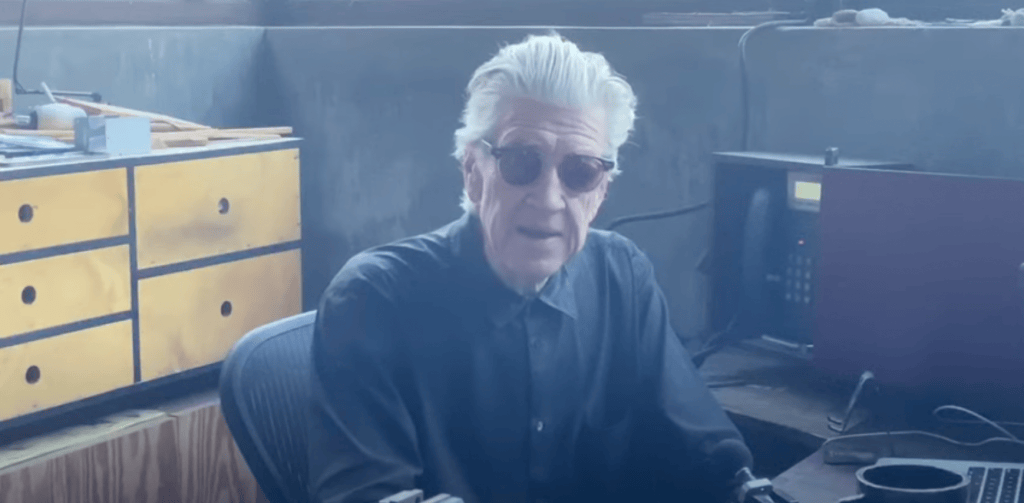
“I’m wearing dark glasses today because I’m seeing the future and it’s looking very bright.” – David Lynch’s Weather Report 8/21/20

by James N Gilmore

It is impossible for me to tell you what David Lynch has meant to me. His work, and his life, and his philosophy, are irreducible, and I have no intention of reducing them in whatever sort of tribute this could possibly be. The news of his passing has deeply affected me, as it has for so many of us. 

For about twenty years, I have been swimming in David Lynch’s work, letting it move me and mean to me and matter to me, but I don’t know if I’ve ever really expressed WHY, exactly, that is. So I figured I would try.

The first I remember hearing about Lynch was in 2001, when Mulholland Dr came out. That was my first year really paying attention to the Oscars, in part thanks to how much I loved and cared about The Lord of the Rings. I was 12. In the build-up to the Oscars (and the months after—things took longer to come out on DVD 20+ years ago), I saw basically everything that was nominated, but I didn’t see Mulholland Dr (Lynch’s last Best Director nomination). I must have watched it at some point in high school. I remember it having a reputation—amongst the burgeoning Online Film Culture I was so giddily involving myself in—as a “puzzle film” with lots of clues and theories about “what’s really going on.” I remember trying to understand who this “David Lynch” guy was—being aware of davidlynch.com, hearing about Eraserhead, trying to see clips of Rabbits, eventually reading about Inland Empire but not seeing it until years later. In this period of 2001 until about 2007, I was a growing cinephile, and Lynch’s reputation in my mind was mostly as a “Puzzle Filmmaker.” His stuff was strange and required close attention. I tried to “figure out” Mulholland Dr and I think I saw Lost Highway in this period. They felt very cool, very edgy, very provocative, very artsy, but I was admittedly way too young to really understand the emotional pull at the heart of these movies.

I remember, very vividly, The Year I Fell in Love with Lynch. It was my sophomore year of college. I decided to use my Netflix account—still DVD by mail then, with streaming barely available—to watch all of his movies, and all of Twin Peaks. This was the first year I had the money to pay for my own Netflix account, using the funds I was earning as a staff movie critic for the university’s newspaper. I had heard of Twin Peaks at this point and I was still sort of carrying around a fondness for Mulholland and Highway, and Netflix offered the opportunity to easily get most of Lynch’s work (a lot of it on pretty crummy DVDs, but that was part of the charm!). But I remember the excitement of receiving—one DVD at a time—Twin Peaks (about 3-4 episodes a disc if I remember). I’d watch the entire disc in one sitting and put it back in the mail. When I watched Fire Walk With Me after finishing the series, I did so having heard that it was a “bad movie” that “didn’t answer anything” but it completely floored me and emptied me. Few movies, I think, are as deeply affecting, horrifying, and troubling as Fire Walk With Me, and it’s only gotten better over the last decade now that Twin Peaks: The Return sort of ties the knot in how to conceptualize the broader arc of Twin Peaks, Laura Palmer, and Dale Cooper. Those marathon viewings of DVDs, and waiting patiently for 3-4 business days for the next DVD to show up, are cherished memories. 

In college, I was attracted to Lynch’s work because it was surreal and strange and different. I thought the way he told stories was deeply impressive and immersive. It was accessing a way of thinking about movies and experiences that I hadn’t ever really seen or thought about before. My year-long plunge into Twin Peaks involved getting—and rewatching—the DVD Gold Box Set, reading all manner of online theories about the Black Lodge and some of the more disconnected elements of Fire Walk With Me—elements that would inevitably be ‘answered’ (or at least addressed) in Lynch’s final work, The Return. The blend of mystery, soap opera, and nightmare that is characteristic of Twin Peaks has been oft imitated but never equaled, because Lynch (and the team around him, including of course Mark Frost) had such empathy for human experience. Things didn’t need to make sense in Lynch’s worlds. They had toproduce a sense, though. A deeply felt sense of human connection, often manifesting as agony or pain.

“Maybe that’s all Bob is. The evil that men do.” This line, uttered by FBI agent Albert Rosenfield after the big revelation halfway through season two of Twin Peaks, could serve as a thesis statement to a lot of Lynch’s work. It tries to understand human joy and human suffering, and how these things exist at the same time. Dale Cooper reminds us throughout Twin Peaks to buy ourselves gifts, to savor coffee and donuts and the smell of trees. Yet Twin Peaks is also about elemental evil that traumatizes and kills in the most horrific ways. And as much as Lynch’s movies are concerned with quite terrible, nightmarish things—chief among them abuse, murder, and grief, often happening to or around women—he himself was also someone who presented as someone deeply in love with the world and its possibilities for living. He was concerned with the sadness, but he always seemed to seek joy.

I remember watching Blue Velvet in an undergraduate film theory class—not the first time I’d watched it, but the first time I had an opportunity to really analyze it and engage it in the way it’s meant to be engaged, to see its dialectic tension between different visions of American life.

I remember watching Eraserhead and just completely not getting it, but being—as I think everyone must be the first time they watch Eraserhead—completely enthralled by the images, the sounds, the feelings it was eliciting.

I remember meeting Lynch’s Steadicam operator in my undergraduate years. He was an alum of my program at University of South Carolina, and he came to do an alum visit and talk about his experiences in Hollywood. He talked about shooting the opening shot of Lost Highway. I went up and shook his hand afterwards and told him how glad I was to meet him, and how much the use of camera in Lynch’s work impressed me. He was kind and grateful.

It’s easy to get lost in the surreal elements of Lynch’s work, like the Black Lodge in Twin Peaks (and Bob, Judy, the Woodsman in The Return), the mysteries around fugue states or body swapping or however you want to describe Lost Highway, and the divides between dreams and waking life in Mulholland Dr ; they all speak to the complex abstraction that is part of so many of his best projects. But to consider Lynch a “weirdo” or even a surrealist is to miss why his films and television shows have had such enduring legacies. It’s not really about the weirdness: it’s about the humanity. The intensity with which he treats human experiences.

It wasn’t until I saw a screening of Mulholland Dr at the Aero Theatre while living in Los Angeles that I felt like I finally understood David Lynch (or at least, began approaching an understanding). It was on a double bill with Sunset Blvd — two movies about LA streets! Mulholland Dr probably didn’t begin until 9 or 9:30, so it let out close to midnight, maybe even a little after midnight. I was seeing it with my friend Josh, and afterwards I drove him home through, in part, driving down the parts of Mulholland Dr connecting Westwood and Beverly Hills to West Hollywood. I can still feel those turns, see the lights on the road. Watching Mulholland Dr late into the evening, in what was probably my fourth or fifth time watching it, I realized that trying to “follow the mystery” or “trace the clues” wasn’t really the point.

There is a narrative in Mulholland Dr, but in many ways the narrative, or the vignettes of a narrative, serves as a way to access something else. What the film is “about” is a set of feelings. Terror (at whatever the hell is behind that Winkie’s diner), passion, loss, desire and aspiration, suicidal ideation, trauma—the movie is in part about producing these affects. That people often cry, or scream, or dance, or sing in Lynch’s movies is all part of this. What he was trying to attune to, I think, was his own particular way of processing human experiences, and share his struggles to process the world with all of us. At this point, Mulholland Dr is in my top 5 movies ever, and is making a play for the #1 spot. But if you asked me to explain why, I don’t know if I could beyond what I’ve written above. It isn’t just about the filmmaking, the writing, the acting (which are perfect, just to be clear), but it’s about all the ways it’s made me feel, all the ways it has opened ways of thinking and imagining and being to me. And how it opens those things up for others, often in ways that are entirely different from what the movie has made me feel.

There was something magic about the summer of 2017 as The Return came out week by week. Again, as with his other work, the mystery and the strangeness were completely immersive, but what made it work and transcend basically any other television show or long-form storytelling I can think of off the top of my head is how all of that was anchored in the tragedy of its characters, each of them struggling and working to make some good in their life. There is an extraordinary sadness around The Return, amplified through the characters who are not in the show because the actors had passed on, or images of actors quite near the end of their lives offering hushed monologues in close-ups for just a few scenes. That the show builds to Agent Cooper trying to literally go back in time and change a tragedy from happening is a fitting end, I think, for Lynch’s work. “What year is this,” Cooper mutters to himself in the astonishing final scene of The Return, and while I won’t dare to speak a word about my read on what’s ‘actually’ ‘happening’ in that final scene, it remains one of the most emotionally and intellectually overwhelming and cataclysmically devastating moments I can remember watching. It’s a “twist,” sort of, but it’s also a tragic culmination of not just the 17 hours of The Return, but the story of Twin Peaks from 25 years prior. What remains so staggering about Twin Peaks and The Return is not the mystery, per se, but rather how the mystery matters in so far as it is about the characters trying to navigate their lives in the wake of what they experience.

Honestly, reading that paragraph back now, I’m not sure if it makes any sense at all, but trying to produce tidy words around something as monumental as The Return doesn’t really seem possible, at least to me. Perhaps someday I will have the space and time to really reflect on what The Return was able to achieve. But I guess I should leave it at that: What it—as a story, as a television season, as an experience—made me feel was not like anything I had felt before or have felt since.

And that, I guess, is why I continue to watch Lynch’s movies. And why there are images, sounds, and sequences in them that haven’t left my brain from the first time I watched them. They tackle our experiences, the ways we struggle, the ways we try to deal with the evil men do—with “people like Frank.” They are beautifully made. Lynch was always an artist. His work is deeply felt, carefully produced, with stunning sound mixes, wonderful music, and some of the best and most intense acting. Lynch encouraged us to feel so many things, to try and work through so many things in his work.

I’ve been talking a lot about emotions and affect and meaning, but I should of course mention that the other inspiring thing about Lynch is he never stopped creating and making. His avant garde roots, his painting, his music, his weather reports and all the small trinkets of digital content he created over the last 15 years are all part of a larger fabric of what he called the art life. Even as his health declined, he said he would never retire. 

I love the joy of creativity. I love writing. I love being imaginative. Even at their darkest, most intense, almost unbearable moments, Lynch’s work is so fundamentally creative. It creates. It generates. It moves. It makes things happen.

I’m not sure if I’ve said anything meaningful or even coherent in these reflections. I guess I don’t really intend to. What Lynch continues to mean to me goes beyond and goes deeper than a typical gushing about an artist’s work. This may not, in the end, be much of a tribute, but I hope it gets close to capturing something about why his work matters so much to me. I just wanted to get this down on words, in this moment, in some form or another.

His legacy should inspire us all to just keep creating. Keep making room to dream.
No Wizard that there is or was

– by James N. Gilmore

At this point, trying to untangle all the relationships of the various Oz texts is a journey in its own right. While L. Frank Baum’s original novels (beginning with The Wonderful Wizard of Oz in 1900), the original stage adaptation in the 1900s, and the MGM adaptation in 1939 form sort of a “core” of iconography around the Oz storyline, the world has had its fair share of revision over the decades. From the multitude of books written by different authors after Baum’s death, to “unofficial” sequels like Walter Murch’s 1985 Return to Oz, the Land of Oz has been a source for all manner of fables. None of these has been as successful as Gregory Maguire’s 1995 novel Wicked and its subsequent 2003 stage adaptation, which has defied gravity to become the odd example of a revisionist history to a piece of popular culture whose popularity rivals—in some circles, anyway—the popularity of the original texts.

Wicked Part 1 has seemed to arrive, like a Kansas farmhouse dropped from a twister, at an opportune moment. Over twenty years after the premiere of the musical of the same name, and nearly thirty years after Gregory Maguire’s revisionist history of Oz, Wicked’s representation of an authoritarian government quite literally scapegoating its Animal citizens and naming an ambitious young witch Wicked in the process is hitting theaters the same week newspaper headlines discuss the potential for 2025 to entail the mass deportation of immigrants from the United States, the suspension of birthright citizenship, and the possible dismantling of the Department of Education, with other government services and departments on the chopping block in the name of increased efficiency. 

The Wonderful Wizard of Oz, despite its fairy tale dressings, has always been treated as a political fable. Baum’s original novel has been subjected to a variety of interpretations about the social and political contexts of the 1890s, including debates about gold and silver, whether “Oz” is really a play on the abbreviation of “ounces” and thus about the centralization of markets, and the emerging power of mass media to facilitate propaganda, as in the role William Randolph Hearst’s newspapers played in facilitating the beginning of the Spanish-American War in 1898. Whether these interpretations are “correct” or the result of clever scholars reading backwards from the vantage point of decades later is almost beside the point: Readers have been eager to filter Oz through the Technicolor prisms of social, political, and economic conditions. The Wizard himself is a bit of a cipher for reading a variety of fears about media and persuasion: he deceives the citizens of Oz using projection technology and audio technology; he refuses to grant Dorothy’s wishes until she kills the Wicked Witch of the West; and his giving of gifts has little in the way of magic. The Wizard was always a con man, but Baum’s novel and MGM’s film present him more as a bumbling magician who is not, in Dorothy Gale’s words, much of a wizard at all.

That 1939 film, similarly years in the making, also arrived at a fortuitous moment. It premiered on August 25, 1939, one week before Hitler began invading Poland on September 1. The MGM film is a constant reminder of the power and vibrancy of artifice. Its painted backdrops, full-body makeup, and trick photography remain incredible to look at, and the repeated framing of special effects through proscenium arches—seen in the film’s best shot, Dorothy opening the door from her sepia-toned home onto the colorful world of Munchkinland—seems to cheekily point to how “the movies” are the only medium that could facilitate the kind of magical transportation at the heart of The Wizard of Oz. For older viewers, though, the reveal across the second act that the Wizard is not, in fact, all he is cracked up to be is surely aligned with the structures of feeling at the time that radio, journalism, and movies were crucial propaganda tools for Axis and Allied powers alike. 

The political interpretation of Wizard of Oz remains at the relative margins of the movie, which is celebrated more as a family film and delightful fantasy than anything else. Gregory Maguire’s 1995 novel, Wicked, provides a revisionist pathway that fully explicates the Wizard as an authoritarian who has instigated a coup, mined the land of Oz for its resources, suppressed Animals, and installed a special police force to patrol the streets and kill dissenters. It is a book as much about authoritarianism and propaganda as anything else, where the Wicked Witch—here, as in the stage show, named Elphaba—becomes a political insurrectionist after the murder of her professor (a Goat trying to advocate for Animal rights against the increased oppression of the Wizard’s regime) radicalizes her. 

The stage show softens these politics a bit, turning Maguire’s book into more of a two-hander about the relationship between Elphaba and Glinda (Galinda at the beginning) and the paths that lead them to become the archetypes of Baum’s fairy tale. It is still fundamentally a show about propaganda, though: When Elphaba realizes the Wizard is behind Animal suppression, and she is tricked into creating the flying monkeys, she revolts. The Wizard and his allies, in response, label her ‘Wicked.’ As my daughter put it when we discussed the movie after seeing it, Elphaba was “tricked.” The stage show premiered on June 10, 2003, less than three months after the US invasion of Iraq—yet another geopolitical conflict that happened largely due to propaganda and manipulation on the heels of rampant Islamophobia across the country. 

While this is all, for the most part, coincidence—the MGM film, the novel, and the play clearly took years to produce, their release dates selected months if not years ahead of time—what I’m pointing to here is more the nagging persistence of that so-called Wonderful Wizard as a reminder that we can’t seem to rid ourselves of tendencies towards authoritarianism, as well as the role that media technologies of all sorts play in deception.

In all renditions, the Wizard is always marshaling technology as the means to control fabricate narratives about his rivals. Be he more a numbing magician or a violent ruler, his power is populism and sovereignty: appeals to the citizens of Oz that his Emerald City is a bastion of invention and progress, when really it serves the centralization of his own mythos. After all, he basically forces Dorothy to kill the Wicked Witch of the West before granting her safe passage back to Kansas. To put it another way, the lasting power of these stories is in part about the seductive allure of con-men who are more than happy to use manipulation and violence to achieve their ends.

It is curious, then, that Elphaba describes him as having “no real power” upon realizing what has happened. She means, of course, that he has no capacity to perform magic, but the line also works to undercut sovereign power. The Wizard’s only powers are those he has given himself. They are industry and technology, and they are cultivated and maintained through the discipline he imposes onto the citizenry of Oz. Even if they are nothing but smoke and shadow, they can sound and seem profoundly frightening. And that’s part of why Wicked has worked so well for 30 years: the Wizard isn’t a hapless nitwit here, but someone who understands deeply how to seize and hold power over the regions of Oz through violence of many forms.

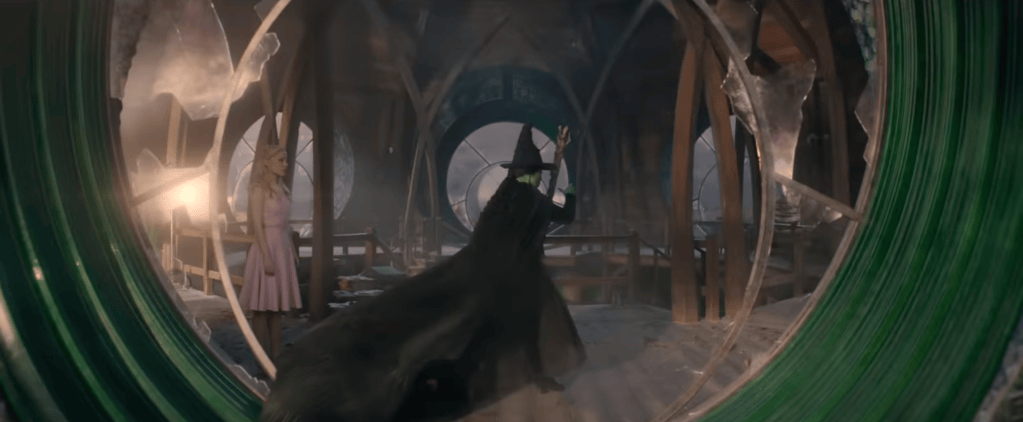
Wicked: Part One has the gloss and shine of theatrical camp and the feel of a movie with an enormous budget, but it too is deeply engaged in the politics of this moment. Let’s not mince words, then: Elphaba’s cry at the end of Defying Gravity is a protest against the creep of authoritarianism, a call for all of Oz to wake up, to see what the Wizard really is. Here, at the end of 2024, we are reminded again of the need to resist how easily propaganda can twist its way around the social fabric. We can’t afford to not pay attention to the man behind the curtain.

Culture Critically podcast episode 14: TikTok and mental health feat. Meredith Scott

On this week’s episode, host James Gilmore welcomes Clemson undergraduate student Meredith Scott onto the show to discuss how TikTok contributes to unrealistic beauty standards and mental health issues.

See direct mp3 link above, or find us on Apple and Spotify

How COVID-19 transformed the community, classroom, and careers

By: Madison Wilkins

No one ever expected the elbow bump to replace the handshake, or for a virtual meeting program to take over the classroom space. The idea of having to wear a surgical mask for your own safety would’ve sounded absurd, and having to maintain 6 feet from somebody is otherworldly. For a brief period of time, COVID-19 made this our new normal.

Social norms are the perceived informal, mostly unwritten, rules that define acceptable and appropriate actions within a given group or community, thus guiding human behavior. The COVID-19 pandemic has completely transformed our community, classroom, and careers. More specifically, our perception of the every-changing social norms within these “3 C’s”. As the three areas are explored, I examined the personal impact it has made on my experience as a college student. Additionally, taking a closer look at the various findings and current events that tie into the impacts it has made on our world.

Community begins within the home. It takes a village to often have that needed support amongst a group of people. The first COVID-19 impacts we saw within the community was the serious health and financial burdens in many U.S. households. Our villages grew smaller as our health officials and care-givers spent more time in hospitals, and we spent less time with our high-risk members of the community who lost the battle against the Coronavirus. Our local businesses in these communities suffered financial losses as they either temporarily or permanently closed. The community had to also quickly adapt to the inability to host social gatherings, remain less than 6 feet apart, and for some states, adopt curfews. As a resident of New Jersey, we saw the shift from normality as we spent 3 consecutive months without leaving our homes. The police department searched the streets past a certain time of night to ensure safety within the community. A source by the National Academy of Medicine further explains these impacts and compelling needs of the patients and family communities, “It is amid this period of declining health and growing inequality in America that the COVID-19 pandemic struck. The public health emergency—which remains ongoing at the time of this paper’s publication—has negatively impacted the lives of virtually every patient, family, and community throughout the nation and the world”. In addition to these worldwide impacts, we are also seeing this shift in normality within the classroom as well.

The role social norms have played, how they’ve changed, and the impacts on the future. Our governing rules of behavior have also created large impacts within the classroom. As a current junior in college, the memories of times when zoom was’t utilized are blurry. For some, pen and paper have simply become a thing of the past. As a member of the Class of 2020, there was no senior trip, prom, or graduation parties. Not to mention the transition to becoming a college student. The classroom faced some of the biggest changes during the global pandemic. Virtual meeting options are normalized and I can’t remember the last time I’ve seen a scantron. From a psychological perspective, COVID-19 in the classroom disrupted student growth and development. For example, the staff shortages and lack of face to face brings forth confusion and frustration for many students that need individualized attention. Brookings, Brown Center Chalkboard focused an entire study on the pandemic’s impacts on learning. The research made new discoveries on impacts on learning during a pandemic as well as the possible school closures. “The COVID-19 pandemic has introduced uncertainty into major aspects of national and global society, including for schools. For example, there is uncertainty about how school closures last spring impacted student achievement, as well as how the rapid conversion of most instruction to an online platform this academic year will continue to affect achievement”. The rapid conversion to online instruction heavily impacted my transition into Clemson University. 

My entire first semester at Clemson was spent online as I tried to adapt to being miles away from home, a pandemic, and the changes that come with being a college freshman. Despite the transition, COVID-19 sparked new developments in education for higher seminaries of learning. It is now socially acceptable to virtually meet with your advisor or professor even after the end of the pandemic. For those applying or transferring into Clemson, the university is still test optional for admission. These decisions set the precedent for the college experience for all of the students. Additionally, the COVID-19 classroom impacts create change for the “c” that follows as we explore the changes it has made in careers.

The career field is always changing but a global pandemic is a factor that no corporation saw coming. COVID-19 impacted desirable job types and employment around the world. At the onset of the pandemic we saw a shift to remote work for the jobs that allowed. For those that relied on in person interaction, drastic changes were made as they pushed to stay open or prepared to be permanently closed. Many individuals and families struggled through unemployment as well. The Organisation for Economic Co-operation and Development stated that, “The COVID-19 pandemic has triggered one of the worst jobs crises since the Great Depression. There is a real danger that the crisis will increase poverty and widen inequalities, with the impact felt for years to come.” The previous dilemma came to life as we saw the impacts of this current job crisis. Moreover, we are also seeing a shift in job desirability. More individuals are choosing to work remotely from home when given the opportunity. The career field is also changing as more are making the decision to make a living off of social media rather than a traditional job. Regardless of the place of work, COVID-19 is making impacts in all of these areas.

All things considered, the COVID-19 pandemic has completely transformed our community, classroom, and careers. The world has had to adapt to new guiding behaviors. Whether it’s social distancing or virtual meetings, these were the new social norms and they have impacted our “3 c’s” forever.

The Kardashian Empire and its Contributions to Shaping Social Norms

by: Ashley Myers

The Kardashian family has created an empire that no other family of influencers has been able to replicate, and have a ubiquitous force on popular culture. Everyone knows their names, brands, and television shows, and many strive to be like them: beautiful, rich, and successful. They have integrated themselves into mass media, and offer up a template for people who want to become successful influencers. Since their first television show, “Keeping Up with the Kardashians,” came out in 2007, the family has soared to the top of the social pyramid, and has left an imprint so large on our culture that it has actually helped to shape some of the social norms we follow today. From shaping an idea of the ideal body type to empowering female entrepreneurs, the family has clearly had an impact among younger generations’ thoughts on how they should act, as well as what they should look like.

Since their rise to fame the family constantly competes for who has the highest net worth. Currently, Kim holds the highest net worth in the family at $1.8 billion, with a large portion of her wealth coming from KKW Beauty and Skims. Following behind her is Kylie with a net worth of $600 million. Kylie was also named “The Youngest Self-Made Billionaire” at the age of 21 by Forbes in 2019. The family has also collectively launched 26 businesses since they made a name for themselves. However, not all of these businesses have succeeded as exceptionally as their top brands today. Yet, the family has demonstrated that failure of a business venture does not necessarily mean that you have failed. They take their failures as a lesson instead of a defeat, which shows hopeful entrepreneurs that even the most powerful business people fail. Despite the public’s animosity for the Kardashian family, they are a successful family of women in business, and are an inspiration for female entrepreneurs who want to make a name for themselves, as well as for mothers who want to do it all.

Despite their overwhelming success as business tycoons, their brands also tend to promote a specific beauty standard. For example, Skims is a shape wear company that is “Kim’s answer to shape wear that actually works” and is designed to “smooth, enhance, lift and tone.” Though the company encourages women on embracing their natural shape, they call their product “solution-oriented,” which paradoxically implies that women’s bodies are not good enough as they are, and they need a brand like Skims to help them achieve the ideal shape. Another brand that tends to promote looking a certain way is Kylie’s makeup brand, Kylie Cosmetics, and specifically her popular lip kits. Kylie’s lips have famously become a part of her signature look, and have become the preferred look for many individuals. Her lip kits are designed to help consumers achieve full, plump lips without the help of lip fillers. However, the brand constantly uses Kylie’s lips as a model for the brand, despite the fact that she has admitted to receiving lip injections. Though the brands tailored by the Kar-Jenners may be controversial, there is no doubt that their multi-million dollar brand empire is a tremendous testament to just how influential they are in the beauty industry, and how they help promote specific beauty standards to be the norm.

The Kar-Jenners seem to set up their brands to make it easier for the general population to be more like them without spending loads of money on their appearance. However, the photographs we see on social media are not entirely realistic, as almost all of the family has had some sort of work done as well as has admitted to using photoshop on the photos they post to social media. The phenomena of advertising brands that are supposed to make you look more ‘perfect’ feeds into the idea that women must look a certain way to be beautiful, and it is no secret that social media idealizes the bodies of the Kardashians. Social media sites such as Instagram and TikTok make it increasingly easier for users to change their appearance with the countless filters that they provide. There are even filters that help you to replicate the look of the Kardashians, such as the Kardashian filter effect on TikTok. 

While the brands created by the Kar-Jenners are a testament to how successful and influential they are, they also contribute to shaping certain social norms, especially how we think about body image. The family’s brands and companies are seemingly centered around products that better how we look, such as clothing, makeup, and skin care products, so it is only fitting that the family has a set beauty standard: curvy with a small waist, full lips, glowing skin, perfect makeup, and no sign of cellulite or imperfections. Due to their empire of brands and influence in the media, the beauty standard they have created has become ideal for much of the younger generations, and it has actually become a norm to strive to look this certain way, hence why their brands have gained so much popularity. Though this promotion of a certain body type may be good for the family’s ever growing empire, it is not necessarily good for everyone else. Constantly seeing images of seemingly perfect women online can cause distress in mental health, and can even lead to eating disorders. This feeling among women has become increasingly normalized, especially those between the age of 18 and 25. Along with the idea of needing to fit a certain body type, photoshopping pictures has also become increasingly normalized. Social media has essentially become an individual’s highlight reel where all posts are carefully tailored to fit a certain aesthetic. Though this norm was not created by the Kardashian clan, they have definitely helped to promote the idea that photoshopping is normal, as their influence on social media is enormous, with their following count amounting to over 1.2 billion followers collectively. As social media continues to be a very influential platform for the younger generation, the promotion of having a certain body type by influencers continues to have a negative effect on how people view themselves, and the Kardashians’ seemingly perfect feeds are not helping the situation.

While the Kardashians are a controversial family with drama surrounding their every move, there is no doubt that they are very influential when it comes to ideas surrounding female entrepreneurship and body image. They are powerful women who have made names for themselves through entrepreneurial ventures, and are loved and hated by viewers around the globe. Though many of their projects have good intentions, the norms they promote are not always ideal for women in society, especially younger generations, when it comes to mental health. The Kar-Jenners have created a powerful empire with a platform that has the ability to influence certain social norms, whether they have good or bad ideals. Let’s hope they continue to push forward good ideals into the media, and leave hurtful ones in the past.

How TikTok is Changing the Narrative Surrounding Mental Health

by: Brooke Harley

In the past couple of decades, social media has completely changed the world in nearly every way imaginable. It has allowed for connections across the globe, and for everyday people to share a glimpse into their lives at just the click of a button. Even within social media itself there are so many different platforms, expectations and trends whose popularity is constantly ebbing and flowing. These changes have added a whole other layer to societal expectations both on and off the platforms. Since this particular blog series focuses on social norms and how they change and differ, I find it only fitting to dive into one of the biggest recent changes in social media. This post focuses on TikTok, and how it has altered the narrative surrounding mental health in both positive and negative ways.

Up until recently, mental health was not a very popular discussion topic. Concerns were only really addressed with the closest and most trusted of family members and friends, or a professional. The struggles associated with mental health and mental illnesses were completely kept to oneself and dealt with in private, and to discuss them publically was seen as a taboo. Social media has been a key player in the shift away from this narrative. Early platforms like MySpace and Facebook provided the space and opportunity to share very casual thoughts and even struggles from the user’s day-to-day lives. Not only did these platforms provide the space, but they also provided the audience. On public accounts, these more vulnerable posts were reaching many more people, some of whom related to struggling with mental health and slowly, people started to find support and community through sharing their struggles online.  Not only did social media provide support for those struggling mentally, but it also exposed others to mental illness in a more concrete and relatable way, allowing for more education about mental health. At the same time, many negative influences on mental health have come out of social media, not only from the bullying that takes place behind the anonymity of a screen, but also regarding unrealistic portrayals of lifestyle and body image. While social media became an outlet for more casual and vulnerable posts, it also allowed for people to create an appearance of casualness and vulnerability that was not genuine, but extremely staged. On top of that, it also allowed for rather unhealthy and unbalanced lifestyles to be portrayed as “normal” when in reality they were promoting behaviors that encourage eating disorders, and unrealistic body “goals” and image. In more recent years, with the rise of TikTok, I’ve seen this frequently on the platform and in my day-to-day life. As the platform continues to grow, creators start to make more and more original content that falls into these categories in one way or another. The four content creators that I will be highlighting in this post each show through their content the ways in which these themes are seen on TikTok every day. 

TikTok features a variety of different genres that aim to help its viewers. From recipes, to home decoration advice, to ways to study more efficiently, there is much to learn from the platform and its creators. One of the most important sub-categories of these tips and tricks are the TikToks created by mental health professionals. Many of these videos contain information on mental illnesses, like commonly overlooked symptoms and characteristics, as well as small tips to help alleviate the burdens caused by the illnesses. They also provide resources for those who want to seek help but either don’t know where to start, or haven’t found a resource that works for them. Two creators that are very different from each other, but both create this type of content are Maggie Lancioni (@therapywithmaggielpc), and Tom Hulme (@mindful_tom).  Lancioni’s content focuses much more on mental struggles themselves, with much of her content highlighting symptoms of mental illness that aren’t discussed as frequently, small ways to combat specific mental illnesses, and reenacting real life scenarios to show what it’s like to live with mental illnesses.  Her page has about 300k followers, and over 2 million likes, so her content is reaching much further than most traditional mental health resources would on another platform. The awareness that her page brings, could potentially not only help someone who is already looking for mental health resources, but someone who is struggling and isn’t sure why. Lancioni’s page is also described in her bio as a “Safe Space“, and the comment sections of her videos are filled with people not only relating to her content, but venting in a place where they won’t be judged. On the other hand, Hulme’s content takes a much different approach to the topic of mental health. The majority of his content contains tips to lighten the burden of certain mental health issues, and words of encouragement for bad days. His page has over 600k followers and over 53 million likes, so while his content isn’t quite as specific as Lancioni’s, the reach is more than double. This type of content doesn’t promote seeking help, but instead offers more advice and portrays a positive message that could turn someone’s day around completely. Both of these creators, as different as their content is, contribute to the changing and improving narrative surrounding mental health on social media and in real life. By creating safe spaces, and encouraging reminders, they are normalizing and working to improve the reality that is living with a mental illness.

In a stark contrast to the uplifting and positive side of TikTok that aims to improve mental health issues, there is a very different side of TikTok that normalizes unhealthy, imbalanced lifestyles aesthetically disguised as “Wellness Lifestyles“. This category of creators often make videos that show a peek into their day, including everything from what they eat, to what they do, to what they are wearing. While the videos are supposed to seem like an authentic peek into an inspirational way of life, they are often unrealistic, highly curated and edited, and leave the viewer feeling less than for not being able to maintain a similar lifestyle. Two accounts that I’ve found showcase this concept well are are Sophia (@wellbysophia)  and Lexi Shadle (@lexishadle).Sophia’s content is less overtly problematic than Shadle’s, but still promotes an unrealistic view of what a healthy life looks like. Many of her videos include clips of her “healthy girl lifestyle” that feature aesthetically pleasing shots of skimpy matching workout sets, a perfectly clean apartment, fresh fruit, and working out. These oversimplified images of what it means to be “healthy” don’t look like a day in the life of an average person, and this leads many people to have a negative self-image because of their inability to perfectly recreate the “healthy” lifestyle. This being said, there are few things more harmful to self-image than the accounts that focus solely on losing weight and being thin, each micro and macro included. Shadle’s account features content that revolves solely around the lifestyle of losing weight and staying skinny, including videos with recipes that are “macro friendly”, including calorie content and how to stick to your weight loss routine during the holidays. Her account has over 58k followers and 1.5 million likes, promoting a lifestyle highlighting counting calories and working out 5-6 times a week. This focus on staying skinny and keeping track of every single calorie consumed is incredibly damaging to body image and self-worth, and accounts like this are a very large part of why social media is considered unhealthy and detrimental to mental health.  Although the content from both of these users varies, the same underlying theme of promoting an unrealistic “healthy” lifestyle exists, and these creators aren’t seen as very big creators who have millions of followers and billions of likes. As TikTok continues to grow, and these kinds of users gain bigger followings, it is clear that the social media mental health crisis could continue to expand, specifically regarding body image. 

The change in narrative surrounding mental health has without a doubt been altered by TikTok. The amount of both positive and negative content is astounding, and the resources it can provide are incredible. However, there is still so much misinformation and disinformation on the platform that are presented as facts. As TikTok and other platforms continue to grow, it is vital to gain a broader and deeper understanding of the information presented, especially when it comes to topics like mental health.