Culture Critically episode 08: Flo and the cultural politics of Anonymous Mode

Click the link below to listen to this week’s episode of Culture Critically:

Contents:

  1. Show intro
  2. Story of the week: Twitter sues Elon Musk
  3. Main feature: Flo and Anonymous Mode

Full show script

Culture Critically script

Intro

Hello and welcome back to Culture Critically. We’re a podcast focusing on communication, media, technology, and popular culture, and how these impact the ways we think, know, and live.

I’m your host, James Gilmore, and I’m a professor of media and technology studies in Clemson University’s department of communication.

We’ve got a good one for you today. We’ll be continuing our discussion of pregnancy tracking apps in the wake of the decision to overturn Roe v Wade

As always, Culture Critically is focused on generative and provisional conversation about these ideas. My hope is to get us thinking and talking about important issues.

The Story of the Week

Twitter is suing Elon Musk for pulling out of his bid to acquire the company, setting up a legal battle that will shape the future of Twitter’s ownership and its operations

With reports in Wired indicating the company is “on autopilot” and “a mess,” we’re seeing one of the social media titans continuing to sit at a crossroads not just for its future ownership, but also potentially for its vision, growth, and long-term viability. https://www.wired.com/story/as-elon-musk-walks-twitter-workers-say-no-ones-in-charge/

This story will be playing out over months, I’m sure, and we’ll hope to cover it in more detail as we learn about the lawsuit, Musk’s response, and what pathways it will move through.

Main story: Flo and Anonymous Mode

If you missed our last episode, I talked briefly about the calls to delete period tracking apps as well as to request all data from your profile.

Flo, which has a userbase of nearly 250 million users, announced the launch of its new Anonymous Mode on June 30. 

So let’s talk about 

1: What Anonymous Mode is

2: Why it is necessary

3: What it indicates about the politics of this present crisis

Now, let me just start with the obvious: I am, indeed, a white man talking to you about women’s reproductive health. I acknowledge that’s problematic, to say the least. I was hoping to find a female-identifying colleague to join me on today’s podcast to take the lead on this discussion, but this podcast is still relatively new, and people’s schedules are difficult in the summer, and I’ve had a hard time attracting potential guests. I’m still working on it though!

If YOU listening—yes, you!—have some perspective and insight on this or any other issue, reach out to us. I’m @JamesNGilmore on Twitter and you can DM me directly if you’d like to come on the show and talk about your research, your insights, and your perspective on this or any other issue related to technology, media, and culture. That’s right, Culture Critically needs guests. It could be YOU!

So I apologize in advance if I’m unable to capture the complexity of this issue, especially for any of the women-identifying listeners. If I miss anything important, write me a correction and I’ll feature it in the next episode. I want to be sure I’m getting this as right as I can.

According to Flo’s June 30 press release, the new Anonymous Mode “deidentifies data on a deeper level by removing personal email, name and technical identifiers. In the event that Flo receives an official request to identify a user by name or email, Anonymous Mode will prevent Flo from being able to connect data to an individual”

Flo also notes the company “does not share or sell any health data with any other company”

As I mentioned on the last episode, Flo’s previous promises to protect data were misleading.

An FTC complaint alleged the following: : Flo, as early as 2016, “handed users’ health information out to numerous third parties, including Google, LLC; Google’s separate marketing service, Fabric…Facebook, Inc. through its Facebook Analytics tool…marketing firm AppsFlyer, Inc…and analytics firm Flurry, Inc….And Respondent took no action to limit what these companies could do with the users’ information. Rather, they merely agreed to each company’s standard terms of service. By doing so, Respondent gave these third parties the ability to use Flo App users’ personal health information expansively, including for advertising”  https://www.ftc.gov/system/files/documents/cases/192_3133_flo_health_complaint.pdf

Flo settled this complaint, and according to the New York Times, one of the conditions of this settlement is that Flo must “obtain users’ consent before sharing their health details and ot obtain an independent review of its privacy practices” https://www.nytimes.com/2021/01/28/us/period-apps-health-technology-women-privacy.html

The company denied wrongdoing, and insisted it only used a vaguely defined “analytics” to improve user experience

So Flo has a specious track record with matching its claims about privacy to its actions. Flo did obtain a review of its privacy practices that did not find any current misrepresentations, and the company included quotes from that report in their June 30 announcement.

But what does any of this have to do with Roe v. Wade?

Flo—and apps like it, as well as most consumer-grade wearable fitness trackers—are not health devices. Their terms of service make that very clear, often for legal purposes.

As such, they aren’t covered by HIPAA, which has federal regulatory law governing how patient health data can be protected and transferred.

Flo, Fitbit, Apple, Samsung, these companies exist outside the protections from HIPAA because they aren’t, for the most part, associated with an actual doctor or hospital.

This can be confusing, because these companies regularly claim that in order for their products to provide the most accurate information, you need to disclose as much data as possible. And for women who are trying to gather actionable data about their own bodies for fertility purposes or to monitor any number of health conditions, or heck—just because they want to—it can be infuriating to learn that this data isn’t actually treated as federally regulated Health Data.

As Kayte Spector-Bagdady wrote on Twitter after the draft of the Supreme Court ruling leaked, “Your period information can be used to track if and when you got pregnant. And if and when you are no longer pregnant. And that information can have absolutely no protections for who gets it (and how they use it)” https://news.bloomberglaw.com/pharma-and-life-sciences/fertility-apps-bound-by-weak-disclosure-rules-in-post-roe-world

So because this data is not protected, law enforcement agencies could request Flo to release information related to your account if they are investigating you for potentially having had an abortion. 

A recent Vox piece about this issue lays out how major companies like Google and Apple regularly comply with law enforcement requests for data, and do not see the data you provide them as deserving of legal protection if you are suspected of a crime. https://www.vox.com/recode/2022/7/6/23196809/period-apps-roe-dobbs-data-privacy-abortion

If this is coming as a surprise to you, it really shouldn’t. While not explicitly connected, much of this can easily be traced to the development of the US Patriot Act and the ways it legalized digital wiretapping through things like the PRISM program. The legalized investigation of digital data means that all of our traces can be used against us if we become a person of interest.

So what does this indicate?

First, let’s talk about self-tracking. The term has become somewhat popularized—at least it was a decade ago—to describe how we can use apps and devices to gather information about how much we move, what we eat, and various other elements of everyday life. I’ve published on this, as have dozens of others media and technology researchers. Gina Neff and Dawn Nafus’s book Self-Tracking, published in 2016, maps out the contours of what this industry looked like about six years ago now.

The problem with so-called “self-tracking” is that it’s largely a misnomer. It implies a system where you are tracking yourself. But that’s rarely the case. The work has been delegated, offloaded to some sort of computational system that analyzes data you provide it. Apple Watch activity data processes a variety of sensors to determine if you’ve met your move goals for the day, much as Flo analyzes the data you provide to make algorithmically determined analyses of your health.

“Self-tracking” as we currently define it is actually all about mediation, the use of a third party to analyze the data we collect—sometimes passively, sometimes actively inputting it—and having it make sense to us.

While these devices have been met with grand claims about the diffusion of health knowledge into everyday life, the democratization of medical tracking, about the ability to push science forward given how many millions of people contribute data to these systems, we should be cautious.

I think what’s important here is to recognize that self-tracking is actually a misnomer. Rather, we need to think about this as always-already an act of self-surveillance, where we willingly provide data to a variety of third parties

While we’ve sort of, I think, collectively accepted that companies like Google and Facebook are data extraction companies as much as anything else—that they are invested in surveillance capitalism, to borrow Zuboff’s concept—we need to do more to scrutinize the variety of health, wellness, and productivity apps that ask us to constantly input data.

Which gets us to 3: How this underscores the current politics. We are in a moment where juridical changes have suddenly shifted what is considered criminal activity and criminal behavior. If law enforcement agencies are investigating whether an abortion has taken place because it is a legally punishable act

An NPR story from July 11, for instance, details the practice of keyword warrants. https://www.npr.org/2022/07/11/1110391316/google-data-abortion-prosecutions

Keyword warrants allow law enforcement to “request information on everyone who has Googled specific search terms,” and these can be cross-referenced against Geofence warrants, which “seek information about every device that has crossed into a defined location in a specific period of time.”

If you can triangulate keyword searches, phone location, and health data provided to Flo, law enforcement can create lists of potential criminals, using nothing but data provided to smartphones, obtained through warrant requests, to prosecute women.

Currently, there’s a case in Colorado where an attorney has filed a motion to suppress evidence obtained from a keyword warrant, claiming it is antithetical to the Fourth Amendment. https://www.theverge.com/2022/7/1/23191406/denver-arson-google-keyword-warrant-challenge-constitutional-fourth-amendment-privacy

We’re in another moment, much like the Patriot Act 20 years ago, where the legitimation of data-based surveillance is coming to the fore. 

The most infuriating part of this, of course, is that women should feel like they can trust a company to secure their data. And I’m not saying that Flo’s Anonymous Mode isn’t a step in the right direction. But we should be treating health and wellness data as intrinsically needing to be anonymized, not just encrypted. Anonymous should be a default position for building these apps, not something that is developed after settling a complaint with the FTC about privacy issues.

And in addition to the work being done to help secure reproductive rights and bodily autonomy for women, we need to push for even more legislation which can reduce, if not eliminate, keyword warrants and geofence warrants before they spiral out of control.

We can, ourselves, begin understanding self-tracking as a mode of self-surveillance, and do an audit on the kinds of data we are supplying, and whether we are encrypting and anonymizing that data sufficiently. This doesn’t change the systemic problem of data surveillance, but it might help protect us.

Imagine analog, handwritten ways to create these charts and perform the work of tracking. 

Conclusion

Alright, that’s our show. Thank you for joining us on today’s episode of Culture Critically.

You can find us on social media, with rebranded accounts:

On Twitter, we’re @culturecriticly and on Instagram we’re @culturecritically

You can find me @JamesNGilmore


Thanks for listening and I look forward to being back with you soon.
Culture Critically podcast episode 07: Mental health platforms

Click below to listen to this week’s episode of Culture Critically

Show contents:

  1. General show update
  2. Story of the week: Flo and ‘Anonymous Mode’
  3. Online mental health platforms and the cul de sac of care

Full show script

Intro

Hello and welcome back to Culture Critically. It’s been a while! We took time off at the end of the academic year, I’ve been teaching summer classes, and I’ve got some updates to share with you on today’s show.

If you’re joining us for the first time, we’re a podcast that talks about big ideas in communication, media, technology, and popular culture. We care about how these areas impact how we think, know, and live.

I’m your host, James Gilmore, and I’m a professor of media and technology studies in Clemson University’s department of communication.

In today’s episode, I’m going to be outlining some of the changes in the podcast moving forward, before talking with you about a recent journal publication analyzing online mental health platforms.

We’re moving to a planned podcast every other week for the time being, likely with more happening during the academic year.

In our previous podcasts, we’d focused on roundtable discussions with students. While students will remain an integral part of the podcast during the academic year, I also want to find opportunities to devote episodes to discussing recent events, interview colleagues and friends, and provide perspective and commentary. 

Because undergraduate students rotate in and out of working with me, they’ll be invited on to share research occasionally, often near the midpoint and end of semesters. 

I’ve been thinking, in the month and a half off, about what this podcast is meant to do. I’ve arrived at trying to play around with podcasting as a form of “gray literature”

I can’t promise everything—heck, anything—we discuss will be fully formed, but it seems that right now, with so much going on in the realms of media, technology, and culture, this blog can serve as a space for reflection, commentary, and discussion.

There are lots of opportunities for CS researchers and analysts to develop gray literature online: Blogs, microblogging like Twitter, video-based media like YouTube and TikTok, and audio media like podcasting all offer unique opportunities.

I’m excited to play around with what I can offer you in this show

Story of the week

We have to highlight the Supreme Court’s decision to overturn Roe v Wade, a decision that is already causing chaos across the United States and leaving the future of bodily autonomy and reproductive rights in horrifying uncertainty.

But for the story of the week, we wanted to highlight how technology is part of this chaos and uncertainty. You may have heard about the calls to delete period tracking apps as well as to request all data from your profile.

For the next episode of Culture Critically, I’m hoping to do a deeper dive into the policies around data collection on these apps and talk about them in relation to issues in datafication and surveillance.

For now, I want to point out that Flo, the most popular period tracking app, just on Friday announced that it intends to create an Anonymous Mode for data collection. In a June 24 tweet, Flo Period Tracker said: “You deserve the right to protect your data. We will soon be launching an ‘Anonymous Mode’ that removes your personal identity from your Flo account, so that no one can identify you”

A year and a half ago, Flo settled a complaint with the Federal Trade Commission over how the company had “deceived its users” based on language stating it would not share “information regarding…marked cycles, pregnancy, symptoms [and] notes” to any third parties or other health data to certain types of parties. https://www.mobihealthnews.com/news/fertility-app-flo-health-settles-ftc-over-sensitive-data-sharing-complaint

The FTC alleged the following: Flo, as early as 2016, “handed users’ health information out to numerous third parties, including Google, LLC; Google’s separate marketing service, Fabric…Facebook, Inc. through its Facebook Analytics tool…marketing firm AppsFlyer, Inc…and analytics firm Flurry, Inc….And Respondent took no action to limit what these companies could do with the users’ information. Rather, they merely agreed to each company’s standard terms of service. By doing so, Respondent gave these third parties the ability to use Flo App users’ personal health information expansively, including for advertising”  https://www.ftc.gov/system/files/documents/cases/192_3133_flo_health_complaint.pdf

I want to devote our next episode of Culture Critically to talking about Flo and other trackers more in-depth, but for now let me just say this: Flo fundamentally failed to protect its users for a three year period, until—according to the FTC complaint—the Wall Street Journal revealed this practice in 2019. Flo may say that you have the right to protect your data, but that’s not a right the company was interested in protecting until it became expedient for it to do so, first in 2019 after its deceptive practices were made public, and again in 2022 after women are rushing to stop using these apps. 

Flo is not here to protect you, and you shouldn’t expect a third party tracking application with this kind of record to adequately care for your health data.

Main story: TAO

But onto our main story, which is a discussion of my recently published article “Stuck in a cul de sac of care: Therapy Assistance Online and the platformization of mental health services for college students.” It was published several months ago in Television & New Media, and I share authorship with seven former students, most of whom were undergraduates when we performed this research together!

This article emerged from our undergraduate students trying to grapple with the lack of available mental health resources on our campus. And it’s not just a Clemson problem. In a 2018 study of 571 US college counseling centers, 34% report a wait list to mental health services and an average wait time of 17 days.

So instead of directing more funding these centers so they can hire more counselors and serve the needs of students dealing with a variety of mental health concerns—most specifically anxiety, depression, stress, and sleeping disorders—many universities are trying to instead license technological platforms that can supplement care. At Clemson, we have TAO, or Therapy Assistance Online, which is a cognitive behavioral therapy platform designed to help provide care to students who can’t get an appointment in the counseling center.

When COVID-19 first hit and Clemson pivoted to online education in March 2020, the university sent an email to all employees and all students about how to navigate a landscape becoming rapidly upended. There was a dedicated section on Mental Health, and TAO was touted in the first paragraph of this section: “There are nine online treatments with multiple modules from which you can select to best address your concerns.”

Calling TAO “online treatment” is generous, at best. We were already in the midst of researching the platform when this email was sent, and we were shocked that the university was placing it front and center in its mental health response to the COVID crisis. TAO’s promotional materials sound great: a user an “work on behavioral change online anytime…work when you want, where you want.” While it positions itself as accessible, it also positions itslf as work, and it’s up to the user to navigate, understand, and apply its information. There’s no therapist, no counselor, just pre-made videos loaded with stock footage. All the while, users are providing data to the platform without receiving feedback.

In one of its promotional videos—which was embedded on Clemson’s counseling and psychological services website—TAO explicitly argues it is more effective than face-to-face therapy at improving “life functioning,” “global mental health,” “well-being” and “symptoms” in a bar graph that is never explained. Moreover, its promotions do not align with the realities of the program: Its founder has claimed the platform uses “artificial intelligence to create practice tools so people can practice with feedback throughout the week.” For instance, there are claims the platform “introduces [users] to different approaches to depression, and then based on how they are responding to depression perhaps moves them into a cul-de-sac of modules that take that particular approach. If they’re not responding the way you would expect or not really liking it…you can move them to a different model.”

There’s a logic of personalization here and, in fairness to TAO, maybe that does exist in some version of its service, and maybe our university just didn’t license that version of the service, but here’s some of what we found:

  • Its consent form explicitly claims it is “not a treatment for mental health disorders. If you require treatment for an emotional or mental health problem please contat your local counseling service.” However, our local counseling service was deferring to TAO as an online treatment, misrepresenting it. The company calls TAO a “prevention program,” but its legal documents qualify that pretty considerably: it is “a platform to assist you to bounce back from life’s disappointments and frustrations.” Using “disappointments” and “frustrations” in place of words like “stress’ and “depression” make clear that TAO is legally positioning itself not as a care provider, but as something else.
  • We were constantly asked to complete the Warwick-Edinburgh Mental Well-Being Scale, which asked questions like “I’ve been feeling optimistic about the future” on a scale of “None of the time” to “All of the time.” Over our two-month research period, we all responded truthfully in our personal accounts to the Scale. Every time we completed the survey, we received a prompt thanking the user, and that was about it. None of us saw any changes in the programs we were offered or the assignments we were asked to complete. This Scale was just sucking up our data, but never giving us anything in return.
  • This replayed itself when completing other activities. In the session “Core Beliefs,” we were asked “What is the first picture that comes to mind from your childhood?” After filling out a form and hitting next, we were then asked “Why? What was the conclusion you reached from this experience?” We answered these questions honestly, with some of us sharing traumatic memories and others sharing non-traumatic memories. Regardless, hitting “Submit” simply ended the session and we never received any sort of feedback from the system.
  • As we used TAO, we came to see it more as a data extraction platform than a care platform. While teletherapy has many benefits for many people when done ethically and compassionately, the experience of using TAO was mostly just constantly giving the platform survey responses, qualitative answers, and answering other forms of prompts while never getting the kind of personalization, feedback, or care structures promised in the advertising

Calling TAO a cul-de-sac is quite fitting, as in French it simply means “dead end.” TAO is a constant series of dead ends. 

We know that mental health is reaching epidemic status among college campuses, if it’s not already there. If we can’t provide better funding to support these students, we deserve to give them better than a bunch of forms to fill out and hope that works.

Conclusion

Alright, that’s our show. Thank you for joining us on today’s episode of Culture Critically.

You can find us on social media, with rebranded accounts:

On Twitter, we’re @culturecriticly and on Instagram we’re @culturecritically

You can find me @JamesNGilmore


Thanks for listening and I look forward to being back with you soon.

The Dark Side of Sex: The Male Gaze in HBO Shows

By: Maddy Grumet

Sexual politics rule the media industry. Although many may be familiar with the term “the male gaze,” it is critical to understand the impact it has on television viewers and society at large. According to Oxford Languages, “the male gaze” is defined as “the perspective of a notionally typical heterosexual man considered as embodied in the audience or intended audience for films and other visual media, characterized by a tendency to objectify or sexualize women” (Mulvey, 1975). On a deeper level, the male gaze limits the ability of female audience members to imagine themselves as an individual with agency.  In two very popular HBO shows, Game of Thrones and Euphoria, the male gaze sexualizes a variety of different women. 

In Game of Thrones, the male gaze emerges most notably in the female character’s nudity, frequent sexual violence towards female characters, and how women gain political power and influence through sexuality and fertility. A viewer of the show would know that female characters are not necessarily powerless in all situations and at all times. However, almost all of their access to power is through obeying and acting on typical forms of femininity or with the help of men they have relationships with, which means that their power is limited and ultimately controlled by men. Without the male gaze present in the show, female characters would have the opportunity to gain power without offering their bodies.

Beyond the sexual ways that the male gaze emerges in Game of Thrones, non-gendercomforming female characters like Arya Stark and Brienne of Tarth are still subject to the underlying patriarchal views. Arya and Brienne, among others, are still subjected to the control, coercion, and discipline of the male gaze if not necessarily in a sexual way. Perhaps the reason they are not subject to sexualization like most of the other female characters is because they are portrayed in a more masculine way. Their physical strength and ability to wield a sword saves them from being sexually abused, hinting that if a woman doesn’t “fight like a man,” they will be abused at the hands of others. The male gaze does not mean every female character is powerless. It does mean, however, that the progress of having strong female characters is offset by constantly subjecting these characters to mistreatment by torturing, degrading, assaulting, sexualizing, etc. While Game of Thrones is notorious for keeping no one safe from harm, the show developed a pattern of degrading, objectifying, and hyper-sexualizing female characters significantly more than any male character on screen. However, the male gaze ensures that all of these instances of violence against men are not sexualized like the instances of violence against women. 

Although one of HBO’s more modern shows, Euphoria, may seem more progressive than Game of Thrones to viewers, the conflict between female empowerment and the male gaze is present in both shows. Euphoria’s demonstration of female sexual empowerment has the potential to be a great thing as a departure from other media. However, this demonstration often manifests itself in a way that caters to the male gaze. In examining Barbie Ferreira’s character Kat Hernandez, a simplification of feminism is evident. In the show’s early progression, Kat discovers a newfound confidence that manifests in a sexual way; she chooses to pursue sexual camming where she can make money off of her newly harnessed sexual confidence. Although this idea demonstrates that women should be free to not only express their sexuality but to have control over their bodies, the Euphoria directors chose to exacerbate the objectification of women in order to demonstrate Kat’s confidence rather than choosing another, less sexual path. Additionally, instead of creating a conversation around the mental impact of selling one’s body online, the show promotes it. Ferreira’s character may pressure female watchers, especially younger ones, to chase desirability in harmful ways and base their self-worth strictly on sexual attractiveness. 

Kat’s character is also interesting when examining her sexual fantasies compared to a male character Nate Jacobs’ sexual fantasies. Euphoria directors crafted intentionally erotic cinematography of Nate’s later love interest, Cassie, both in scenes demonstrating reality and fantasy. Although female characters like Kat do have their own sexual fantasies, the scenes are shot incredibly different. The difference in shooting changes the way the audience absorbs information. Kat’s fantasy is essentially a way of sharing more information about herself. Nate’s fantasies are intended to sexually tease the audience as it does him. The deliberate sexualization of the male characters’ fantasies in the show, but not the female characters’, demonstrates clear complicity in the danger of the male gaze. 

Deliberate sexualization in Euphoria continues when examining Sydney Sweeney’s character, Cassie Howard. Cassie is one of the most evidently objectified characters in the show, presented to viewers as a hopeless romantic who struggles with her self-worth and how to say “no” to people, specifically men. These traits are not foreign to many people, especially younger women navigating their confidence both sexually and not. However, Cassie’s relatability is overshadowed by the sexual nature in which her character is written and portrayed. In Cassie’s sex scenes, she is shown fully nude and the camera focuses on her body rather than her male counterparts. It is not abnormal to struggle with the need for male validation as Sweeney’s character does. However, the overt objectification in scenes involving Cassie restricts the viewer from understanding her struggles by providing sexual distraction. The show explores male character’s struggles without overly sexualizing or objectifying them, demonstrating that Cassie and other female characters are heavily subjected to the male gaze.

At face value, Euphoria may seem like an effort to subvert the male gaze and fight the moral panic surrounding teen girls’ sexuality. However, upon examination, Euphoria’s writers and directors are actively participating in perpetuating both the male gaze and such moral panic. There is a fine line that Euphoria has seemed to cross between sexualizing and objectifying young women and being informative on how younger people think about and experience sexuality.  

The link between two seemingly different HBO shows demonstrates a network issue as well as a societal issue at large. For many, the male gaze is an intrinsic way of understanding and navigating the world, revealing itself in so many facets of life. The first step to combatting this engrained thought and behavior is to acknowledge it and a great place to start is somewhere that has a great effect on us all: media.

Sex Cartoons & Safe Spaces

By: Sara Ciplickas

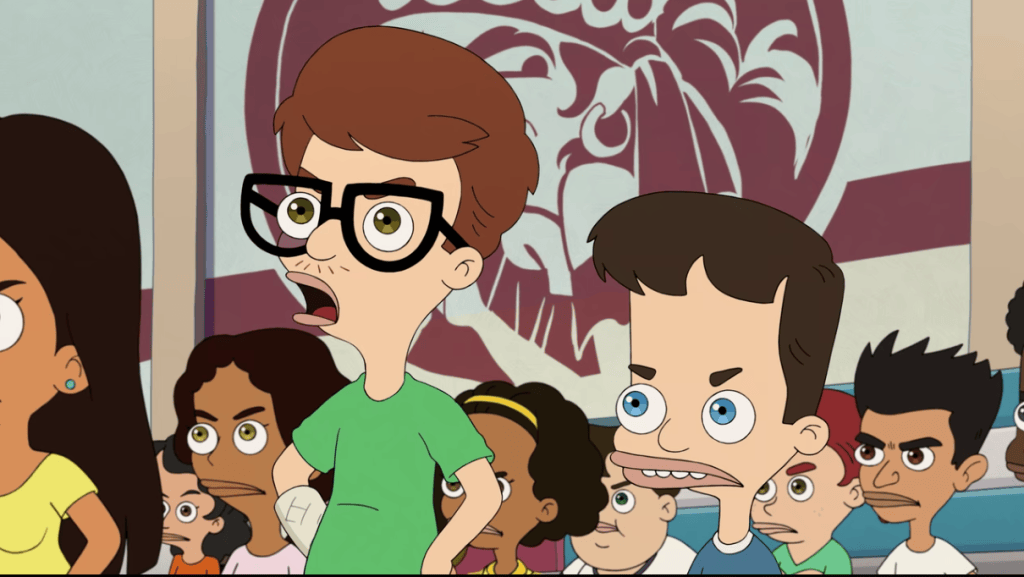
“Messy,” “repulsive,” “foul-mouthed” and “cringe” are adjectives used on Rotten Tomatoes to describe the Netflix animated success known as Big Mouth. Now with five seasons under its belt, Big Mouth has taken its audience on a wild ride following the lives of middle schoolers trying to survive adolescence. Created by Nick Kroll, Andrew Goldberg, Mark Levin, and Jennifer Flackett, the series is described as a mature cartoon as it graphically displays everything and anything related to sex and puberty. However, as individual states pass and continue strict comprehensive health laws, once comedically uncomfortable shows like Big Mouth are now offering empathetic, safe spaces that younger generations need.

After starting in 2017, the show has explored a wide range of topics including masturbation, porn, sexuality, and mental health. In season one, the audience is introduced to the Big Mouth universe that includes main characters, Nick and Andrew (voiced by Nick Kroll and John Mulaney), their friends Jessi, Jay, and Missy, and Maury the Hormone Monster (also voiced by Kroll). Along the way, more friends, family, and the monsters who make their lives complicated are introduced. The pilot episode (S1, E1: Ejaculation) quickly lets the audience know that this show is not going to hold back. The season introduces us to the shit-show that is puberty and touches on both male and female issues including poorly timed erections and periods (S1, E2: Everybody Bleeds). The show conjures up pop culture icons including The Ghost of Duke Ellington (voiced by Jordan Peele) and The Ghost of Freddie Mercury (also by Peele and Brendan McReary) when Andrew questions his sexuality (S1, E3: Am I Gay?). The show even introduces more “adult” (as if it isn’t already mature enough) situations when the young character’s first encounter sexual assault (S1, E8: Head Pusher).

After the initial shock of season one, the show continues for four more seasons poking fun at both the mental and physical changes people go through as teens. Season two introduces The Shame Wizard (voiced by David Thewlis) and The Depression Kitty (voiced by Jean Smart) forcing the pre-teens to self-reflect, or self-destruct. Writers engaged with serious national issues allowing for commentary, open discussion, and laughter at the uncomfortableness of the complex situations. In season three, after the guidance counselor Mr. Terry Lizer (voiced by Rob Huebel) imposes sexist dress codes and forms an inappropriate relationship with a student, the show presents some hilarious musical numbers about “sex-walks” and the movie, Disclosure (S3, E2 Dress Code and S3, E10 The Musical). With recent movements in the Black community, Big Mouth corrected itself mid-show by changing voice actors for the character of Missy. Instead of being voiced by white actress, Jenny Slate, the show brought on black actress and writer, Ayo Edebiri. They continued to evolve in season four and five, putting heavier emphasis on both sexuality and gender including the inclusion of their first trans character, Natalie (voiced by Josie Totah), at the beginning of season four (S4, E1 The New Me).

While the majority of views are positive, and Big Mouth has corrected some of its content, the show has had its fair share of criticism about its depictions of sexuality amongst pre-teens. Some critics have claimed that the depictions of sexual preteens are borderline pedophilic or that is glorifies preteen masturbation. The ambitious writers, at times, have struggled to grapple with the ramifications of what they are trying to accomplish. The show deals with heavy complicated topics, intertwines realism and fantasy, makes large amounts of pop culture references, is supposed to be funny and entertaining, and refuses to limit itself on how many jokes it makes about urine, feces, and other bodily fluids.

The criticisms are, however, overblown and largely fail to consider the important work the show’s representation is doing. First, talking about sex/masturbation when it comes to preteens does not make the show or viewers pedophilic. In all sexual situations, the show shifts into the fantasy of animation and gives the viewers metaphors for what’s really going on. In other words, the show does not show children or teenagers explicitly engaging in sexual situations. But the show does allow for conversation about those situations, which is something our American classrooms do not. Second, while I agree that the show is very complex and balances a lot of elements, I personally think it works. However, this isn’t a piece destined to sell you to watch Big Mouth. It’s truly not for everyone. Despite the fact that you might see genitalia, bodily fluids, or something else that is just plain gross, the show manages to address complex situations in less than one hour an episode. It is raunchy and shameless, but it is also ridiculously inventive and demonstrates how popular culture can connect us to sex-ed.

Only about half of the young people in the US are receiving sex education. Many states do not require comprehensive health programs or do not require it to be medically accurate. Furthermore, the US, and conservative states in particular, love to preach “abstinence is key” rather than addressing the ins and outs of safe sex. With the recent influx of anti-LGBTQ laws passed, such as the “Don’t Say Gay Bill” in Florida, students who are part of the LGBTQ+ community are disproportionately at a disadvantage when it comes to learning about puberty, sexuality, and gender identity. As some will claim, the US is failing our youth. Not only do we lack educational resources for American youth, we are increasingly losing safe spaces for students to explore, question, and try to understand who they are. There are obvious gaps in our sex-education system, and one can only wonder who and what will fill those gaps.

Just like the US’s current sex education system, Big Mouth isn’t entirely scientifically accurate, but it is based on real-life experiences of the writers. While the hormone monsters, ghosts, and ghouls don’t appear during depressive episodes or unexpected, erotic moments, the situations and the awkward reality of growing up is true to life. If anything, the addition of the animated monsters allows for a better understanding of all the different aspects and inner monologues people must face when they go through puberty. The audience may not have had the same experiences the writers had, but many can relate to storylines about unexpected periods or boners, new relationships, divorcing parents, coming-out, and standardized test taking. It may not have been funny at the moment, but the show reminds us that everyone has awkward moments, and they can be funny (way after the fact). The conversations, stories, and complex dialogues do not exist in many American classrooms. Some students don’t even learn about the changes their own body goes through, let alone the changes other students may experience.

Netflix is continuously growing as more and more people turn to streaming services for television and film. Kids ages 2 to 18 watch almost 2 hours of streaming TV a day, and since 61% of Netflix originals, including Big Mouth, contain mature content, there is no doubt that younger audiences have access and watch “adult shows.” Kroll’s show follows a no fuck’s given policy full of compassion, empathy, and acknowledgement of one’s own flaws. Yes. It is adult content, but over the past five seasons the show has constantly addressed relatable, relevant situations experienced by the American pre-teen and teenager. Is it the filler our American sex-education program needs?

No. The show, as entertaining as some may find it, is not the solution to the educational problems in the United States. However, it is becoming clear that shows like Big Mouth who comedically address real life, sex related issues might become a safer space for younger generations to talk about sexuality, gender, and puberty.

How Adolescents Can Navigate Around the Culture of Inadequate Sex-Education in the U.S. Through Multimedia 

By Anna Transou

There’s a layer of conservative social fabric that seems to be tightly woven amidst the reds, whites, and blues of American ideals and values, specifically regarding open discussions about sex. Although our media may not reflect that, the general requirements (or lack thereof) for comprehensive sex education curriculums across the nation surely does. Out of only 30 states which mandate that “when provided, sex and HIV education programs meet certain general requirements,” only 18 states require program content to be medically accurate. Conservative teachings and tight-lipped sex-talks leave adolescent teens in the dark on important discussions about hygiene, reproductive systems, physiology, sexuality, relationships, and more.

The lack of adequate sex education programs across the U.S. stems from a few sources of misinformation about sex. Many adults fear that the “knowledge about sex leads to early sexual activity”, which explains why abstinence-only sex-education is, and has been, the dominant mode of sex-ed in the United States. The Abstinence Only Until Marriage (AOUM) program was officially adopted by the U.S. government in the late 90s as a “singular approach to adolescent sexual and reproductive health…with 49 of 50 states accepting federal funds to promote AOUM in the classroom.” So instead of teaching the youth about safe sex practices, the U.S. opted to just not teach it at all, embracing a stonewall approach to sex-ed. This “don’t ask, don’t tell” methodology has deprived the youth of America from vital knowledge during one of the most confusing times of their young lives, puberty, wherein “only half of U.S. adolescents receive adequate sex education”. 

Comprehensive sex-education (CSE) includes a plethora of crucial topics that not only inform the youth of America, but also help set them up for success in navigating relationships with themselves, their health, and others throughout their lifetime. CSE “ideally teaches the student about sex, sexuality, reproductive health & hygiene, sexually transmitted infections and how to prevent them, and how to have safe sex” through broad discussions centering health and wellness. There is an abundance of data from across the world that proves the success of teaching the youth a curriculum of well-rounded sex education with “global studies [which have] shown that children who receive sexual education… lead healthier sex lives, and are more likely to make informed, mature decisions.” Students who are equipped with an arsenal of sex-ed information “are most likely to delay having sex, avoid unwanted pregnancies and sexually transmitted infections.” A study within the U.S. that took place in 55 counties “provide[d] population-level causal evidence that funding for more comprehensive sex education led to an overall reduction in the teen birth rate at the county level of more than 3%”. Alas, despite the large body of research proving the success of CSE in “support[ing] young people’s development into sexually healthy adults,” the prevailing fear and misguided notion that sex talk leads to riskier sex practices in adolescents has impeded any real change within the public school systems of America, which are still largely focus on lessons of abstinence. The tradition of avoiding comprehensive teachings of sex leaves the youth in a position of seeking out information from uninformed deviant sources like pornography or peers, oftentimes leading them astray in the quest for knowledge about safe-sex practices.

To fill in the gaps of inadequate sex education curriculums, today’s adolescents can now turn towards sex-ed focused TV shows and podcasts, which serve as informed alternatives to porn, peers, and insufficient school curriculums. Sex and sexuality are complex matters which should not be reserved to the biased and misinformed options of porn and peers for education which could set them up for failure not only in their youth, but for their future lives as well. A collection of Netflix shows dedicated to sex, nicknamed “Sexflix,” encompasses shows such as Sex Education and Big Mouth, which not only showcase open discussions of sex, but also difficult topics, such as sexual assault and body insecurity. The inclusivity within these shows ensure that no matter what race or sexual orientation, a young person has the opportunity to learn more about sex to substitute for the lack of information from parents, peers, porn, and/or schools. These TV programs function as informed deviants and at the very least, as conversation starters, which can be supplemented with educationally-focused podcasts which focus on discussions of sex, health, and relationships. Podcasts provide yet another avenue of accommodation for young students confused by the non comprehensive sex-ed programs of many U.S. public schools. There’s a large selection of sex-ed podcasts to choose from, many of which are hosted by “sexperts” ranging from sex & relationship coaches to licensed sex therapists, reflecting a level of intention and expertise that is similarly embedded in Netflix’s Sex Education and Big Mouth. These media forms allow for a domain of reconciliation wherein students deprived of CSE can seek out information from valid sources in an effort to reclaim the right to knowledge about something which is natural to life and a big part of growing up.

To sufficiently prepare the youth of America for safe and healthy lives, we as a society cannot sit back and wait for the slow to change federal systems of which only offer up non inclusive and incomprehensive sex education curriculums. There are a variety of media options to aid the youth in filling in the gaps left by inadequate sources, assisting young people in the learning and implementation of healthy and safe sex practices which are vital to the development of our nation’s youth.

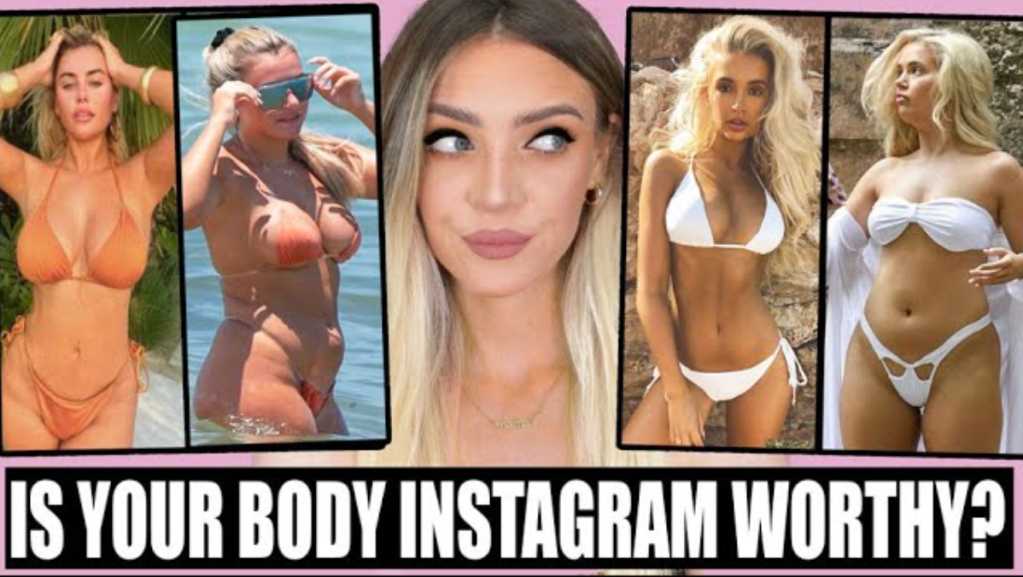
#InstagramVersusReality

By Hillary Hardig and Liv Provosty

Photo Taken from YouTube

Beauty Standards are Perpetually Evolving

How do we determine what makes a person beautiful? Women are routinely pressured to fit certain standards of beauty. But like fashion and interior design, these standards shift over time varying by culture and era. The question is: Why do we fight so hard to meet the standards of perfection when we know that what is considered perfect is continuously changing? In Ancient Greece, the ideal woman was plump and fair-skinned, signifying wealth. During the Victorian era, women achieved an hourglass figure by cinching their waist with corset undergarments. For women of the 1920’s, beauty was androgyny. Instead of emphasizing their curves, women masked their chests, and wore clothes that downplayed the waist and hips. During the Golden Age of Hollywood, the hourglass figure was brought back to life with Marilyn Monroe as the ideal standard of beauty putting an end to the boyish figure trend that emerged in the Roaring Twenties. Coined “heroin chic”, models of the 1990s were so thin some thought their bodies mimicked those of an unhealthy drug user. With the development of social media, beauty standards are now treated like the trends of fast fashion and being reshaped at the click of a button.

 Runway Models and Cover Girls to Influencers and Insta Baddies

The blueprints for “the ideal” standards of beauty have shifted significantly in the last twenty years. Print media is dying in comparison to digital, and it is creating the new frontier of marketing and advertising. Social media plays the role of democratizing content production. It is an incredible innovation that has allowed for the expansion of free speech, art, and learning at the largest scale in history. This democratization has also shifted the culture of “beauty:” Now social media users have access to the means of producing, editing, and sharing content. The phenomenon of staging a magazine cover worthy photoshoot requires a photographer, stylist, beauty team, professional photo editors, a supermodel or celebrity. This process can be equated to an update to an influencer’s Instagram feed. Posts consist of the influencer, her outfit-possibly sent as part of a clothing brands influencer promotion program- her makeup, a tutorial could be produced for followers, camera self-timer, and a photo editing application. Similar factors of achieving the desired standard of beauty are present in both scenarios. However, the digital scenario may be even more dangerous, because “beauty” is presented constantly. And it’s not just a rack of magazine covers, it’s an endless feed, an algorithm that curates an explore page of one image of perfection after another. 

Influencers do not intentionally market themselves as unattainable standards for beauty, in contrast their success is often linked to “relatability.” The “reliability” factor makes it easier for the influencer and follower to bond, to become linked in a parasocial relationship that sells an image of themselves and often sells a product. According to Dr. Brooke Erin Duffy, an assistant professor at Cornell University studying self-presentation on Instagram, “Nobody wants to be called a fake. Influencers very much feel they need to present themselves authentically while getting the best image possible.” But as Duffy states, this “relatable” factor often does not extend itself to unflattering images or vulnerabilities (x). And with this parasocial relationship built upon the pretense of “relatability” it opens up avenues for comparison more directly than the 2000’s Vogue cover or the Chanel runway show. This assertion aligns with social comparison theory, meaning that an individual, often a girl or young woman, compares themselves at a higher tendency to someone they perceive as similar to themselves (x). While it may not seem that a fifteen year old girl and a young woman with millions of followers have a lot in common, similarity has been crafted between them through the follower and influencer dynamic.  This dynamic has flattened the hierarchies of image production allowing influencers to feel “more real” in comparison to a model on a cover the fifteen year old girl sees in line at checkout.

Facetune

The popular photo-editing app FaceTune is self-described as “providing a range of powerful tools giving you the ability to precisely edit your selfies and have fun expressing the best of YOU-giving you the confidence in creating & sharing photos, knowing you are showing the best of yourself” (x). This application is very popular, with over sixty million downloads (x). Since the coronavirus lockdown downloads of FaceTune have increased by twenty percent (x). FaceTune is known for its easy to use interface allowing for photo retouching and selfie alterations like skin smoothing and teeth-whitening to slimming body modification. The ability to alter one’s physical appearance drastically with such ease opens up a serious concern over self image, body dysmorphia, eating disorders, and body modification procedures. 

Startling statistics have been reported in link to use of Facetune. According to a study from  the International  Journal of Eating Disorders, teens who edit their appearance in photos with applications like Facetune were more likely to report high scores related to eating and body image issues (x). Additionally, Dr. Ramani Durvasula, critical psychologist and professor, credits the phenomenon of photo editing at this level to causing individuals to seek cosmetic alterations at younger ages (x). All of this to conclude with, Zeev Farbman, the CEO of Lightricks, the parent company of Facetune, “[I] didn’t intend for users to manipulate their bodies on the app,” although it is advertised very clearly as a selling-point of the application, “I’m not sure it’s our place to decide how people use the app, (x).” Farbman does not welcome the association between Facetune and damaging body image, however if the developers of the technology distance from responsibility for this phenomenon, then how are the dangerous consequences like increased eating disorders, body dysmorphia, and body modification checked. It assumes that the weight of responsible, safe use of the application falls onto the shoulders of the users. However, some may not see young and impressionable users as entirely capable, particularly when the stakes are so high.

Where Does the Responsibility Lie?

In September of 2021, the Wall Street Journal reported on a collection of internal Facebook documents which it says exhibits how the platform is exceedingly aware of the harmful effects Instagram has on the mental health of teens. The reported research, done by Facebook, focuses on mental health effects linked to young users being shown certain content, which can then cause or exacerbate depression, eating disorders, or other mental health issues. It’s no surprise that Facebook would not publicly disclose these findings. Facebook’s data collection policy plays a central role in whether users see, or do not see specific content. The Wall Street Journal reported that Instagram made at least one out of three teen girls feel worse about their bodies, and that, “13% of British users and 6% of American users traced the desire to kill themselves to Instagram”. 

In efforts to grow engagement and financial gains for shareholders, Instagram needs to retain user’s attention and keep them active for long periods of time. The Journal reports that, “Facebook executives have struggled to find ways to reduce Instagram’s harm while keeping people on the platform, according to internal presentations on the topic”. Facebook says it plans to develop a version of Instagram for children under the age of 13. Worried about children’s safety, a group of 44 US attorneys general wrote to Facebook to reconsider the new version. Facebook says even though kids under the age of 13 aren’t supposed to sign up for the photo-sharing app now, many still do. Facebook responded saying that the company would not show ads “in any Instagram experience developed for people under the age of 13”. But harm to teens isn’t only coming from advertisements. Content that exploits the vulnerability of children is. In either case, sizable data collection is what enables the harm.

Democratic FTC Commissioner Rohit Chopra tweeted, “Given the financial incentives embedded in its surveillance-based business model, it is yet another sign that the company cannot be trusted with our data.” Big tech needs to be asking themselves if their profit pushing business models built on the exploitation of teenagers are worth the potential damage done. If so, then to what end?